sheela na gig

Sheela Na Gig: Unveiling the Mystery of These Medieval Stone Carvings

I’ve always been into carvings, especially gargoyles. I’m not sure why it took me so long to notice these relics of Medieval times and lore. Sheela Na Gigs are among the most intriguing figures in architectural history, leaving us with more questions than answers. These mysterious stone carvings of naked women, often displaying exaggerated genitalia, have been found on religious and secular buildings across Europe. Known for their stark and provocative imagery, they challenge modern concepts of modesty, femininity, and morality. But what exactly do these figures represent, and why were they created? Their story is as layered as the stone they were carved from, touching on themes of fertility, protection, and societal taboos.

Sheela-na-gig at the Ghobnatan Cemetery,
Wednesday, 20 December 2023.
Adventures in County Cork, Ireland.
Photos by Thomas Baurley, Techno Tink Media.

Historical Origins and Placement

The origins of Sheela Na Gigs are rooted in Romanesque architecture, dating primarily between the 12th and 17th centuries. These carvings are most commonly found in Ireland, though examples have also been discovered in other parts of Europe, including England and France. Their prevalence on churches, castles, and other significant buildings suggests they held a vital cultural or religious purpose during their time.

Many Sheela Na Gigs are prominently placed over doorways, windows, and other entry points. This positioning has led historians to speculate that these carvings served as apotropaic symbols, designed to ward off evil spirits or bad luck. Their placement at thresholds—a symbolic space between worlds—seems to underscore this protective role. To explore further about their history and significance, the Sheela na Gig entry on Wikipedia provides excellent context.

Cultural Context and Symbolism

The symbolic meaning of Sheela Na Gigs is still hotly debated among historians and folklorists. Some theories connect them to the Celtic past, seeing them as remnants of pagan traditions. Others interpret them as fertility symbols, celebrating the power of the female body to create life.

However, another interpretation, rooted in Christian morality, portrays Sheela Na Gigs as warnings against lust and sin. Their grotesque and exaggerated forms may have served as reminders of the dangers of carnal desires, displayed strategically on church walls to deter parishioners. According to Sheela na Gig Theories, this duality—a mix of empowerment and admonition—highlights the layered meanings these figures held.

There is also an argument to be made about their apotropaic function. Similar to gargoyles, Sheela Na Gigs might have acted as guardians, their exaggerated and unsettling forms scaring away malevolent forces. This protective role aligns with their prominent positions near entrances and windows, areas often associated with spiritual vulnerability.

Etymology and Linguistic Significance

The name “Sheela Na Gig” itself is as enigmatic as the figures. Scholars have proposed various translations, with one popular interpretation rendering it as “old hag of the breasts” or “old woman on her haunches.” Both descriptions evoke the image of an aged, otherworldly figure, aligning with the carvings’ often emaciated and wizened forms.

The linguistic roots of the name are thought to intertwine with Gaelic and Old Irish, reflecting the deep cultural heritage of the regions where these carvings are most commonly found. For a deeper dive into Sheela Na Gig’s linguistic background and interpretations, explore this insightful resource on their significance.

Contemporary Interpretations and Reclaiming Symbolism

Sheela Na Gigs are much more than relics of the past. In recent decades, they’ve been embraced as symbols of empowerment, particularly within feminist and artistic circles. Organizations and individuals alike have used these carvings to celebrate female autonomy, sexuality, and strength.

Projects like Project Sheela have integrated Sheela Na Gigs into modern art, using them to address societal issues such as women’s rights and historical injustices. For example, their imagery has been famously used to shed light on abuses linked to the Magdalene Laundries in Ireland. These modern interpretations reclaim what was once a controversial figure and give her a voice in contemporary discourse.

Symbol of Female Empowerment

Many now view Sheela Na Gigs as a bold celebration of femininity and sexuality. Unlike traditional depictions of women in art, which often render the female form as an object of beauty, Sheela Na Gigs present it as raw and unapologetic. This stark portrayal serves as a counter-narrative to societal norms that have long sought to control or censor women’s bodies.

Feminist movements have drawn inspiration from Sheela Na Gigs, using their rebellious imagery to champion conversations around female liberation and sexual autonomy. This intriguing article from The Guardian examines how such symbols have been reinterpreted through a modern lens, highlighting their enduring relevance.

Reviving and Preserving the Sheela Na Gig Legacy

Efforts to preserve Sheela Na Gigs have grown in recent years, spearheaded by cultural organizations like the National Museum of Ireland. Unfortunately, many carvings have been lost to time, either destroyed due to religious objections or eroded by the elements. Still, mapping and documentation projects aim to safeguard the remaining figures, ensuring their stories are not forgotten.

There are still challenges to overcome. For much of history, societal taboos regarding female sexuality kept Sheela Na Gigs in the shadows. Today, advocates work to debunk myths and raise awareness about their historical and cultural importance. Learn more about these preservation efforts through resources like Sheela Na Gig.org, which offers a comprehensive look at their legacy.

Conclusion

Sheela Na Gigs remain a fascinating blend of history, mythology, and modern interpretation. Whether viewed as guardians, fertility symbols, or feminist icons, they continue to provoke thought and spark dialogue. Their ability to traverse boundaries—between past and present, sacred and profane—makes them uniquely captivating.

As we study these figures and their evolving symbolism, we are reminded of the complexity of human culture and belief systems. In a world that often seeks to suppress the unknown or controversial, Sheela Na Gigs stand as timeless reminders of the power and mystery of the human story.


Tobairin Holy Well, Co Kerry, Eire

Comments Off on Tobairin Holy Well, Co Kerry, Eire | Living Myth, Religion, Sacred Sites Tags:, , , , ,

Tobairin Holy Well
Coomanaspig, near the Cliffs of Kerry, County Kerry, Ireland

Just past the parking area of the Cliffs of Kerry, up the hill, along the Ring of Kerry, is a holy well and Mary shrine embedded into the hillside along the road just as you cross the mountain to St. Finian’s Bay. Dedicated to the Blessed Virgin Mary, sits the small well locally known as “Tobairin Holy Well.” It was stated to have been built in 1994 so is more modern than most of its counterparts across the Irish landscape. There are cross inscribed stones found around the well, which is a commonplace practice and offering by visiting pilgrims to the well and other similar Christian sacred sites. Small offerings are observed left by pilgrims and visitors, for devotion, respect, and prayer. This overlook has a stunning view of Valentia Island from the top of the Coomanaspig along this Seklligs ring road.   Directions: Portmagee along the Ring of Kerry, northwest on the R365, along the Skellig ring road, 4 kilometers on the right. Longitude: 10° 22′ 26″ W, Latitude: 51° 51′ 31″ N.

The inscription at the Base reads: Tobairin, Our Lady of Grace Coomanaspig, During the 1st Mass on Oct 31st 1994, concelebrated by
Fr. P Sugrue P.P & Fr. E. O’Carroll C.C., This grotto was opened & blessed on May 17th 1998 by Bishop of Kerry, Bishop Bill Murphy, concelebrated Mass to 500 people, with Fr. M Hussey P.P. & Fr. John Shanaan P.P. Erected Autumn 1994, thanks to generosity of many people. “May Our Lady bless you in your going, your coming and your staying, May she bless you in your thinking, your doing and your saying, May she bless you in your joys, and bless you when you weep, May she bless you in your waking, and bless you when you sleep
May she keep her arms around you, and fold you to her heart, Till you meet with her and Jesus, where you never more will part, Amen.”

References:


Uragh Stone Circle and Famine Cottage

Comments Off on Uragh Stone Circle and Famine Cottage | Faerie Hills, Haunted Locations, Sacred Sites Tags:, , , , ,

URAGH STONE CIRCLE
GPS: 51.81157, -9.69532
Coordinates: 51°48′42.23″N 9°41′37.74″W
Map Ref: V8311763439
Discovery Map Number: D84
Latitude: 51.811550N Longitude: 9.695514W
near Gleninchaquin Park, Beara Peninsula, County Kerry, Ireland

While driving the Ring of Kerry and the Ring of Beara, I spied on the maps a stone circle known as Uragh, so I decided to give it a gander. After a twisty country lane drive into the hills and farmlands, following signs to the off-the-map destination, I came to the gate—opened it up—and drove on in. Crossing a raging river with scenic overlooks of lakes and an astounding waterfall in the distance, the site was nothing more than enchanting.

The stone circle is atop a plateau above the valley overlooking Loch Inchiquinn, the other side of Cloonee Upper, and is surrounded by a ring of mountains. The 8′ diameter circle consists of approximately five low small megalith locally sourced sandstone stones (1.2-1.8 meters high) with a significant 3 meter high (approx. 10′) monolithic outlier standing stone. Two of the rocks are portal stones (one leaning outwards). The standing stone aligns the circle on a NE-SW axis. Center of the circle has been dug out potentially by looters, when it was looted is unknown. A low earthen bank surrounds the circle. The Irish Office of Public Works manages the site, which is open year-round, free of charge.

The circle dates to the Bronze Age. It is estimated to have been built between 3300-900 B.C.E. It is connected to a larger typology of stone circles commonly found in Brittany, Britain, and Ireland. These are often constructed of standing stones arranged in a circle. Many believe this was used for burials, religious or ceremonial purposes, and/or community gatherings. In Irish regional stone circles, this particular circle is representative of D-shaped stone circles found in this region, with the axial stone forming the line of the “D”. This specific circle is aligned with the Winter Solstice sunset.

Down the road and up a slippery slope is a famine cottage built into the hillside. It’s crazy to think how the poor during the Irish Famine had to live in such miserable conditions. I can’t even imagine the folkways and lore that surrounded these houses. This one evoked a feeling of somberness and solitude, and the ruins echoed that feeling.

References:

  • Ancient Ireland 2024 Uragh Stone Circle And Lake Of Gleninchaquin. Ancient Ireland Tourism. Website referenced 3/28/24 at https://www.ancientirelandtourism.com/uragh-stone-circle-and-lake-of-gleninchaquin/
  • Bretgaunt 2021 Dancing stones and peeing giants: the folklore of ancient sites in Derbyshire. BUXTON MUSEUM AND ART GALLERY. Website referenced 3/28/24 at https://buxtonmuseumandartgallery.wordpress.com/2021/12/10/dancing-stones-and-peeing-giants-the-folklore-of-ancient-sites-in-derbyshire/#:~:text=Stone%20circles%20and%20standing%20stones%20were%20often%20the%20haunt%20of,otherworld%20and%20the%20fairy%20kingdom.
  • Burgoyne, Mindie 2023 Drawn to the Mystery of Ireland’s Stone Circles. Website referenced 3/28/2024 at https://travelhag.com/stone-circles/
  • 2011 Uragh Stone Circle on the Beara Peninsula – Enchanting. Thin Places Mystical Tours. Website referenced 3/28/24 at https://thinplacestour.com/uragh-stone-circle/
  • Byron, Susan 2024 Uragh Stone Circle. Ireland’s Hidden Gems. Website referenced 3/28/24 at https://www.irelands-hidden-gems.com/uragh-stone-circle.html
  • Clarice 2021 Uragh Stone Circle: Magical Ireland. Nourishing Ireland. website referenced 3/28/24 at https://nourishingireland.com/uragh-stone-circle-magical-ireland/
  • Hannon, Ed 2020 Uragh Stone Circle, Kerry, Ireland. Visions of the Past. website referenced 3/28/24 at https://visionsofthepastblog.com/2020/07/22/uragh-stone-circle-kerry-ireland/
  • Irish Archaeology 2024 Uragh Stone Circle. website referenced 3/28/24 at https://irisharchaeology.org/uragh-stone-circle/
  • Megalithic 2024 Uragh NE – Stone Circle in Ireland (Republic of) in Co. Kerry. The Megalithic Portal. Website referenced 3/28/24 at https://www.megalithic.co.uk/article.php?sid=3528
  • Larson, Celeste 2022 Reflections from Uragh Stone Circle, Ireland. Mage by Moonlight. Website referenced 3/28/24 at https://magebymoonlight.com/uragh-stone-circle/
  • Tripadvisor 2024 Uragh Stone Circle. Trip Advisor. Website referenced 3/28/24 at https://www.tripadvisor.com/Attraction_Review-g4045372-d8787688-Reviews-Uragh_Stone_Circle-Tuosist_County_Kerry.html
  • Unknown 2024 Uragh Stone Circle. Megalithic Ireland. Website referenced 3/28/24 at http://www.megalithicireland.com/Uragh%20Stone%20Circle.html
  • Wikipedia 2024 Uragh Stone Circle. Wikipedia. Website referenced 3/28/24 at https://en.wikipedia.org/wiki/Uragh_Stone_Circle


Black eyed children

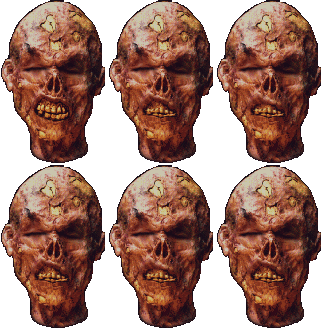
The legend of Black-Eyed Children, or B.E.K., is a modern urban legend of mysterious, ghastly, ghostly evil children who appear late at night with solid black eyes. It apparently first dates from Texas folklore in the mid-1990s. It is the ominous horror scare of the obstructed gaze of deep black eyes from young kids as images of demonic and devilish possession. Although a relatively “new” legend, they have been reported worldwide.

The original Texas legend was told by Brian Bethel, who claimed to have met the black-eyed children when he was out paying his cable bill in 1996 while living in Abilene, Texas. He stated he was sitting in his car outside a strip mall writing his check, and then a group of teenagers, wearing hoodies and possessing black eyes, came standing in his car – they asked him for a ride to their mother’s house to get money for movie tickets. However, the movie was already running, and the teenagers sounded older than the kids. He was scared and sped away when, looking back, the kids disappeared. He wrote about the encounter and published it in the Abilene New Reporter.

Many scholars say this urban legend has evolved from demonic descriptions of possessed children or could be examples of death personified as children. Children have also been an image of dark fae or fairies, shorter-statured humans with dark black eyes. They often have pale skin and appear to people in cars or homes, wanting to be in the vehicle or home.

The eyes are solid jet black, with no pupils, white, or iris, just totally black. The kids are often school-aged, ranging from kindergarteners to high schoolers. Often, their clothes are outdated, and they speak in a monotone voice, more mature than perceived age. They often repeat the same phrase and insist on being let inside the house or the car the appears before. They start innocent and evolve into more aggressive in their actions. Like vampires, they must be invited in to have power over an individual. When denied, they wander off. The accounts of these children allowed in led to the disaster unfolding, ranging from tragedy to destruction, cancer, and curses.

In Irish lore, these creatures are sometimes compared to changelings. Changelings in Irish faerie lore are fairy babies swapped for human children and are often riddled with evil actions or destruction. Water baby legends from Lake Tahoe, California, also share imagery and actions, such as when they cry to lure people to their deaths.

References:

Image is of Creative Commons, Wikipedia: Black-eyed children. (2024, October 23). In Wikipedia. https://en.wikipedia.org/wiki/Black-eyed_children


Navajo Spring (Manitou Springs, CO)

Navajo Spring, Manitou Springs, Colorado: September 6, 2012

Navajo Spring
Manitou Springs, Colorado, USA

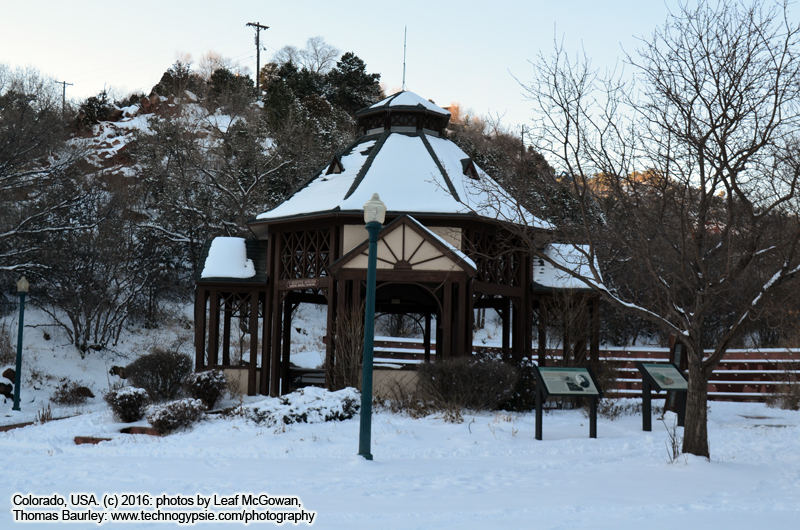
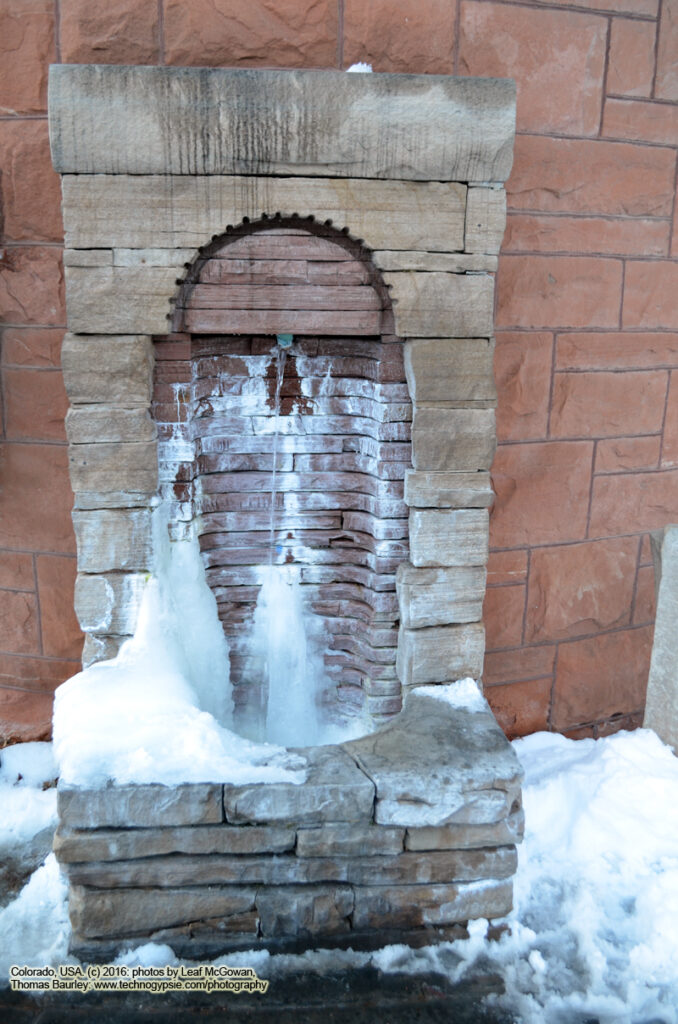
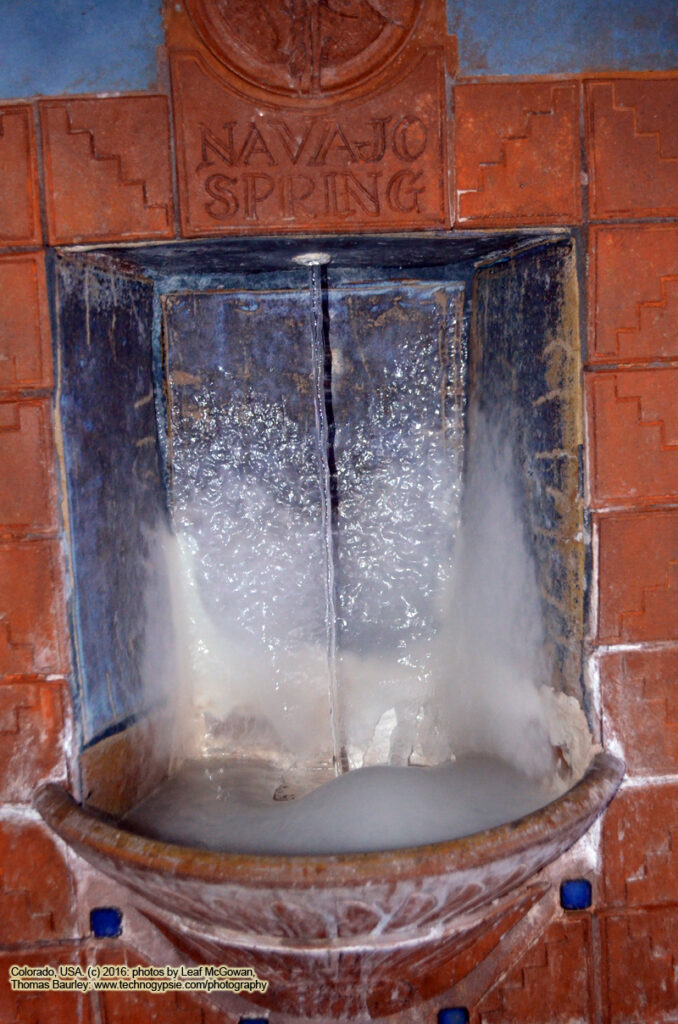
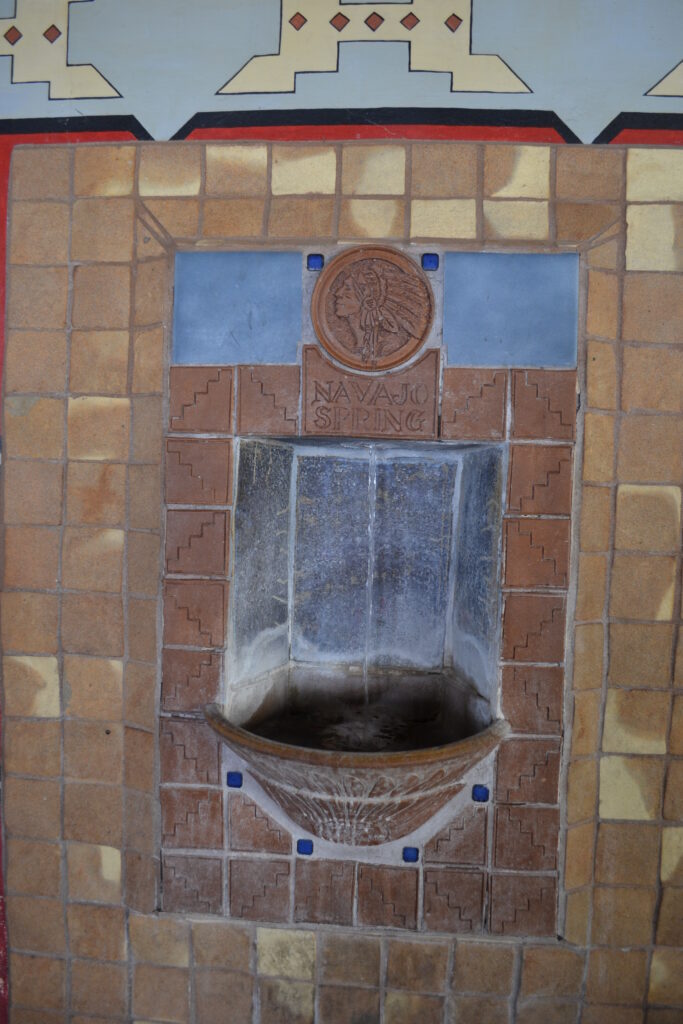
Just off of Main Street in historic Manitou Springs, at the back of the popcorn and candy store in front of the amusement arcade, a natural soda spring comes out of the wall in a decorated font. It is one of eight famous natural springs that put this town on the map. The spring was initially visited by Native American Indians who sought their healing and spiritual powers, which some believed were gifted by the great spirit called Manitou.

They were then frequented by white Euro-American settlers, who pushed the tribes out and commercialized the area. Legend has it that the Utes placed a curse on all whites that the Westerners could never have a successful business in this place because of the commercialization of this particular spring. By the late 1880s, the Westerners built a large bathhouse and spa, as well as a bottling plant, on this former location but did not succeed. The waters, however, were famous throughout America at that time and place.

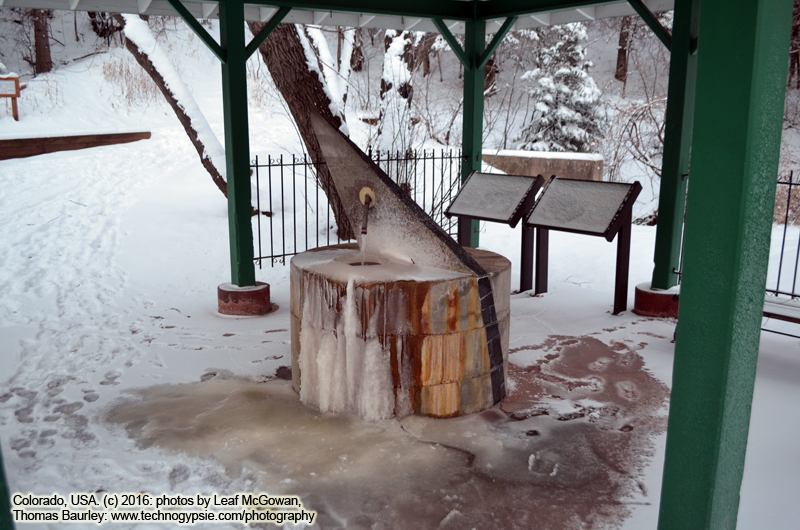
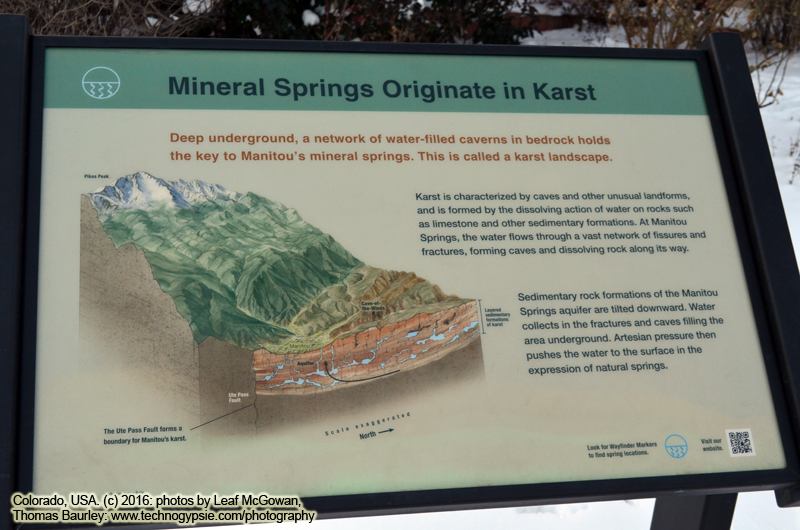
The spring waters are fissured through rock fractures from the rainwater and snowmelt from Pikes Peak. Water reaching the depths becomes heated and mineralized, flowing up through the Ute Pass fault zone into limestone caverns that carbonate them and are tapped into by natural springs or wells. Each spring in the area has its distinct taste and flavor. This particular spring originally had a bowl-like concretion of calcium carbonate large enough to dip or wash oneself in.

From 1871-1972, Chief Joseph Tafoya – Chief Joe “Little Deer” and his family came to this spot to do authentic Indian dances and songs from the Tewa tribe of the Pueblo Reservation of Santa Clara, New Mexico. In 1889, Jerome Wheeler built a 3 story bottling plant east of the arcade. He used these waters to bottle up to 5,000 gallons of water daily, selling it worldwide as table water for the famous non-alcoholic Giner Champagne. After the collapse of the plant, the spring fell into abuse and was restored in 1991 by Manitou’s residents and donors.

Navajo Spring: “Chief Joseph Tafoya – Chief Joe ‘Little Deer’ 1891-1972: Generations of the Tafoya family have presented authentic Indian dances and songs on this site and at the Manitou Cliff Dwellings Museum since 1925. The Tafoya Family Dancers are members of the Tewa tribe from the Pueblo Reservation of Santa Clara, New Mexico, and descendants of the ancient Puye Cliff Dwellers. For 15 years, Chief Joseph Little Deer served both as governor of the Santa Clara Reservation and Chairman for the All Pueblo Indian Council. He introduced a democratic form of government on the reservation, opened his home to orphaned Indian children, and worked tirelessly to improve the living conditions of his people. Chief Little Deer married Petra Suazo, a great niece of Cheif Manitou so named for his active promotion of Manitou Springs at the turn of the century. Chief Manitou danced for 20 summers at the Cliff Dwellings museum. Navajo Spring is one of the seven natural soda-type springs that led to the settlement of Manitou. The early French trappers named the bordering creek “Fountaine qui Bouille”, the Boiling Water. Mineral deposits containing large amounts of carbonate of lime created a natural basin where the Indians bathed their sick and wounded. The white mineral basin now is hidden under the arcade floor. In 1889, Jerome Wheeler built a 3-story bottling plant east of the arcade and used Navajo Spring for bottling up to 5000 gallons of water a day. The water was sold worldwide as table water of the popular non-alcoholic Ginger Champagne. Navajo Spring was restored in 1991 by generous assistance from various donors” ~ sign outside the Spring.
(more…)


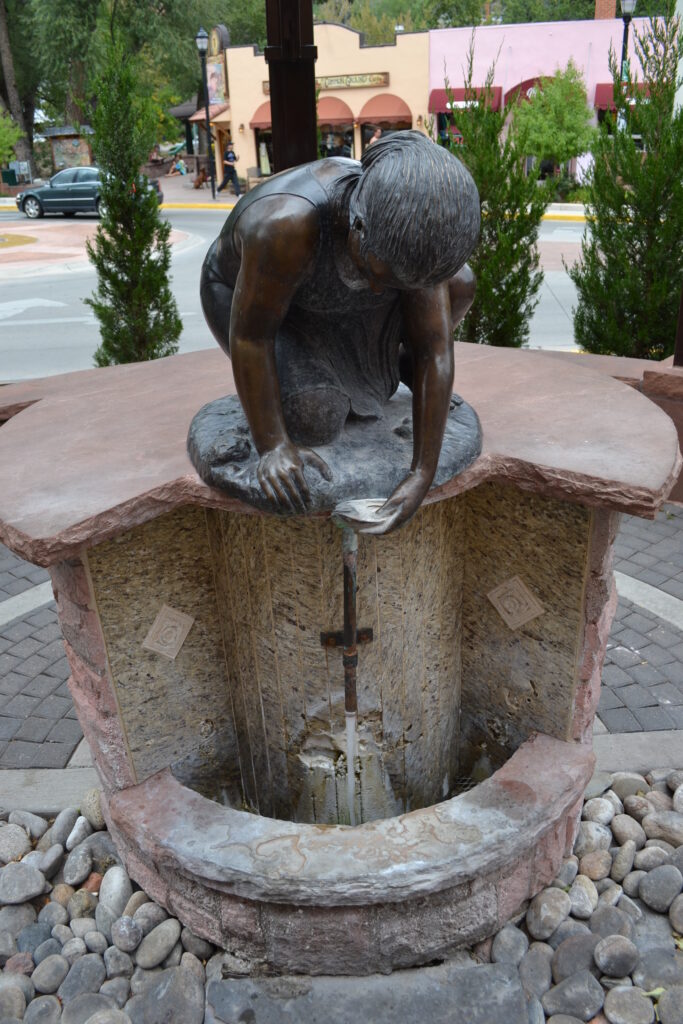
Stratton Spring (Manitou Springs, CO)

Stratton Spring
Manitou Springs, Colorado

From the deep fissures of the Ute Pass Fault, where the rainwater and snowmelt of Pikes Peak meet and become heated and mineralized in the deep limestone caverns where they take thousands of years to make their way to the surface absorbing numerous minerals and nutrients as well as natural carbonation. Stratton Spring was a drilled source by the Stratton Foundation to serve the town where they felt it was located along earlier Native American trails.


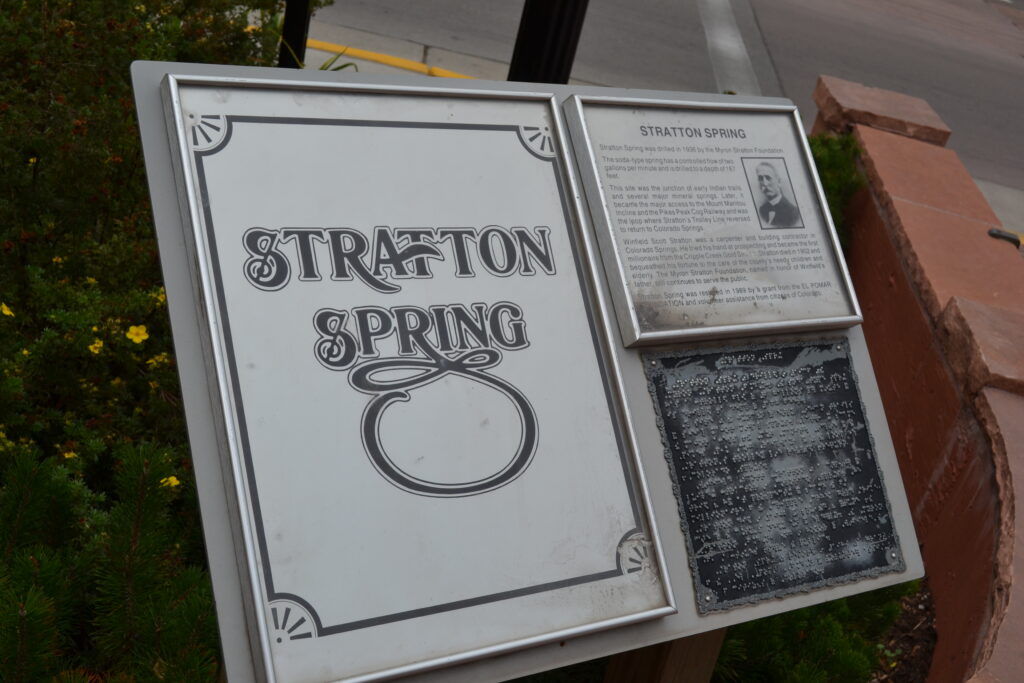
“Stratton Spring was drilled in 1936 by the Myron Stratton Foundation., The soda-type spring has a controlled flow of two gallons per minute and is drilled to a depth of 167 feet. This site was the junction of early Indian trails and several major mineral springs. Later it became the major access to the Mount Manitou Incline and the Pikes Peak Cog Railway and was the loop were Stratton’s Trolley Line reversed to return to Colorado Springs. Winfield Scott Stratton was a carpenter and a building contractor in Colorado Springs. He tried his hand at prospecting and became the first millionaire from the Cripple Creek Gold Strike. Stratton died in 1902 and bequethed his fortune to the care of the county’s needy children and elderly. The Myron Stratton Foundation, named in honor of Winfield’s father, still continues to serve the public. Stratton Spring was restored in 1989 by a grant from the EL POMAR Foundation and volunteer assistance from citizens of Colorado. “

~ sign outside the Spring. September 6, 2012: Manitou Springs, Colorado.

The Mountain Ute would come through this pass alongside many other tribes to pay homage and be treated by the magical waters they believe were blessed by the Great Spirit Manitou. In the late 1880s, developers and Westerners pushed the tribes out of the valley. They began commercializing the healing waters with spas, bathhouses, and other commercial ventures, such as bottled water companies. This spring, one of 10 within Manitou Springs, was believed to have healing properties to treat TB and other illnesses.

This spring flows two gallons a minute of naturally carbonated soda-type spring water. The well was drilled to a depth of 167 feet. This Spring being drilled has little folklore besides its more modern healing attributes. It was drilled by Winfield Scott Stratton, a local carpenter and building contractor who lived in the area after trying his hand at prospecting during the Cripple Creek Gold Strike, which led him to become the first millionaire from that Gold Rush. He died in 1902 and willed his fortune to care for the county’s elderly and needy children through the Myron Stratton Foundation. The Spring was restored in 1989 through an EL POMAR Foundation grant and various volunteers and donors from the region.

(more…)


The Magical Springs of Manitou Springs Colorado

7 Minute Spring – Explorations around Manitou Springs, Colorado.

The Magical Mineral Springs of Manitou
~ 354 Manitou Ave, Manitou Springs, Colorado ~
Article by Thomas Baurley, Leaf McGowan, Techno Tink Research

The little touristy village of Manitou Springs is most famous for its mineral springs, which well up through eight fonts (previously ten fonts, upwards of 50 springs) peppered throughout the town. These springs are free to visit, and each holds its own variation of minerals, magic, folklore, and healing properties that visitors have sought throughout the ages. Each has its unique flavor, natural carbonation, and effervescence.

This valley was originally heavily frequented by various Native American tribes who visited Fountain Creek and its natural springs for their healing magic, offering homage and great respect to the spiritual powers that dwell here. They believed these magical springs were the gift of the Great Spirit Manitou, after which the town and valley were named. They brought their sick here for healing. The aboriginal inhabitants and visitors of the area called the “Great Spirit” as “Manitou”, and felt these mineral springs was its breath, as the source of the bubbles in the spring water. This made the waters and grounds extremely sacred.

The Ute, Arapaho, Cheyenne, and many other tribes came here to partake of the great spirit’s breath. They would heal their sick here, collect the waters, stay for winters, and share in the waters as an area of peace where no conflict was allowed. There were believed to have been ten natural springs in the valley. The Euro-Americans caused conflicts and skirmishes with the Natives, pushing them out so they could utilize the valley for business, resort, tourism, and commerce. It is said that after the Natives left, they cursed the area for the Whites and that no company would ever succeed there. Some believe Manitou Springs has since been an ever-changing valley with businesses coming and going, failing and closing, and new ones coming in and replacing those that left.

Stephen Harriman Long was one of the first white explorers to record the waters in 1820. The expedition’s botanist and geologist, Edwin James, detailed the healing nature of the waters. The explorer George Frederick Ruxton wrote in his travel about these “boiling waters” as well that “… the basin of the spring was filled with beads and wampum, pieces of red cloth and knives, while the surrounding trees were hung with strips of deer skin, cloth, and moccasins”. Throughout the world, it is a common practice to leave similar objects, items, and cultural artifacts around the world at magical and healing springs, wells, and bodies of water.

Iron Spring: Explorations around Manitou Springs, Colorado.

Nearly 50 years later, Dr. William Abraham Bell and General William Jackson Palmer made plans to develop a health resort here during the Civil War with “a vision of dreamy summer villas nestled in the mountains with grand hotels and landscaped parks clustered around the springs” that they called “Fountain Colony” and “La Font.” It became Colorado’s first resort town. By 1871, white settlers had begun developing the area for tourism, health care, and profit.

A resort was soon developed here, taking advantage of the waters and incorporating them into medicinal and healing water therapies. This brought great prosperity to the region. By 1873, a developer named Henry McAllister, who worked for Palmer, spread the news about the medicinal benefits of the Springs and pushed for it to become a spa resort with an “incomparable climate and scenery” as its backdrop.

Shoshone Spring: Explorations around Manitou Springs, Colorado.

Then came various medicinal practitioners, such as Doctor Edwin Solly, who pushed the area as a resort for healing and therapy. They preached that the combined waters to drink, soak in, and breathe pure air mixed with the sunny climate would be the most effective prescription to treat tuberculosis. The commercial businesses began to claim the various springs, enclosing some of them as the village grew.

The first was the Cheyenne Spring House, established as a red sandstone brick, conical-roof structure. Immediately after, over 50 wells and springs were drilled, many enclosed. Once popularity disappeared and “dried up,” many of these springs were capped, paved, and closed. However, as the fad died, medical centers and hospitals around the United States improved.

Manitou became forgotten and suffered abandonment. The Mineral Springs Foundation was formed in 1987 as an all-volunteer 501(c)3 non-profit to protect, improve, maintain, and manage the springs. It targets the restoration of some springs and promotes their popularity once again. The Foundation hosts walking tours called “Springabouts” every Saturday from Memorial Day to Labor Day, beginning downtown. Tours can be arranged by visiting the Tourist center or calling 719-685-5089.

Upon request, the visitor center will provide maps, brochures, detailed content charts, and sampling cups. They can also be found on their website at http://www.manitoumineralsprings.org. The series of springs has been developed as a National Register of Historic Places district and is located in one of the country’s largest districts of its kind. It was initially called the “Saratoga of the West” and established as a resort community within a spectacular setting at the edge of the Rocky Mountains along the base of Pikes Peak. Numerous bottling companies moved into the area, making a profit on the waters, the most famous of which was “Manitou Springs water” and was sold globally.

7 Minute Spring : Explorations around Manitou Springs, Colorado.

Geology: The waters come from two sources in the Rampart Range and Ute Pass: “deep-seated waters” that travel through limestone caverns and drainage systems created by karst aquifers. The water dissolves the limestone and absorbs carbonic acid, carbon dioxide, and other minerals, making it “effervescent” or slightly naturally carbonated. Volcanic and inner core processes heat it. Through time, the waters return to the surface naturally using an artesian process rising to the surface, collecting soda, minerals, and sodium bicarbonate upwards. The other sources of water are Fountain Creek and Williams Canyon, snow melt, rainwater, and surface waters.

The warm water then flows into a limestone cavern, where it becomes carbonated and springs forth to the surface in natural and human-drilled locations. Most of these waters take thousands of years to complete their voyage from the mountain snow-capped peaks down to the inner earth and back up to the surface, freeing their content and solutions from being affected by industry, development, and atmospheric contamination.

Navajo Spring: Explorations around Manitou Springs, Colorado.

The Springs of Manitou:
https://wells.naiads.org/the-magic-and-minerals-of-manitou-springs/

  • Cheyenne Spring – This natural sweet soda spring comes from limestone aquifers and is believed to be over 20,000 years old.
  • Iron Spring – The Iron Spring is named after its harsh, foul, iron-tasting flavor and content. It was a man-made spring drilled in the 1800s and prescribed to patients for iron deficiency.
  • Lithia / Twin Spring – This is a combined location of two man-made drilled springs—Twin Springs and Lithia Springs. It is popular for its Lithium content and sweet taste, calcium, lithium, and potassium content. It’s popular to mix it in lemonade.
  • Navajo Spring is a natural soda spring over which commercial development was built. It is now within and beneath the popcorn and candy store. This was the most popular spring, frequented by Native Americans and early Euro-American settlers, and was the founding spring for the village. It originally fed a large bathhouse and bottling plant, bringing fame to the town.
  • Old Ute Chief Spring – is a defunct spring outside the old Manitou Springs bottling plant.
  • Seven Minute Spring – A man-made spring drilled in 1909 to enhance the neighboring hotel’s tourist attraction. Its unique carbonization caused it to erupt like a geyser every 7 minutes. It became dormant until the 1990s, when it was re-drilled, and the surrounding park was established.
  • Shoshone Spring—This natural spring had sulfur content and was prescribed by various physicians for curative powers before modern medicine became popular and effective.
  • Soda Spring – located in the spa stores next to the arcade.
  • Stratton Spring—The Stratton Foundation created this man-made drilled spring as a service to Manitou Springs village, where tourists could come and partake of its waters. It is dedicated to early Native American Trails.
  • Wheeler Spring—This is another man-made drilled spring donated to the city by settler Jerome Wheeler of the New York Macy’s. Wheeler resided and banked in the town during the mining and railroad period. His former home is located where the current post office is today.

References:

7 Minute Spring; Explorations around Manitou Springs, Colorado.
(more…)


CHANGELING

One of the most common Fae species known in folklore … “Changelings” are faerie creatures that replace stolen human children. These are sometimes called an “auf” or “oaf.” In fairy lore and myth, there are many tales about fairies stealing a human child and substituting it with a misshapen fairy baby known as a “changeling.” Sometimes, they are replaced not by fairies but by demons, trolls, nereids, or spirits. Sometimes, they replace the child with a piece of wood that appears to be alive under a glamour for a short period of time.

Adults have been reportedly taken and replaced as well, especially in Ireland, Scotland, and Scandinavia. There is also the historic-day event of a man murdering his wife, Bridget Cleary, in Ireland. because they believed she was replaced by a changeling.

Throughout world lore, fairies, for some reason, like to kidnap human adults and children. Some claim the abducted human children are given to demons, faeries, or the devil or imbued into faerie races to strengthen their stock. Sometimes, newlywedded wives and mothers are taken. It is believed that some nursing mothers were kidnapped to provide milk to fairy children.

In the United States, there was an attested case of Miss Kittie Crowe who was believed to have been taken from fairies in 1876. It has been rumored that King Charles I of England (1600-1649) was a changeling as a nursemaid claimed a hooded figure appeared at his bedside and cast a cloak over his cradle with him in it.

The most targeted human victims are usually unbaptized babies, blonde-haired children, those with blue eyes, pretty girls, women touched by the fae, those found walking in a fairy ring, those wandering near fairy mounds at night, and anyone who sleeps under a hawthorn bush. In Catholic folklore, there is a widespread belief that infants are susceptible to demonic possession, which is why baptism is very important.

Changeling Traits

When a parent discovers the baby in their crib is not their own, for whatever reason, certain telltale signs signify it is a fairy surrogate. These changelings could have a deformed appearance, a wizened look, appear thin or weak, sickly or ailing, and not stop crying.

Adult changelings appear to have a voracious appetite, are aging, exhibit unfamiliar behavior and trickery, love dancing and frolicking outside when thinking they are alone not being observed by others, and often comment on their own age.

There is a myth in Ireland that a left-handed child is not human but rather a changeling. A child with a caul (remnant amniotic membrane) across their face was a changeling in Scotland.

Changelings are described as creatures that look like the humans they replace but are often sickly, aged, withered, or just “off.” Sometimes, they possess physical features rare in humans, such as an infant having a beard or long teeth. They come off as being more intelligent or gifted than those usual for their physical age appearance.

Sometimes, if a changeling is raised as a human child and is never detected, they will forget they are fae and continue living a human life. Those that do remember may return to their fae families leaving the human family without warning, while the abducted human may never return.

Around the World

While predominantly ascribed to the legends and lore of Celtic countries, their existence is described worldwide. In European folklore, they are seen as deformed or imbecilic offspring of fairies or elves. The Welsh call this fairy race the “cipenapers” (a contraction of kidnappers). In world folklore, there are many creatures similar to the “changeling.” Many of these are described as creatures left by spirits. They are mentioned in African, Asian, Germanic, and Scandinavian folklore.

In Scandinavia during the Medieval period, trolls were believed to trick humans into raising their offspring. They often targeted unbaptized children since those baptized were protected from trolls. In Scotland, it was said the replacement children gave fairy children a tithe to Hell as discussed in the infamous ballad “Tam Lin.” In Germany, they are called Wechselbalg, Wechselkind, Kielkopf, or Dickkopf. They are said to either be the devil, a female dwarf, a water spirit, or a Roggenmuhme (Rye Mother – a demonic woman living in cornfields and stealing human children). In the Anglo-Scottish border region of Scotland, it was believed that the faeries living in the “elf hills” would spirit away children and adults, taking them back to their world, and a simulation of the victim, usually by an adult male elf left to be suckled by the mother. The elves would treat the human baby well and raise it as one of their own.

In Poland, the Boginka or Mamuna was a Slavic spirit that would exchange babies with changelings that often possessed abnormally large abdomens, small or large heads, humps, thin arms/legs, hair body, and/or long claws. In Spain, it is often a nymph called Xana who would appear to travellers to help them. These little female fairies were born with enchanting beauty and would often deliver babies for humans that they’d swap with fairy babies because Xana could not produce milk. The Igbo people of eastern Nigeria believed that women in the tribe who lost numerous children were being tormented by a malicious spirit known as an ogbanje that reincarnated itself over and over.

Social scientists such as folklorist D.L. Ashliman claim that this myth illustrates the aspect of family survival in pre-industrial Europe. Families then relied on the productive labor of each family member to subsist, and there had to be a solution for those family members who drained the resources. Since changeling’s appetites were known to be voracious, they were seen as a threat to the family. Infanticide was sometimes utilized as the solution to this dilemma.

Some scientists claim that the “changeling” accusation would often be used to explain deformed, developmentally disabled, or neurodivergent children. Various legends have claimed those with symptoms of spinal Bifida, cystic fibrosis, PKU, progeria, Down syndrome, homocystinuria, Williams syndrome, Hurler syndrome, Hunter syndrome, autism spectrum disorder, Prader-Willi syndrome, and cerebral palsy were symptoms of a “changeling.”

As parents had higher expectations of childbirth and when children were born with ailments, they preferred to find a demon to blame for the ailment. Regressive autism has been compared to the marks of a changeling child. Before autism was defined and understood, it was very common for children possessing autistic traits to be labeled as elf-children or changelings because of their strange, inexplicable behavior. The obsession that faeries seem to have with an impulse to count things is now a trait found in autistic cases.

A network of humans today, known as “Otherkin” sometimes identify as being “changelings” (or elves, fairies, faeries, aliens, and were-creatures) often because their life experiences exist with feeling out of place in this world so much that they self-identify as being not human.

In movies, music, books, magazines, art, and literature there has been much focus on “changelings” and its phenomena.

Throughout the world, in folklore, there is a method of detecting changelings, such as eggshells. Arranging empty eggshells around a fireplace or hearth, a changeling can’t help but get up and examine them. They will peer into each other, saying, “This is but a windbag; I am so many hundred years old, and I have never seen the like of this.” Another method is for one to pretend that they are brewing water into the halves of eggshells. The changeling is said to jump up and declare, “I have seen the egg before the hen, I have seen the acorn before the oak, but I have never seen brewing in an eggshell before!” thereby revealing its age such as “I’m 1500 years old in the world and I’ve never seen a brewery of eggshells before!” Other methods are causing it pain or making it laugh. Many child abuse cases in Ireland have excuses that it was done only to reveal the changeling inside. In German and Irish lore, a changeling can be revealed by tricking it to believe its being heated or cooked in a oven. Also whipping, hitting, or abusing the changeling will sometimes force it out.

Füssli- Der Wechselbalg-1780

When a changeling reveals itself, lore states it’ll disappear up a chimney, and the real baby will be found alive and well outside the door or sleeping in its cradle.

Many spells and prayers exist to protect a child from a changeling. One method is leaving pieces of iron beneath the cradle, making rowan wood crosses with red thread, using St. John’s wort, or wrapping a child in its father’s shirt. Keeping an inverted coat or open iron scissors near the bed is also said to deter them. A red ribbon tied around the baby’s wrist or wearing a red hat would prevent an abduction in Poland. Not washing diapers after sunset, not turning one’s head away from a sleeping baby, and keeping a baby out of moonlight would also be protective measures.

In Cornwall, the magical stones known as the “Men an Tol” are believed to be guarded by a faerie who can return stolen children when the changeling baby is based through the stone.

  This article is a work in progress. Please return for more lore. 

Bibliography / Recommended Reading:


Changelings in Media and the Movies:

Changeling – movie, 2008 is about a changeling.

My Little Pony Friendship is Magic – children’s television series featuring shape-shifting pony-like creatures called changelings.

So Weird – Disney Channel episode “Changeling” features a child swapped with a changeling.

Star Trek: Deep Space Nine – race of shape-shifting aliens called “changelings.”

Supernatural – Season 3, “The Kids Are Alright” features changelings.

The Changeling – 2023 Horror fantasy television series by Kelly Marcel and Melina Matsoukas.

The Daisy Chain – 2008 movie about a little girl believing she was a changeling.

The Hole in the Ground – 2019 movie based on changeling folklore.

The Moorchild by Eloise McGraw is a story about a half human – half folk child exchanged for a human child.

The Watchers (PG-13: 2024): Set in Western Ireland, a human woman with changeling aspects gets trapped in the woods only to join three others also captive in a bunker where they have to entertain changelings at night, using them for a plot to escape their imprisonment beneath the surface and within the forest.


The Watchers (PG-13: 2024)

Comments Off on The Watchers (PG-13: 2024) | Changeling, Faeries, Movies Tags:, , , , ,

The Watchers. Horror, Fantasy. Rated PG-13, released June 2024. Director: Ishana Shyamalan; Writers: Ishana Shyamalan; A.M. Shine; Starring: Dakota Fanning; Georgina Campbell; Olwen Fouéré; and more. IMDB: https://www.imdb.com/title/tt26736843/.

I’m always fascinated with films that embrace the age-old faerie lore and embed it into current times. This film does just that. Another stunning mysterious tale from the Shyamalan lineage, this time by his daughter … and lives up to the power of the Shyamalan collection. Taking place in the land of legends and fairy lore … western Ireland, a young artist gets stranded in the woods discovering three others who too, are trapped. They have to hide in a bunker every evening and daylight provides little time to find an escape before darkness falls. Strange phenomena cloaks their every move and soon its discovered that the species of Changelings of the Fae imprisoned under the earth has a plot for their escape. True to descriptive nature of changelings and dark fae, this film embraces the most horror filled nightmares surrounding them. It leaves room for a sequel, which I can only hope manifests into reality. Review by Oisin Rhymour, 5 stars out of 5.


The Lure (2015: NR)

Comments Off on The Lure (2015: NR) | Faeries, Mermaids, Movies Tags:, , , ,

The Lure: NR; 2015. Drama, Fantasy, Horror. Director: Agnieszka Smoczynska; Writer: Robert Bolesto; Starring: Marta Mazurek; Kinga Preis; Michalina Olszanska; Kinga Preis; and more. IMDB: https://www.imdb.com/title/tt5278832/.

By far the most enticing thrilling enchanting movie I’ve watched this year sofar (2024), definitely atop my all time favorites. The Lure, which i stumbled upon on some streaming channel I can’t remember which one … I was instantly mesmerized by this foreign horror musical drama featuring one of my favorite fae species … Mermaids. Anyone who knows me, knows I’m overly obsessed with Faerie lore. This movie embraces fae living amongst us in the 1980’s time period. Not only that, but the 80’s/alternative music atmosphere drives me home to my era, with even more excitement. The story shows the tale of mermaid sisters named “Silver” and “Golden” who become enchanted by the song of “Figs and Dates” band members partying on the beach – they make friends and become adopted by the cabaret club the band operates within. Its a twisted love story beyond the “Little Mermaid” obsession with a human and going through a twisted operation to gain human legs permanently. The sister doesn’t understand and decides to listen to her natural desires -devouring the flesh of humans in the city. While this pitstop was meant only as a stop-over for the sisters new life in America, they become trapped in Warsaw. The music, sex, horror, the gore, comedy, drama, and the art-house madness makes it a uniquely enchanting mermaid tale. Review: 5 stars out of 5 by Oisin Rhymour


Archives

Categories