CHANGELING

One of the most common Fae species known in folklore … “Changelings” are faerie creatures that replace stolen human children. These are sometimes called an “auf” or “oaf.” In fairy lore and myth, there are many tales about fairies stealing a human child and substituting it with a misshapen fairy baby known as a “changeling.” Sometimes, they are replaced not by fairies but by demons, trolls, nereids, or spirits. Sometimes, they replace the child with a piece of wood that appears to be alive under a glamour for a short period of time.

Adults have been reportedly taken and replaced as well, especially in Ireland, Scotland, and Scandinavia. There is also the historic-day event of a man murdering his wife, Bridget Cleary, in Ireland. because they believed she was replaced by a changeling.

Throughout world lore, fairies, for some reason, like to kidnap human adults and children. Some claim the abducted human children are given to demons, faeries, or the devil or imbued into faerie races to strengthen their stock. Sometimes, newlywedded wives and mothers are taken. It is believed that some nursing mothers were kidnapped to provide milk to fairy children.

In the United States, there was an attested case of Miss Kittie Crowe who was believed to have been taken from fairies in 1876. It has been rumored that King Charles I of England (1600-1649) was a changeling as a nursemaid claimed a hooded figure appeared at his bedside and cast a cloak over his cradle with him in it.

The most targeted human victims are usually unbaptized babies, blonde-haired children, those with blue eyes, pretty girls, women touched by the fae, those found walking in a fairy ring, those wandering near fairy mounds at night, and anyone who sleeps under a hawthorn bush. In Catholic folklore, there is a widespread belief that infants are susceptible to demonic possession, which is why baptism is very important.

Changeling Traits

When a parent discovers the baby in their crib is not their own, for whatever reason, certain telltale signs signify it is a fairy surrogate. These changelings could have a deformed appearance, a wizened look, appear thin or weak, sickly or ailing, and not stop crying.

Adult changelings appear to have a voracious appetite, are aging, exhibit unfamiliar behavior and trickery, love dancing and frolicking outside when thinking they are alone not being observed by others, and often comment on their own age.

There is a myth in Ireland that a left-handed child is not human but rather a changeling. A child with a caul (remnant amniotic membrane) across their face was a changeling in Scotland.

Changelings are described as creatures that look like the humans they replace but are often sickly, aged, withered, or just “off.” Sometimes, they possess physical features rare in humans, such as an infant having a beard or long teeth. They come off as being more intelligent or gifted than those usual for their physical age appearance.

Sometimes, if a changeling is raised as a human child and is never detected, they will forget they are fae and continue living a human life. Those that do remember may return to their fae families leaving the human family without warning, while the abducted human may never return.

Around the World

While predominantly ascribed to the legends and lore of Celtic countries, their existence is described worldwide. In European folklore, they are seen as deformed or imbecilic offspring of fairies or elves. The Welsh call this fairy race the “cipenapers” (a contraction of kidnappers). In world folklore, there are many creatures similar to the “changeling.” Many of these are described as creatures left by spirits. They are mentioned in African, Asian, Germanic, and Scandinavian folklore.

In Scandinavia during the Medieval period, trolls were believed to trick humans into raising their offspring. They often targeted unbaptized children since those baptized were protected from trolls. In Scotland, it was said the replacement children gave fairy children a tithe to Hell as discussed in the infamous ballad “Tam Lin.” In Germany, they are called Wechselbalg, Wechselkind, Kielkopf, or Dickkopf. They are said to either be the devil, a female dwarf, a water spirit, or a Roggenmuhme (Rye Mother – a demonic woman living in cornfields and stealing human children). In the Anglo-Scottish border region of Scotland, it was believed that the faeries living in the “elf hills” would spirit away children and adults, taking them back to their world, and a simulation of the victim, usually by an adult male elf left to be suckled by the mother. The elves would treat the human baby well and raise it as one of their own.

In Poland, the Boginka or Mamuna was a Slavic spirit that would exchange babies with changelings that often possessed abnormally large abdomens, small or large heads, humps, thin arms/legs, hair body, and/or long claws. In Spain, it is often a nymph called Xana who would appear to travellers to help them. These little female fairies were born with enchanting beauty and would often deliver babies for humans that they’d swap with fairy babies because Xana could not produce milk. The Igbo people of eastern Nigeria believed that women in the tribe who lost numerous children were being tormented by a malicious spirit known as an ogbanje that reincarnated itself over and over.

Social scientists such as folklorist D.L. Ashliman claim that this myth illustrates the aspect of family survival in pre-industrial Europe. Families then relied on the productive labor of each family member to subsist, and there had to be a solution for those family members who drained the resources. Since changeling’s appetites were known to be voracious, they were seen as a threat to the family. Infanticide was sometimes utilized as the solution to this dilemma.

Some scientists claim that the “changeling” accusation would often be used to explain deformed, developmentally disabled, or neurodivergent children. Various legends have claimed those with symptoms of spinal Bifida, cystic fibrosis, PKU, progeria, Down syndrome, homocystinuria, Williams syndrome, Hurler syndrome, Hunter syndrome, autism spectrum disorder, Prader-Willi syndrome, and cerebral palsy were symptoms of a “changeling.”

As parents had higher expectations of childbirth and when children were born with ailments, they preferred to find a demon to blame for the ailment. Regressive autism has been compared to the marks of a changeling child. Before autism was defined and understood, it was very common for children possessing autistic traits to be labeled as elf-children or changelings because of their strange, inexplicable behavior. The obsession that faeries seem to have with an impulse to count things is now a trait found in autistic cases.

A network of humans today, known as “Otherkin” sometimes identify as being “changelings” (or elves, fairies, faeries, aliens, and were-creatures) often because their life experiences exist with feeling out of place in this world so much that they self-identify as being not human.

In movies, music, books, magazines, art, and literature there has been much focus on “changelings” and its phenomena.

Throughout the world, in folklore, there is a method of detecting changelings, such as eggshells. Arranging empty eggshells around a fireplace or hearth, a changeling can’t help but get up and examine them. They will peer into each other, saying, “This is but a windbag; I am so many hundred years old, and I have never seen the like of this.” Another method is for one to pretend that they are brewing water into the halves of eggshells. The changeling is said to jump up and declare, “I have seen the egg before the hen, I have seen the acorn before the oak, but I have never seen brewing in an eggshell before!” thereby revealing its age such as “I’m 1500 years old in the world and I’ve never seen a brewery of eggshells before!” Other methods are causing it pain or making it laugh. Many child abuse cases in Ireland have excuses that it was done only to reveal the changeling inside. In German and Irish lore, a changeling can be revealed by tricking it to believe its being heated or cooked in a oven. Also whipping, hitting, or abusing the changeling will sometimes force it out.

Füssli- Der Wechselbalg-1780

When a changeling reveals itself, lore states it’ll disappear up a chimney, and the real baby will be found alive and well outside the door or sleeping in its cradle.

Many spells and prayers exist to protect a child from a changeling. One method is leaving pieces of iron beneath the cradle, making rowan wood crosses with red thread, using St. John’s wort, or wrapping a child in its father’s shirt. Keeping an inverted coat or open iron scissors near the bed is also said to deter them. A red ribbon tied around the baby’s wrist or wearing a red hat would prevent an abduction in Poland. Not washing diapers after sunset, not turning one’s head away from a sleeping baby, and keeping a baby out of moonlight would also be protective measures.

In Cornwall, the magical stones known as the “Men an Tol” are believed to be guarded by a faerie who can return stolen children when the changeling baby is based through the stone.

  This article is a work in progress. Please return for more lore. 

Bibliography / Recommended Reading:


Changelings in Media and the Movies:

Changeling – movie, 2008 is about a changeling.

My Little Pony Friendship is Magic – children’s television series featuring shape-shifting pony-like creatures called changelings.

So Weird – Disney Channel episode “Changeling” features a child swapped with a changeling.

Star Trek: Deep Space Nine – race of shape-shifting aliens called “changelings.”

Supernatural – Season 3, “The Kids Are Alright” features changelings.

The Changeling – 2023 Horror fantasy television series by Kelly Marcel and Melina Matsoukas.

The Daisy Chain – 2008 movie about a little girl believing she was a changeling.

The Hole in the Ground – 2019 movie based on changeling folklore.

The Moorchild by Eloise McGraw is a story about a half human – half folk child exchanged for a human child.

The Watchers (PG-13: 2024): Set in Western Ireland, a human woman with changeling aspects gets trapped in the woods only to join three others also captive in a bunker where they have to entertain changelings at night, using them for a plot to escape their imprisonment beneath the surface and within the forest.


Malificent (PG: 2014)

malificent

Malificent (Rated PG – Released May 2014)
Starring: Directed By: Robert Stromberg, Written by Linda Woolverton, Charles Perrault, and others. Starring: Angelina Jolie as Maleficent, Elle Fanning as Aurora, Sharlto Copley as Stefan, Lesley Manville as Flittle, Imelda Staunton as Knotgrass, Juno Temple as Thistlewit, and many others. http://www.imdb.com/title/tt1587310/.
.

I’m really digging the fact that Walt Disney and other major film companies are starting to get on track with depicting fairy tales with “real faeries” as is becoming the artsy trend these days in media, film, and music. They were golden with how they manifested Snow White and the Huntsman I didn’t think the film wizards could do any better with the classics – wrong was I. “Malificent” is in that tradition, embedded deep into the faerie realms and the struggles between humans and the fae, following true folklore about faeries and iron, and much of historical folklore as accurate as they could go. It is the classic retelling (and most probable more authentic of the Sleeping Beauty myth if there was one in history). A young powerful faerie girl well respected in Faerieland as “Malificent” goes and befriends a young human mortal who stumbled into the protected realms. They begin a long childhood friendship which leads up to the guise of “true love” only to meet the ever-told fate between fae and humans that humans will always cross the fae. This throws Malificent into a darkness after she loses her wings and seeks revenge on the wrongdoer. She curses his child into a “sleeping beauty” enchantment that not even she could break, only to be broken by a kiss of true love – which she believed did not exist. As time passes she falls for the young cursed one only to despair that she couldn’t break the curse she cast. Battles between the humans and the magical folk build up high action and turmoil leaving you on the edge of your seat. Ents, Dryads, Pixies, Elves, Dragons, and other magical folk animate your imagination as malificent finds her way back to the fate of her beautiful wings. Just how I would have imagined “Sleeping Beauty”. Rating: 5 stars out of 5 [rating:5]


Pluto's Cave (Weed, CA)

033014-098

Pluto’s Cave
* Shasta, California * Article by Leaf McGowan, Technogypsie Productions © 2014: Written March 31, 2014.

During our fabled quest for Telos, we decided to head off in search of Pluto’s Cave. In the heart of the high desert just 12 1/2 miles north of Weed, California. “Pluto’s Cave” is not really a cavern, but a lava tube dating to over 190,000 B.P. (before present) from early eruptions of Mount Shasta. It is located on the northern outskirts of Mount Shasta in the high desert. Segments of the tube are collapsed, while other portions are buried. There are about three segments one can access reliably. Unfortunately the entrances and walls within many sections of the early part of this lava tube has been vandalized with graffiti from locals partying at the location. Some of the graffiti is historic dating to the early 20th century. The cave floor is very dusty and too much activity will cause a cloud burst of fine powder that will take a bit to settle. The tube has a strong stench of bat guano. The early part of the tube has some flat level walking areas, but the deeper you go the more shambling and climbing you’ll need. Bring water, good hiking boots, long pants (I wore shorts and had received a bit of scrapes), and make sure you have a good head torch and several reliable back up lights. It is recorded that visitors can safely hike into the cave approximately 1200 feet. The tube varies from 20-50 feet in height at points. There is evidence that the cave was used by Pre-Columbian peoples. The tube was discovered by Westerners in 1863 by Nelson Cash, a local rancher looking for stray cattle that he believed wandered into these fields. He named the cave “Pluto’s Cave” after the Greek God of the Underworld. Pluto’s Cave is often described as a “classic lava tube” as it was a tunnel formed by molten lava passing through tubes in older, hardened lava. It was discovered because sections of the roof collapsed exposing the inner chamber. This desert contains numerous lava tubes and caves in the region. It is believed that there are over 778 caves and tunnels in nearby Lava Beds National Park, and over 150 documented caves in the Marble Mountain Wilderness that Mount Shasta is part of. Many of these have not been explored.

033014-084

Local mythology: Pluto’s cave is not without its share of mythos. Some believe it is an entrance to the ancient Lemurian city of Telos – whether they be races of aliens, faeries, or other people. No scientific evidence supports these claims and is therefore classified as local legends, lore, and superstitions. In the 2008 edition of Fate Magazine, an article tells the story of “The Shaver Mystery” – depicting bizarre accounts of his abduction by subterranean beings known as “Deros” made into a low-budget movie called “Beyond Lemuria” by a California based Church of Hermetic Scientists that was filmed in Pluto’s Cave. The film’s plot encompasses a sinister Draconian Society that has secretly funded the development of a Intragravatron device and plans to open the vortex at an inter-dimensional convergence point deep in the lava caves on the northern slopes of Mt. Shasta. This was based on a original story of a 17 year old boy named Frederick Spenser Oliver who in the early 20th century published a telling of his channeled story of Phylos in his book “A Dweller on Two Planets” which eventually became an occult classic tale. Some believe it was this book that has triggered many of the myths of the area about Phylos, Telos, and the Lemurians. In 2011 there was a recording of a local boy disappearing. This tale is full of childhood imagination, aliens, and abduction theories. [see details here: http://www.messagetoeagle.com/oddunexdismtshasta_p2.php#.Uzw5ACjDU2c ] That same year, a tourist from Los Angeles claimed to have heard a beautiful woman’s voice coming from the direction of Mount Shasta as he was hiking the Pacific Crest Trail. He followed the voice, became lost, and found his way to Pluto’s cave where he claims to have been abducted, stripped of his clothing, greeting by a beautiful tall woman with unnatural blue eyes, and given a gift as well as secret information. After being lost for several weeks, he was found and he claimed to be “Lord Kalki” – the incarnation of a messianic Hindu god. Legends of a spectral lady appear to haunt the caverns, appearing as a spiritual guide, alien, a Lemurian, or Faerie queen. Online articles also claim there is a Native American legend of a red-headed female who used to live in caverns beneath Mount Shasta, some believe was at Pluto Cave. Some claim this lava tube as well as other tubes, caves, and tunnels in the region interconnect southern Oregon, Mount Shasta, and the upper coasts of California. Some writers online claim that Native American tribes admit to these locations and entrances, but that they are a closely guarded secret never shared with the outside world. Others believe the St. Germain foundation secretly guard the entrance of a lava tube above Mossbrae Falls in Dunsmuir, south of Mount Shasta. It is believed that this Mossbrae Falls tube is the secret entrance to Telos, not Pluto’s Cave. While meditating in the darkness at the end of the tunnel, in the pitch black silence there was a split second I thought I heard a moan, though that could have been my comrade’s stomach. There was another un-determined noise we both heard during our meditation. Other than that, light scratchings of the bats above on the lava rocks was all that permeated the silence.

033014-070

How to get there: Drive approximately 12.5 miles north on Highway 97 from Weed to A12 (the Grenada turnoff), turn left, go past the “Juniper Valley OHV area” signs approximately 3.25 miles to a small sign post saying “Pluto’s Cave”, turn on that dirt road follow to parking lot at hiking trail head. Hike 1/4 mile down the trailhead, following the red lava rocks outlining the trail to a small white arrow sign pointing down into Pluto’s Cave.

033014-074

(more…)


Rock Close: Fairy Glade (Blarney Castle)

Comments Off on Rock Close: Fairy Glade (Blarney Castle) | Faeries, Mythology, Pixies, Sacred Sites Tags:, , , , , , , , , , ,

120313-088

The Fairy Glade in the Rock Close of Blarney Castle
* The Rock Close * Blarney Castle, Blarney, Ireland * http://www.blarneycastle.ie *

Not much is known of this glade except that fairies are rumored to flitter around the foliage. Of course this is more-less the Victorian image of small insect-like fairies that resemble tiny human-shaped beings with wings (better known as “pixies”) rather than a habitat for the human-form shaped Fae or Faeries like Elves, dryads, naiads, nymphs, faun, trolls, orcs, and various other hundreds of beings known as Faeries. Its a beautiful little garden section with a ring walk around. A new addition I noticed in 2013 was a wood carved stump chair with the Druid’s rays on it. Little altars and offerings abound throughout the glade. Since Faeries or fairies cannot be proven to exist, neither does any sound history or archaeology on this place being that it most likely was dreamt up by the Castle grounds owners in the early 1800’s when they landscaped and created the “Rock Close” around the prehistoric dwellings that were believed to be utilized by Druids and early Celtic peoples.

120313-093

(more…)


Goibnui, the Smith of the Tuatha Dé Danann

Other names:
Govannon (Welsh), Gofannon (Welsh), and Gobannos (Gaulish), Goibniu, Goibhnet, Goibhniu.

Counterparts:
There is suggestions that Goibnui, the Smith of the Tuatha Dé Danann, was replaced by Saint Ghobnatan. The site of Tobar Ghobnatan had archaeological evidence of a hut and artifacts such as iron slag, a crucible, and metalworking tools leading experts to believe that the site was used for iron works before its Christian occupation. This may have been the metalworking site of Goibnui. This also led to St. Gobnait to being a Patron Saint of Iron Workers. Both names have similar roots. Monastic site where St. Gobnait’s house, well, church, and grave resides has suggestive evidence that it had formerly been a Pagan Shrine with fairy wells. Gofannon (Welsh) and Gobannos (Gaulish). He lived on in Irish myth as Goban Saor, the craftsman who built the two round towers.

Deity / King / Lord of:
Irish/Celtic God of Smiths, Faerie lord of Metal craft. Son of Goddess Danu. Brew master of Immortality elixirs.

Qualities:
iron working, smelting, metal working, brew master, beer.

Description:
Goibniu is the Irish God of Smiths and was a son to the Goddess Danu. He was the official Smith to the Tuatha de Danann. He is found in company often with Luichtne the carpenter, Creidne the wright, and Diane Cecht the leech. His parents are unknown, but believed to be the hypothetical son of Danu, brother to Dagda and Dian Cecht. Others claim his family to be Tuirbe Trágmar (father), Net (grandfather), Balor Elatha (half-brothers), and Dagda (Nephew). He continued on in Irish folklore as Goban Saor, the legendary craftsman who built the round towers.

History:
He was believed to be killed alongside Dian Cecht by a painful plague that struck Ireland.

Folklore/Mythology:
He was believed to be able to smith swords that would always strike true. He was in possession of the Mead of Eternal Life. He, Credne, and Luchtainel were believed to be the creators of the magical weapons used by the Tuatha de Danann in battle. He and his brothers Creidhne and Luchtaine were known as the Trí Dée Dána, the three Gods of art, who forged the weapons which the Tuatha Dé used to battle the Fomorians. He was believed to be a creator of beer that would make its drinker immortal. He was a master brewer for the Tuatha de Danann. His feast would protect the Tuatha de Danann from sickness and old age.

Archaeology/History:
Referred in the Book of Invasions as “Goibniu who was not impotent in smelting, Luichtne, the free wright Creidne, Dian Cecht, for going roads of great healing, Mac ind Oc, Lug son of Ethliu.” Another text referring to him was the St. Gall codex referencing him in a charm during the “Second Battle of Magh Turedh” calling upon him in a spell to remove a thorn “very sharp is Goibniu’s science, let Goibniu’s goad go out before Goibniu’s goad!” During the Second Battle, Ruadan (son of Bres and Brighid) was sent to kill him. As the Fomorians felt he’d make a good spy, he was asked for parts of a spear from Goibniu assembled by a woman called Fron. Ruadan threw the spear at Gobniu wounding him. The spear was pulled out and he was keened by Brigid inventing the practice of keening and giving it to humankind. Keening is the high-pitched wailing for the dead often referenced to the Banshee (beansidhe). He went to the Well of Slaine, watched over by his family and healed by its magic waters, returned to battle, making more weapons for the Tuatha de Danann, and won Ireland from the Fomorians. His weapons always made their mark and wounds inflicted by them were always fatal. His ale made the Tuatha de Danann invulnerable. the Lebor Gabála Érenn describes him as as ‘not impotent in smelting’.

Monuments and Artifacts:
The site Moytura in County Sligo is supposed to be associated with him as is the Moytura site in County Roscommon.

Bibliography/Recommended Readings:

  • R.A.S. Macalister 1941 “Lebor Gabála Érenn: Book of the Taking of Ireland” Part 1-5. Dublin: Irish Texts Society.
  • Gray, Elizabeth A. 1982 “Cath Maige Tuired: The Second Battle of Mag Tuired”. Dublin: Irish Texts Society. URL: http://www.ucc.ie/celt/published/T300010/index.html
  • MacCulloch, J.A. 1911 “Religion of the Ancient Celts.” Edinburgh: T. & T. Clark.

113013-195
Could St. Gobnata be a modernized version of Goibniu?
Statue at Tobar Ghobnatan


New York Faerie Festival 2013

Comments Off on New York Faerie Festival 2013 | Events Tags:, , , , , ,

062813-055

New York Faerie Festival 2013
* http://www.nyfaeriefest.com/ * Ouaquaga, New York *

Each summer towards the end of June a special portal opens to the Faerie Realm in the farmlands of New york state just east of Binghamton on a very magical nature sanctuary dedicated to the Fae. We decided this year to venture forth to this magical event. On our 2013 visit we came to enjoy the fantasy lands from June 28th until June 30th as the portal remained open. We were first to pass over the slippery muds from the rainstorms that dotted the event. Meeting goblins, mermaids, trolls, and orcs definitely sparked the imagination as we hiked along the paths to the stone circle, bathed on the mermaid beach, crossed the troll bridge, met the tooth fairy, and admired various altars. Frolicking with the Faerie queen, pixies, and elves … dancing to the amazing music of a plethera of talent on its stages. It was family fun for all ages. The merchant village had great artists and craftsmen, food stuffs, and goodies, and amazing faerie chai teas. Time in the realm, albeit wet, was wonderful as the festival was added to one of my current favorites. Rating: 5 stars out of 5

062813-101

(more…)


Thale (R: 2012)

thaleposter

Thale
Rated NR: Released: February 2012
http://www.thalemovie.com/
IMDB: http://www.imdb.com/title/tt2112287/
Facebook: http://www.facebook.com/thalemovie

Director: Aleksander Nordaas. Writer: Aleksander Nordaas. Starring: Silje Reinåmo as Thale; Erlend Nervold as Elvis; Jon Sigve Skard as Leo; Morten Andresen as Hvittkledd; Roland Astrand as the voice; and Sunniva Lien as
Thale.

A fabulous mythical tale meets modern day when Elvis and Leo, two crime scene cleaners discover a hidden stairwell leading to a concealed cellar where a beautiful naked woman has been kept captive. A mystery unwinds through tapes, research notes, and images of horrors unleashed. Secret labs, experiments on the fae-folk, and genetic altering to try to transform a fae to a human. More specifically focusing around the faerie folk named the Huldra, a mythical bipedal anthropomorphic tailed creature with magical powers … based on Norwegian folklore of the hidden folk in the woods. As a faerie lore enthusiast and researcher, I was extremely intrigued when discovering this subtitled gem on the Blockbuster shelf, and to my disappoint found out the store only had one copy, and it was checked out. Not available yet for streaming on Netflix, but did find immediately accessible on Amazon Prime for $3.99 (7 day rental) which you can watch directly through the link below. For any folklore enthusiast, fantasy film buff, or faerie fan … this is a must see. Made in Norway, language is Norwegian/Swedish and released on February 17, 2012. Filmed in Bergen, Hordaland, Norway. Rating 5 stars out of 5. [Rating:5] by Leaf McGowan, viewed 4/21/2013 on Amazon Prime
.


Staurolite: Fairy crosses/stones

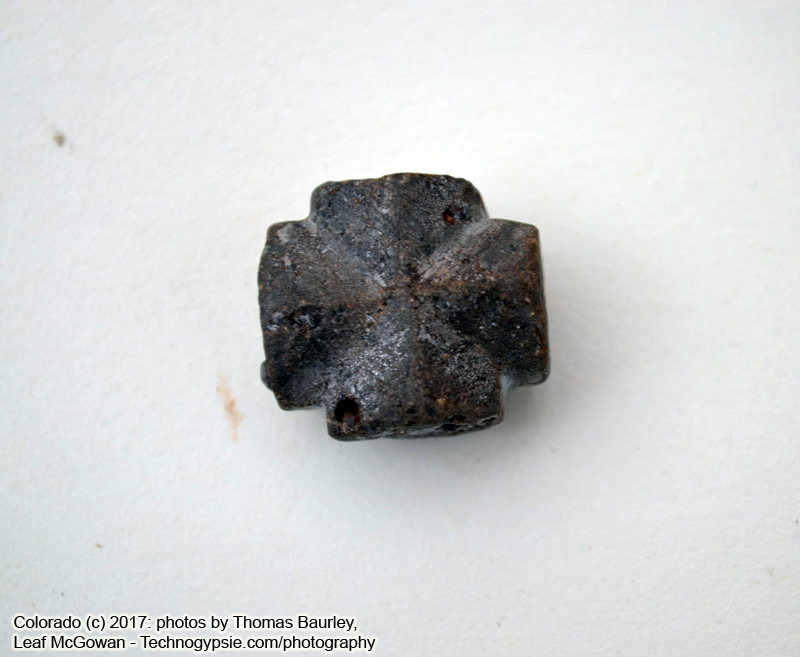
FC-005: Celtic Cross Fairy Cross from Taos, New Mexico.


Purchase one here

Fairy Stone / Fairy Cross / Staurolite

Localities: Fairy Stone State Park, Virginia, USA; North Georgia, USA; Little Falls, Minnesota, USA; Taos, New Mexico, USA; Switzerland; Russia; Australia; Brazil; France; Italy; Scotland.

Description: Popular to its folklore and legends, this stone has a State Park in Virginia named after it as it is home to its namesake “fairy stones”. It is also the official stone of the state of Georgia in the USA. Most commonly shaped like Celtic crosses or the St. Andrew’s cross, as an “X” or as a “T” shaped Roman cross, and square Maltese crosses. Color of the Staurolite varies to the region it comes from but can be dark brow, brownish black, grey, or reddish brown.

Geology:Staurolite are a combination of silica, iron, and aluminum. A silicate mineral, with the Chemical formula of Fe2+2Al9O6(SiO4)4(O,OH)2, and a Strunz classification of 9.AF.30, possessing a monclinic prismatic crystal symmetry. It’s H-M symbol is (2/m), with a Space group of C 2/m, and a unit cell a = 7.86, b = 16.6, c = 5.65; ? = 90.45; Z=2. Coloring ranges from yellowish brown, rarely blue, dark reddish brown to blackish brown, pale golden yellow in thin sections with a subvitreous to resinous luster, white to gray streaks, transparent to opague diaphaneity. Specific gravity is 3.74 – 3.83 meas. 3.686 calc. Twinning is commonly as 60 twins, less common as 90 cruciform twins. Subconchoidal fracture, brittle tenacity, mosh scale hardness of 7-7.5. Common to have penetration twinning, or a characteristic cross-shape. It occurs with almandine garnet, micas, kyanite; as well as albite, biotite, and sillimanite in gneiss and schist of regional metamorphic rocks. It is only found in rocks once subjected to great heat and pressure. A rare mineral occurrence in nature, it is only found in certain areas of the world in the fairy cross or Celtic cross shapes. Each are unique and never are identical. True Staurolite crosses are hard enough to scratch glass.

Folklore: Named after the Greek word “Stauros” for “cross”, they are commonly known as “fairy stones” or “fairy crosses”. According to European and Christianity influenced Native American legend on the state park website, “hundreds of years before Chief Powhatan’s reign, the fairies were dancing around a magical spring of water, playing with naiads and wood nymphs, when a elfin messenger arrived from a city far away bringing the news of the death of Christ. When these creatures of the forest heard the story of the crucifixion, they wept, as their tears fell upon the earth they crystallized into beautiful crosses”. During the first meeting of John Smith and Pocahontas, it is said the Indian princess gave John Smith a good luck charm made out of a “fairy cross”. Legend has it that Richard the Lionheart used them during the crusades to heal the wounded. Some say these are the tears of the Cherokee who wept over the loss of their homeland during the exodus on the “Trail of Tears”. Others talk of an ancient race of mountain faeries who were dancing at their favorite meeting places, and upon finding out that the “Great Creator” had died, shed tears, so moved, were crushed in heart and cried, as they wept their tears crystallized into the “fairy crosses”. Others say that during the defeat of the Tuatha de Danann and other faerie races when they were forced under-ground to live in the hills, the faeries around the world shed tears, made of Iron to represent the Iron Age destroying their race, in the shapes of crosses as an omen of the peopling that would destroy the planet next.

    Ay the charms of the fairy stone make you blessed
    through the days of labor and nights of rest
    Where ever you stay, where ever you go,
    May the beautiful flowers of the good Fairies Grow.
    ~ Little Falls Minnesota web page

Well known that Presidents Theodore Roosevelt, Wilson, Thomas A. Edison, Colonel Charles Lindbergh, and other prominent people carried one of these on their person(s).

Magical uses: For centuries these were believed to protect the wearer from sickness, accidents, disaster, and witchcraft. Used to find lost objects. Placed under the pillow to help induce lucid dreaming and astral travel. Used as amulets for good luck. Used to aid stress, anxiety, fear, considered soothing energy, and helpful with grounding. Many believe they embody an energy that will help you make contact with faeries or nature spirits. Some believe wearing the stones will help one stop smoking. Astrologically associated with Pisces. Associated with the base chakra. Healing qualities, good luck, rituals, protection, fever, defeat of malaria, stress, depression, addictive personality traits, time management, smoking cessation.

By Thomas Baurley, Technogypsie Productions and Research Facility.

(more…)


Tiveragh Fairy Hill (Cushendall)

Tiveragh Hill / Fairy Hill of Cushendall, Northern Ireland. June 2, 2012:
Irish Folklore Quest – Northern Ireland, UK. (c) 2012 – photography by Leaf McGowan/Thomas Baurley

The Tiveragh Fairy Hill
Cushendall, Northern Ireland

Legend and lore have it that this very broad-sided hill with steep sides overlooking the small village of Cushendall in Northern Ireland is the gateway to Tir na nOg. A place very well known locally to be haunted by faeries, leprechauns, elves, and pixies … this giant hill is a natural fortress all on its own and easily seen to be claimed as a stronghold by the fae.

Fairy tales mention many stories about it rising on pillars during the twilight evening with a glimmering merriment of faeries frolicking and dining. Many believe that the wee folk live in this hill accessed by a nearby cave. As the warning goes, if ye are mortal, regardless of how appeasing the faerie music may sound, if you wander within, you’ll never be seen again on this plane of existence. Time holds a whole different rhythm in Faerieworlds.

We, however, of fae persuasion, did venture up the hill at the turn of twilight just as the sun went down. We spied the hill with visions of faerie impressions while across the valley atop Ossian’s Grave – the Megalithic tomb believed to be the burial spot of the fabled poet and bard Oisin. Now Oisin was lured into fae, into Tir na nOg, where he lived until he requested to return to the land of mortals to visit his family. Of course due to faerie time, he returned several hundred years later to find them all gone and deceased. He fell off his faerie steed and became a blind old man wandering these fields, eventually dying.

If the faerie tale is accurate, this would be the hill he would have ridden out of, and across the valley would have been his grave overlooking it … curious and more curious. Midway along the way up the base of the hill is one of the most magnificent Faerie Thorn Trees I’ve ever encountered. As usual with these faerie hills, I always find a wee hole just big enough for the Victorian-sized fae to enter within, usually lined with heavy rocks, making it look peculiarly like a miniature mine rather than an animal hole.

We climbed atop as the sun went down, empowered by the feelings of the ancient ones. Archaeologically, though, this may be a massive hillfort. I’m looking for those records and will post my findings here.

And their playing pitch was hardly as big
As my Uncle Barney’s potato rig;
And me there watchin’ them puck and clout
At the back o’ the wall with my eyes stuck out.

When all at once, like the squeal of a hare,
A wee voice shouted, “Who’s that up there?”
And a bit off a thing about nine – inch tall
Came climbing up to the top of the wall.

And he stood there; he stood about pot -size
With his two wee fingers up at my eyes,
And its God’s own truth that I’m speakin’ mind ye,
“Get out o’ that,” says he, “or I’ll blind ye!”

Aye that’s what he said, “I’ll blind ye,” says he,
And by Jing what he said was enough for me,
Did I run? Aye surely; I didn’t miss –
And I haven’t seen Tiveragh from that to this.

~ H.Browne

The Fairy Hill Tiveragh is a fairy hill and near to Cushendall,
And nobody goes there at night, no nobody at all.
The hill is small, the sides are steep.
And I have heard it said That flickering lights go in and out While everyone’s in bed.
And on the top two hawthorns grow, A white one and a red.

~ John Irvine Desmond

~ Yours truly, Leaf McGowan

Tiveragh Hill / Fairy Hill of Cushendall, Northern Ireland
(more…)


Shakefest 2012: May 26th – Charleville Castle, Tullamore, Ireland

2012 Shake Fest: Charleville Castle, Tullamore, Ireland

Shakefest 2012
May 26-27th, 2012 * Charleville Castle * Tullamore * Ireland * Shakefest.net *

This year will be Shakefest’s “7th” Annual Dance and multi-cultural festival held at the historic epic Charleville Castle. The festival grounds is starting to bustle with activity as preparations are in the flow to welcome local and international community, visitors, friends, and family to celebrate culture. Since 2006, Shakefest has been bringing together an eclectic mix of Middle Eastern, Cultural Dance, and Artistic Workshops ending with a multi-cultural evening of dance performances. This year, Shakefest is expanding into more folklore, diversity, performance art, crafts, and themes for all ages, sexes, and cultures. This year features numerous workshops, classes, performances, and activities such as a “Faerie Glen” to get lost in, A “Madhatter’s Tea Party”, A bouncy Pirate Ship, Indian Cuisine, Performances by Tullamore’s “The Red Embers”, Galway Bellydance, Appolonia Tribal Bellydance, Sheeoneh, Nicole Volmering, and Aoife Hardiman.


Joana Saahirah ~ photo courtesy of Shakefest

This year’s International Guest Instructor is Oriental Dancer Joana Saahirah of Cairo, Egypt providing authentic education on Egyptian History and Folklore as well as Oriental Dance instruction in Classical, Saiidi and Alexandria of Mellaya styles. Declan Kiely will host a special workshop on how to “Dance like Michael Jackson”. Hip Hop, Jazz, Poi & Ribbon Dancing, Bachata and Argentinian Tango classes are also offered. There will also be African dance, poetry, open-mic sessions, a kid’s gigantic Dragonfly and butterfly hunt, punch and judy, juggling & stiltwalking by Stagecraft Ireland, Drum Circles, and a magic show. This year will also be breaking ground on a live history section with the KHI Medieval Re-enactors treating audiences to combat simulations of the Crusader’s Knight’s Templar with medieval tents, a full try-on armoury and archery for all ages.


KHI Medieval Re-enactors ~ photo courtesy of Shakefest

Featured musical performances by 40’s Swinging The Bugle Babes, Our Annual Multi-cultural Hafla, daring fire show by The Red Embers & Babylon’s Inferno, The North Strand Kontra Band from North Dublin. Dazzling Romanian and Bulgarian instrumental band is expected to finish off the fest with explosive energy and lively dance accompanied by original and traditional tunes from clarinet, saxophone, trombone, keys, banjo, double bass, and drums. If you’re travelling through Ireland this weekend or live in the magical isles, this event is not to be missed. Gates open at Noon on Saturday the 26th with admission only €10 general entry, €10 camping, €20 family day pass or only €15 for evening entertainment.  All proceeds will be going towards Charleville Castle Restoration Fund – Operation ‘Raise The Roof’ project in which money will be raised towards putting a protective roof on the castle chapel. We’ll be covering this event, so come back here for photos, review, and the stories we weave from the experience …


North Strand Kontra Band ~ photo courtesy of Shakefest


Archives

Categories