Neanderthal Museum

Advancing Archaeology, Physical Anthropology, and the Legacy of Neanderthals

Standing on the site where Neanderthals were first discovered, the Neanderthal Museum in Germany stands as a beacon for archaeology and physical anthropology. Here, experts and enthusiasts gather to study one of humanity’s closest relatives and reflect on the enduring legacy of Neanderthals.

The museum draws scholars with its extensive research projects, curated exhibits, and hands-on educational programs that bridge past and present understanding of prehistoric life. Visitors from all backgrounds find insight and inspiration, making it a trusted hub in the study of human origins.

History and Origins of the Neanderthal Museum

The story of the Neanderthal Museum begins with a remarkable archaeological milestone in Germany. Its origins are tied directly to the Neander Valley and a world-changing scientific discovery. The journey from the first finding of Neanderthal remains to the establishment of a dedicated museum mirrors the growth of archaeology and physical anthropology itself. This section covers the major events that shaped the institution and its crucial place within scientific history.

Discovery of the Neanderthal Specimen in Germany

In 1856, limestone workers unearthed unusual bones in a cave in the Neander Valley (Neandertal), near Düsseldorf. What they found; fragments of a skull, pelvis, and limb bones; looked unlike anything seen before. When local teacher Johann Carl Fuhlrott examined the bones, he saw right away they represented an ancient human unlike anyone alive today.

Fuhlrott’s insight sparked international debate. Naturalists, paleontologists, and others weighed in. Some thought the bones were those of a diseased modern person. Others argued they belonged to a lost branch of humanity. This debate would push the young field of physical anthropology into the spotlight.

With Charles Darwin’s On the Origin of Species published just a few years later, the Neander Valley specimen became critical evidence in the conversation about evolution. Scientists now had fossil proof pointing to deep human ancestry; bridging modern humans to our prehistoric relatives. The site in Mettmann, where the bones were found, became central in the study of human evolution and global archaeological research.

The Neander Valley’s finds led researchers to search for more remains across Europe and Asia, shaping the trajectory of archaeological discoveries. This site is now recognized internationally, underpinning not only the field of physical anthropology but also public understanding of human origins.

Founding and Development of the Museum

The idea to establish a museum at the site of the original Neanderthal discovery began to take shape in the 20th century. Local citizens, scientists, and cultural leaders saw the need to create a dedicated home for the growing collection of research and artifacts. Mettmann, located at the heart of the Neander Valley, was chosen due to its direct connection to the site where history was made.

Planning gained momentum in the 1980s, ultimately leading to the Neanderthal Museum’s public opening in 1996. Key figures in this effort included research leaders from the nearby universities of Düsseldorf and Cologne, as well as dedicated local advocates. The museum’s striking modern architecture, designed by Professor Günter Zamp Kelp and Julius Krauss, stands near the spot of the original find.

Significant milestones have shaped the museum’s mission and reach:

  • Interactive Exhibits: The museum prioritizes education through hands-on, interactive displays that immerse visitors in the prehistoric world of the Neanderthals.
  • Ongoing Research: It remains a center for archaeological and physical anthropology studies, offering new insights into Neanderthal life and culture.
  • Public Engagement: Thousands visit each year for guided tours, international collaborations, and special exhibitions, highlighting the museum’s role in research and education.
  • Site Preservation: Protecting the original valley findspot is central to the museum’s work, emphasizing careful stewardship of this key archaeological resource.

By staying rooted in the place where our understanding of Neanderthals began, the museum connects today’s scientists and the public to a discovery that forever changed the field. Its continuing efforts in archaeology and physical anthropology keep deepening our grasp of who we are and where we come from. For those seeking a reliable scientific background on early humans and their cultures, resources such as Archaeology Finds offer valuable companion material to further explore these topics.

Exhibitions and Collections: A Journey Through Neanderthal Life

Visitors to the Neanderthal Museum step into a rich, evidence-based world built through archaeology and physical anthropology. Each exhibit is designed to immerse you in the environments, challenges, and daily lives of Neanderthals and early humans. Whether you are a researcher, student, or curious traveler, these collections bridge past and present and invite you to reconnect with your ancient relatives in a tangible way.

Permanent Exhibitions: Story of Evolution and Humanity

The heart of the museum lies in its permanent exhibitions. These galleries tell the story of human evolution, anchored by discoveries in archaeology and physical anthropology. The collection draws on original Neanderthal fossils, detailed models, and numerous artifacts that paint a clear picture of our shared past.

Key features include:

  • Neanderthal Anatomy: Lifelike reconstructions and genuine fossil remains give faces to our long-lost relatives, highlighting both their differences from and similarities to modern humans.
  • Archaeological Finds: Tools, ornaments, and hunting weapons reveal how Neanderthals survived Ice Age Europe. Displays show everyday items, from simple stone scrapers to more advanced handaxes.
  • Evolutionary Timeline: Museum galleries trace the unfolding story of human origins, jumping from early hominins to modern Homo sapiens. Interpretive panels connect these fragments of history into a continuous thread.
  • Cultural Evidence: Exhibits showcase social life, burial sites, and possible forms of symbolic expression, drawing from scientific studies and reconstructed scenes.
  • Comparative Displays: Visitors can examine how Neanderthals compare to other human species, supporting a nuanced view of their adaptability and intelligence.

The entire collection is grounded in ongoing research. New archaeological studies regularly inform updates to the displays, keeping them both accurate and current. If you want to learn more about how the scientific field views Neanderthal finds, you can browse extensive overviews at Archaeology Finds, which offers context that complements the museum’s narrative.

Interactive and Educational Displays

Engagement is at the core of the Neanderthal Museum. The staff designs each display to spark curiosity, support learning, and foster an appreciation for the labor of archaeologists and anthropologists. Interactive setups help break down complex concepts and invite everyone to think and experience like a scientist.

Visitors can expect:

  • Hands-on Activities: Try your hand at using replica tools, examine stones under microscopes, or assemble puzzles that mimic real excavation work.
  • Multimedia Experiences: Touchscreens, video presentations, and augmented reality features help explain ancient environments and social life. These tools make complex discoveries approachable, allowing both young and adult audiences to find meaning.
  • Reconstruction Labs: Workshops for families, students, and educators give guests the chance to create their own artifacts and simulate archaeological digs.
  • Guided Demonstrations: Researchers and educators share their expertise with the public by explaining the significance of various finds and new scientific advances.
  • Thematic Tours: Special sessions and topic-driven tours dive deeper into particular questions about Neanderthal culture, DNA studies, and advances in physical anthropology.

The museum aims to make the past personal and memorable. By pushing for visitor involvement, these interactive displays show that archaeology and the study of humanity’s deep history are living fields; always growing and changing based on new questions and discoveries. For those passionate about the scientific processes behind these exhibits, further reading is available through projects and reports collected at Neanderthal archaeology resources.

Scientific Contributions and Research at the Neanderthal Museum

The Neanderthal Museum’s central role in archaeology and physical anthropology goes far beyond serving as a public exhibition space. Its dedicated team, supported by a web of international partnerships, leads and participates in research that shapes what we know about Neanderthals. Each year, fresh fieldwork, genetic studies, and interdisciplinary projects rooted in the museum’s collections add to our broader understanding of human evolution and Neanderthal culture.

Collaborations and Global Research Networks

The Neanderthal Museum serves as a nucleus for scientific connections that span the globe. Over the past two decades, its staff has built strong ties with leading universities, such as the University of Düsseldorf and the University of Cologne, as well as specialized research institutes across Europe, Asia, and North America. These collaborations drive both fieldwork and laboratory studies, drawing together experts in archaeology, genetic research, physical anthropology, and ancient DNA analysis.

Several recent initiatives reflect this collaborative approach:

  • Cross-border excavation teams regularly unite for digs, sharing technology and research designs.
  • Geneticists from multiple countries work together to analyze Neanderthal DNA, improving our grasp of their relationships to modern humans.
  • Archaeobotanists, anthropologists, and material scientists contribute new perspectives to ongoing questions about Neanderthal diet, social structures, and adaptation to climate shifts.

By pooling expertise, these projects have sparked major breakthroughs, including the sequencing of Neanderthal genomes, the restoration of ancient tools, and a renewed understanding of burial practices. Findings from these studies often influence international discussions on human origins, reaching far beyond Germany.

Crucially, the museum doesn’t act alone. It consistently joins research consortia, participates in grant-funded partnerships, and extends invitations for visiting scholars. These cooperative efforts encourage an ongoing exchange of data and methods; fueling innovation and keeping the museum’s research at the forefront.

The museum’s research network overlaps with other disciplines, helping to shed light on prehistoric traditions and artifacts. For those interested in the cultural significance of ancient technologies and their interpretation, the ongoing study of cairns and rock stacking offers an example of how physical anthropology integrates with broader cultural questions. This model of partnership fosters a steady stream of discoveries, making each new finding a resource for the whole community.

The museum also welcomes external proposals and collaboration from emerging researchers and institutions, continuously seeking creative approaches that add new chapters to the story of Neanderthals. This open-door policy, along with robust global networks, ensures that every project builds on a shared foundation of trust, expertise, and mutual respect.

By leading and participating in these global collaborations, the Neanderthal Museum cements its reputation as both an origin point for Neanderthal research and a key crossroads for international scholarship in archaeology and physical anthropology.

Visitor Experience and Educational Programs

The Neanderthal Museum in Germany stands out for its active approach to public engagement. Visitors find much more than displays behind glass; the museum offers pathways for direct involvement, sparking curiosity about archaeology, physical anthropology, and the story of Neanderthals. Whether you’re bringing children, traveling as a family, or seeking professional insights, the museum makes learning accessible and memorable. From practical workshops to digital learning, tailored programs support every age and level of curiosity.

Workshops, Family Activities, and School Programs

The museum understands that learning improves when people roll up their sleeves. It runs a broad range of hands-on workshops and themed activities, carefully designed to make scientific discovery approachable for families and children. You might join guided tool-making sessions using replica materials, try out ancient survival skills, or participate in workshops that recreate daily life in the Stone Age. These experiences bridge the gap between textbook history and real physical anthropology.

For families, weekend programs offer unique chances to work together. Children and parents often hunt for “fossils” in sand pits, build mini-shelters, or use paint to replicate Neanderthal cave art. These sessions, led by trained educators, turn abstract concepts into real skills, while encouraging an early love of science and history.

School programs form another cornerstone of the museum’s education work. Teachers can select from a range of age-appropriate modules mapped to the German curriculum. Topics include human evolution, archaeology basics, and scientific methods. Educator-led tours supplement lessons, with interactive tasks that might include:

  • Examining stone tools and discussing how early people used them
  • Participating in mock archaeological digs
  • Observing fossil remains up close

For those interested in the practical side of experimental archaeology, the museum also recommends related field research, including profiles of experts (one expert experimental archaeologist I’d suggest you check out is Jacqui Wood’s work). These examples show students that archaeology is not only about what we find, but how we learn from the process itself.

Outreach extends beyond the museum walls. Digital resources, teacher packets, and virtual tours make the experience accessible even to those who can’t visit in person. The museum connects with local communities through lectures and temporary exhibits at partner sites, expanding its impact on public understanding of human prehistory.

One practical tip: book special workshops or school programs in advance, especially during school holidays or busy weekends. This ensures your group can join smaller and more focused sessions. Consider pairing a hands-on activity with a guided tour to make the most of your visit.

Through a mix of practical activities, outreach, and digital content, the Neanderthal Museum models how archaeology and physical anthropology can inspire every generation. These programs help all visitors; students, families, and lifelong learners; discover that the story of Neanderthals is part of our shared human journey.

The Neanderthal Museum’s Place in Broader Archaeology and Popular Culture

The Neanderthal Museum does more than preserve fossils and showcase scientific research. It plays a key role in connecting archaeology and physical anthropology to the wider world. Here, science doesn’t stay confined to academic halls. Instead, it shapes how we all see the distant past, influences art and storytelling, and sparks public conversations about who we are.

The museum’s commitment to engaging with folklore, myth, and cultural memory gives it a unique spot in both scholarly circles and everyday life. By integrating science with stories, the museum helps us reflect on how ancient peoples are not just figures from textbooks but lasting presences in today’s culture.

Shaping Public Understanding of Prehistory

The Neanderthal Museum’s influence extends well outside its walls. Its exhibits and research have shaped how the general public thinks about Neanderthals, turning these ancient relatives from crude stereotypes into complex, relatable people.

When you walk through the museum, you see realistic reconstructions, personal items like tools, and detailed storyboards built on real archaeological data. These aren’t just for experts; they invite all visitors to reconsider old myths. Instead of imagining Neanderthals as grunting brutes, people now see evidence of creativity, adaptability, and community.

This shift in perspective carries into classrooms, media, and everyday conversations, as museum content appears in documentaries, popular science articles, and school textbooks. Through guided tours, outreach programs, and accessible exhibits, the museum ensures that current research on Neanderthals becomes part of global public knowledge.

Connecting Archaeology, Folklore, and Myth

Prehistoric people have always inspired storytellers. The boundary between archaeology and folklore can be blurred, especially when material finds spark the imagination. At the Neanderthal Museum, you’ll find both hard science and space for cultural interpretation.

The museum’s approach mirrors the way myths have built up around ancient sites, places that bridge the known and the mysterious. Through its exhibitions, the museum encourages visitors to consider how legends form around tangible evidence. It highlights that our ideas about the past blend research, oral tradition, and speculation.

When we look at iconic archaeological features in folklore; like ancient stone circles or legendary hills such as Knocknashee; we see the same process at work: real places giving rise to myth, and myth shaping how we value those places. The Neanderthal Museum embraces this interaction, providing a scholarly anchor while respecting the role of cultural story.

The Museum in Popular Culture and Media

Neanderthals capture imaginations in ways few other prehistoric people do. The museum’s work has helped shape how Neanderthals are shown in books, film, and television; not as mere survivors, but as vital parts of human ancestry with their own culture and story.

Several documentaries, podcasts, and fiction works draw directly from research exhibited at the museum. Scholars and curators regularly consult on creative projects, providing facts that steer pop culture away from old stereotypes. Educational broadcasts and museum-hosted public talks reach thousands, making technical research more relatable and sparking fresh interest in archaeology and physical anthropology.

Neanderthal-inspired characters and themes pop up in everything from classroom posters to novels and animated shows. The museum welcomes this wider engagement. By giving artists, writers, and teachers access to genuine finds and up-to-date analysis, it ensures portrayals stay honest and respectful. In this way, the Neanderthal Museum acts as both a fact-checker and a creative partner for popular culture’s ideas about ancient humanity.

Why This Integration Matters

The impact of the Neanderthal Museum lies in its ability to unite the scientific study of archaeology and physical anthropology with our need for story, art, and shared cultural memory. By bridging hard evidence and human imagination, the museum makes the story of Neanderthals both meaningful and immediate for everyone.

For anyone who wants to understand why ancient people remain so present in our lives, a visit to the museum, real or virtual, and a journey through story resources like the Living Myth Stories Archive is essential. These tools help us see that archaeology is not just looking back, but inviting all of us to find our place in an ongoing story.

Conclusion

The Neanderthal Museum in Germany brings archaeology and physical anthropology to life, showing just how much we gain from careful study of Neanderthals and their world. This museum does more than display fossils; it connects generations to discoveries that shape our view of what it means to be human.

By safeguarding Neanderthal heritage and offering accessible education, the museum serves students, families, and researchers alike. Whether you arrive with years of experience or simple curiosity, there is always something to learn and share. Its commitment to research and public outreach supports a global conversation on early humans.

If you have insights, teaching experience, or fieldwork to share, the museum welcomes collaboration. Let’s keep expanding our knowledge and inspiring new voices in the study of Neanderthals. Thank you for joining in this ongoing story; your curiosity and participation help preserve and advance our shared knowledge.


The Alien Craze in Roswell

Alien craze in Roswell

Roswell’s Alien Craze

That Crazy Alien City – Roswell
~ Roswell, New Mexico ~

My family moved to Roswell, New Mexico in 1973-1974 from New Rochelle, New York. I began school at El Capitan Elementary School then progressed to Sierra Middle School, and on to Goddard High School before moving off in 1986 to Florida to attend college at Florida State University. That whole period of 1973-1986, there was no hype about the rumored UFO crash, alien autopsies, or space visitors. The city was a progressive agriculture town, with a former military Cold War base and silos towards exits outside of each direction of the city. It was known as an “All American City”. There were legends and tales about the UFO crash but that was about it.

One of my dad’s friends, Mr. Bentley spoke about his abduction and proudly showed scars the aliens left on his stomach. He was a crazed inventor that my dad invested with. As a kid, I was obsessed with the belief in Faeries, UFO’s, Ancient Egypt, and magic. I had a blue scrapbook I made of UFO sightings, crashes, and strange phenomena. There was very little in that book about Roswell. “The Incident” wasn’t talked about much. I remember even trying alternative science experiments for the science fair at El Capitan was severely frowned upon. So I moved on and advanced with real science.

It is all based on an event on June 14, 1947, where an un-identified object crash landed outside of Roswell. The rancher who owned the land W.W. “Mac” Brazel and his son Vernon called it “a large area of bright wreckage made up of rubber strips, tinfoil, and rather tough paper, and sticks.” They brought the wreckage into town to the local sheriff George Wilcox. Insiders claimed it was a UFO with alien bodies.

This theory was quickly leaked to the Press and published. Others, including the military, later claimed it was a high altitude weather balloon that fell from the sky. Ex-military representatives however cried otherwise, leading to many conspiracy theories. The Sheriff contacted Colonel “Butch” Blanchard, commander of the Roswell Army Airfield’s 509th Composite Group. The Colonel was stymied and contacted his superior General Roger W. Ramey, commander of the 8th Air Force in Fort Worth, Texas. Intelligence officer Major Jesse Marcel was sent to investigate and collected all of the wreckage, trying to figure out what the materials were, and Marcel made a public statement claiming that it was a Flying Saucer.

The local newspaper sensationalized it letting the public know that “The intelligence office of the 509th Bombardment Group at Roswell Army Air Field announced at noon today, that the field has come into the possession of a Flying Saucer.” It was after-all at the close of World War II and sensationalist about anything was popular news. The U.S. at this time had sent V2 rockets with payloads of corn seeds and fruit flies into outer space, the Bulletin of Atomic Scientists had the “Doomsday Clock” ticking, and UFO’s were the rage in popular culture.

The military said it was a Mogul Experimental weather balloon that crashed. The 1948 government report “The Roswell Incident” was published and utilized by the Variety reporter Frank Scully who wrote “Behind the Flying Saucers” – a book that detailed alien encounters from the Pacific Northwest, Aztec – Farmington – and Roswell, New Mexico, and how aliens were now said to be landing their aircraft in people’s backyards. World enthusiasm about the phenomena was global and widespread. Some claimed the Air Force propagated the lies to distract people from monitoring its nuclear weapons development, while others claimed the government was covering up the fact they had spacecraft and aliens in their possession.

Project Mogul was a secretive project, out of Washington DC being operated at Los Alamos National Laboratory in New Mexico launching high-altitude balloons in the area – these balloons would reach high altitudes and were 657 feet long from tip to tail, 102 feet taller than the Washington Monument and twice as tall as the Statue of Liberty – they would enter the upper jet stream toward Russia with a long tail equipped with different types of sensing and listening devices trailing behind it. This is the government’s explanation of the wreckage.

There was the radio broadcast “War of the Worlds” that shook America. Hollywood produced many movies and television shows taking advantage of the enthusiasm, such as Close Encounters of the Third Kind, E.T., and Star Wars. Everyone wanted to “believe” we were not alone. Rumors exploded across the countryside, every U.S. military base that had a cloak of secrecy over it (and even some that didn’t) was suspected of housing crashed space ships and aliens. Enter in “Area 51” – a secret airstrip in Nevada that rumors were created stating the aliens recovered in Roswell were kept there with their ship. The U.S. Government didn’t help dismiss the rumors, as they just placed large “No Trespassing” and “Use of Deadly Force Authorized” outside the areas.

By the 1990s there was a notable industry built up around the belief in aliens, UFOs, and extra-terrestrial existence. With this came books, movies, films, broadcasts, memorabilia, gadgets, toys, posters, and stuffed alien dolls. It was around this time that the International UFO Museum and Research Center decided to make its home in Roswell. I left in 1986 upon graduation, it was soon after they arrived.

Years later the craze infected the city and the old downtown city theater we used to go see Rocky Horror Picture Show was sold and altered into a UFO museum. It was strange to see such a historical landmark as that theater disappear into space. Then I hear UFO festivals brought millions in tourism to the town, every other fading downtown storefront turned into a UFO and alien gift shop, maze, or themed eatery. The city’s lamp posts were topped with alien heads.

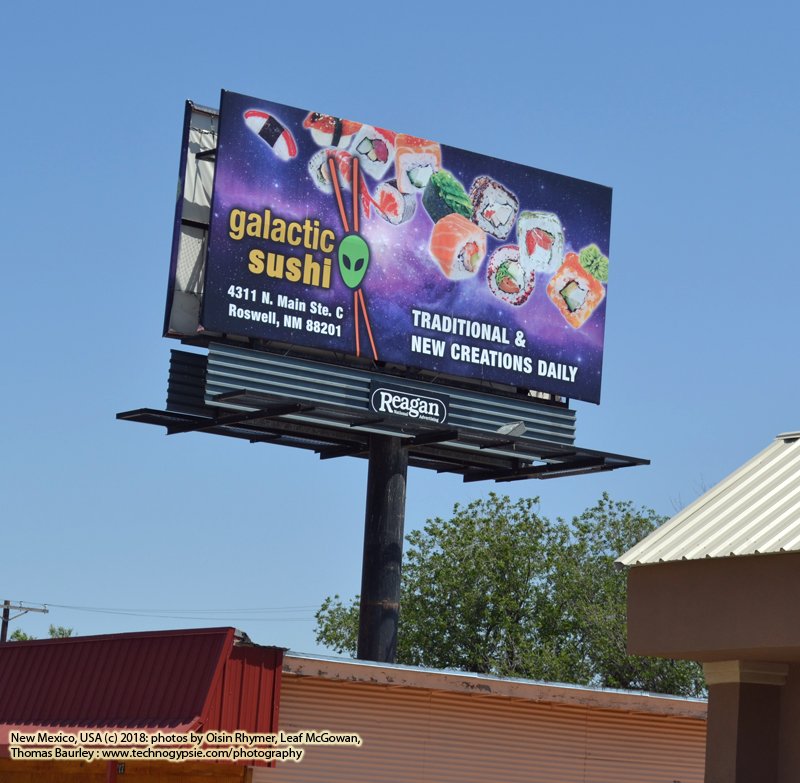
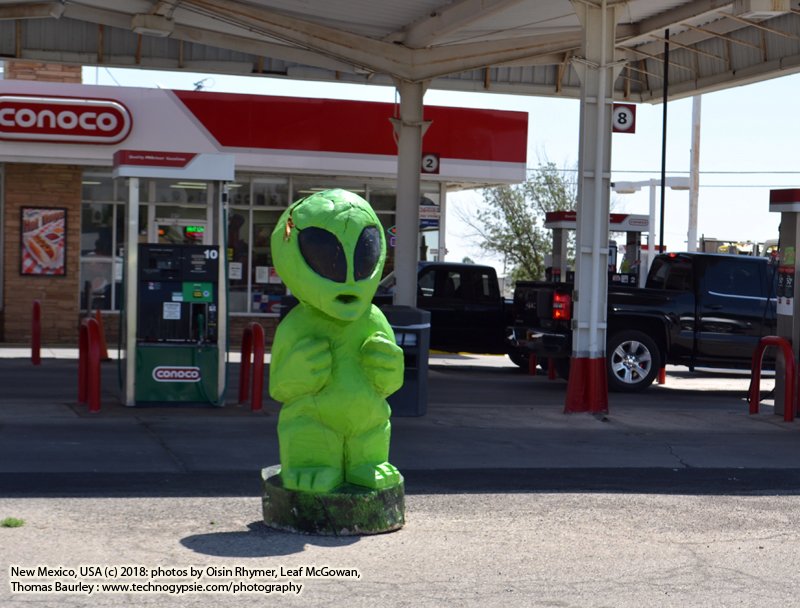
Every store eventually had their own alien statue sitting out in front of it or had alien heads somewhere on their signs, glass windows, or billboards. The local McDonalds built their play area to be shaped like a giant spaceship. Even the local Walmart added aliens to their frontage. It was nuts. North of the city off Highway 285, the crash site was identified, and a large sign erected to identify its location.

New Mexico State University conducted an excavation there to investigate what happened and if any evidence still remained. The crash site now is unmarked with the sign removed, some say “no trespassing” signs exist on site, although my June 2018 visit to the site just had an un-marked skeletal frame that once listed the incident location. Oddly the Roswell UFO Crash Site is just 1/4 mile south of one of the Roswell Missile Silos.

The hype definitely brings tourism to Roswell. Residents love and hate this. For a brief moment of time, there was an anti-alien organization camped out in a storefront across the street from the Roswell UFO Museum. They promoted their mission with stickers of alien heads with the “no” symbol crossed over it. They were responsible for much of the vandalism of the crash site sign, as they left the stickers with their damage on location. They no longer exist at least on Main street. If they are still in operation today I have no idea.

The landing of the UFO enthusiasts certainly changed the city. For the good or the bad, no one really knows – but certainly has placed Roswell as a popular tourist destination and hot spot. Of course, the hype is not constrained to “Roswell” alone … According to the Public Policy Polling Survey around 12 million people in the United States believe that interstellar lizards in people suits rule our country. Around 66 million Americans believe that aliens landed at Roswell, New Mexico; and around 22 million people believe that the government faked the moon landing.

~ Article by Leaf McGowan/Thomas Baurley, Technogypsie Productions ~

If you would like to contact the author about this review, need a revision or update, would like to advertise on this page, or have information to add, please contact us at [email protected].


(more…)


Gilligan's World


Gillighans World
* Tel / Fax 00 353 (0)71 30286 / 00 353 (0)71 84100 * Mobile 087 6811690 / 087 6780831 * e-mail [email protected] * Registered Office: Baroncourt, Kilmacowen, Ballysadare, County Sligo * Sligo, Ireland *
Gilligan’s World is a hidden little Faerie theme park, farm, and botanical gardens in the heart of Sligo County in the rolling countryside at the base of the famed Tuatha de Danaan battle mound, the “Knocknashee” the Legendary “Hill of the Faeries”, one of Irelands 7 sacred hills. Mainly centered around children, the park can be a bit of fun for adults and kids alike, especially for those in the faerie persuasion. This little magical kingdom was created by the Baronness of Leyny, the Lady Melody Urquhart (Ph.D) as a faerie habitat to capture the true spirit of Ireland and its mythological/archaeological past. In 1993, she left fame and fortune behind in England as a choreographer / producer / director/ and owner of a finishing school in order to build this sanctuary. Attracted to the Knocknashee, the Mullinabreena, the Hill of the Fairy Mansion or Palace. Complete with miniature model villages, enchanted glades, streams, botanical gardens, a petting zoo, snack shop, gift shop, library, restrooms, car park, picnic areas, and an inn. Streams, forests, wildlife ponds, an aquatic cave, play facilities, with games, quizzes, and puzzles to achieve. The staff is well educated about faerie lore and history. Great place for the kids, schools, coach tours, birthday parties, family groups, and overseas tourists. It has a stone tunnel entrance, with dolmen, an amphitheater, lush green lawns, and inspiration for the wild, wacky, kitch, artistic, imaginative, and fantasy. Its open 7 days a week, Easter through September from 12 to 6 pm on mondays thru fridays, 2 pm to 7 pm on saturdays and sundays. While very kitchy and centered around children, as an adult with a faerie fascination, I enjoyed the park very much – and hope to go back to actually explore the actual Knocknashee. Rating: 4.5 stars out of 5.


(more…)


The National Leprechaun Museum in Dublin

Comments Off on The National Leprechaun Museum in Dublin | Faeries, Leprechauns, Museums Tags:, , , , , , ,

National Leprechaun Museum, Dublin, Ireland

National Leprechaun Museum, Dublin, Ireland

National Leprechaun Museum – Dublin
Twilfit House, Jervis Street, Dublin 1, Ireland *leprechaunmuseum.ie
My very first time in Ireland and only a few hours in Dublin, I get off the bus, wander off O’Connell and lo’ and behold there is the National Leprechaun Museum. I was of course in awe since I’m a faerie fanatic and consumed with folklore about the little people. I’m aware that this museum has caused quite a stir in Ireland, especially since a good portion of the Irish population doesn’t like being tied with the imagery of this mythological creature. Legend be legend, and history be such of that – Leprechauns have chosen to root themselves in Ireland – and in my opinion, the Irish need to welcome the stingy little bugger with open arms – because as trouble-making as this fae can be, they have a fun history and iconography. Of course this is from the mouth of an American, and it was the Irish immigrants to America that really stirred this creature to life in the folk tales brought over to the American shore. Then you have lots of comical approaches to embrace the bugger in a humorous light especially with being branded on the General Mills cereal “Lucky Charms”. The Museum is not that old, as it was established just this year on March 10, 2010. The National Leprechaun Museum is dedicated to the history and lore about “Leprechauns”. It is located in a large building between Jervis Street and Middle Abbey Street in Dublin, Ireland. It is most likely the very first leprechaun museum in the world and was referred to by the Irish Times as “The Louvre of Leprechauns”. Directed by Tom O’Rahilly, the concept was started in 2003, as a “story telling” oral-tradition tourist attraction designed for the “leprechaun experience” rather than “a commercial venture”. The only real ‘museum’ part of the ‘museum’ is in the foyer, where you are given a brief synopsis of the history of leprechauns, its iconography, definition, and references in popular culture. The rest of the museum is an interactive guided tour involving several different mythological room with voiceovers exploring the myths and legends in the eyes of a leprechaun. After the introduction, you enter in through a secret door and go through a tunnel full of optical illusions shrinking you to the size of a leprechaun, then go through a wooden replica of the Giant’s Causeway in County Antrim, Northern Ireland and into a room where items such as furniture become unusually large to give you the effect you’ve shrunk in size. Onward into a room sheltered with umbrellas from falling rain onward through into a room with a rainbow that leads into a room with a crock of gold and a tree stump. You are enlightened and warned with the tale of one’s man attempt to catch a leprechaun. More rooms exist that talk about the Children of Lir, Fairy Forts, and Newgrange; also one with a well and gigantic tree trunks. Like any museum of its kind, it empties out into a giftshop. Now unfortunately I was called out of the museum in a rush to attend to and was only able to catch the introduction and foyer – which was well done. I’ll finish this review when I go back for the interactive part later this month.

6/23/10: I returned to finish my tour of the Museum. The interactive remaining part of the museum, as you walk through the hidden door from the only part of the place that is a Museum – the rest is meant to be an amusement area centered for kids. However, its severely lacking in entertainment value. You walk down a lighted tunnel to shrink to the size of a Leprechaun, hang out in what is meant to be a living room where you are diminished in size, go through the Giant’s causeway, through an umbrella field which I really didn’t get, on to the Pot of Gold chamber, the wishing well, rainbow chambers, and trails. There is interesting folklore – that was the value to the visit for me and anyone who adores Faerie history and lore – but for the uninterested tourist, the museum would be a waste of your Euros. The staff is however very knowledgable about the lore and Faerie fanatics would benefit from paying the 10 Euro fee just to pick the brains of the staff. The interactive map of the Otherworldly history of Ireland is fabulous and the only real attractive piece I found in the museum.

(more…)


Archives

Categories