Skip to content

Faerie Lore and Legends

Exploring the Unknown, Myths, Lores, and Legends

Faeries
Lost Girl: Season 1
January 8, 2011
Art and Sculpture
Navajo Spring (Manitou Springs, CO)
October 12, 2024
Faeries
The Otherworld, The Underworld, The Sidhe
August 25, 2010
Media, News, Tales
Irish-language Zombie Comic Book
March 1, 2015
Dragons
Real life dragon discovered : SciencePunk
December 9, 2011
Ghosts
The Brennivin Ghost
October 1, 2012

Hag of Beara Stone

Posted on June 10, 2024 By Techno Tink No Comments on Hag of Beara Stone
Cyclops, Faeries, Giants, God/desses, Living Myth, Mythology, Sacred Sites, Sidhe, The Fomorians, Tuatha de Danann

Driving the Ring of Beara in West Cork/County Kerry, Ireland I came across the infamous “Hag of Beara” stone – also known as An Chailleach Bhéara or the White nun of Beara, The Cailleach, “Hag”, “Old Crone”, or Old Woman of Dingle. In Irish lore, she is known as the Cally Berry or Cailleach Bheara.  

The Ballycrovane Ogham Stone of Beara

Posted on May 13, 2024 By Techno Tink No Comments on The Ballycrovane Ogham Stone of Beara
Sacred Sites, Sidhe, Tuatha de Danann

At this point in my journey, I was bouncing between West Cork and County Kerry, so I apologize for any content stating that this standing stone is in Kerry – it’s in West Cork. As I spied on the map, an Ogham Stone was outside of the Ballycrovane quay, so I took a gander. It is in the backyard of a private cottage with very few parking places without blocking the residents. They have an iron gate with a 2 Euro donation box to wander up to see the stone firsthand. It is a massive pointed granite monolith atop a hillock overlooking the Ballycrovane Harbour, standing approximately 17 feet tall. The Ogham inscription purports to say, “Son of Deich descendant of Torainn” (MAQUI DECCEDDAS AVI TURANIAS). There is also a modern national monument declaration plaque below.

Stone Circles

Posted on March 29, 2024 By Techno Tink No Comments on Stone Circles
Haunted Locations, Living Myth, Mythology, Religion, Sacred Sites

by Thomas Baurley, Archaeologist and Folklorist

Stone Circles can be found worldwide but are most notorious in the British, Irish, and Scottish landscapes. Stones can be small, medium, and large, often dug into the ground as deep as they rise above the ground. A Stone Circle is a circular ring of stones, often with a defined entrance between two stones, with arrangements often related to the path of the rising and setting sun or the moon at sacred times of the year or in geographic alignment with other sites, hills, and circles.


Uragh Stone Circle and Famine Cottage, County Kerry, Ireland

Generally, however, stone circles are believed to be used by ancient peoples for magic, ritual, religion, astronomy, burials, and gatherings. Some have been used as tombs. In all reality, most of them do not know the true purpose as most stone circles belong to past people who did not leave behind written explanations or histories. Some stones have been inscribed with symbols, Ogham, and inscriptions. Much of what has been written about stone circles is from antiquarians, mystics, anthropologists, archaeologists, historians, and religious zealots. Generally, they are believed to have been used for multiple purposes – most commonly thought were religious or ceremonial, burials, and community gatherings.

Many stone circles have been recorded to possess lunar and solar alignments or astrological mapping. Some have called them solar and lunar observatories used by the ancients. Often, they are primarily a circular geometry with usually an empty center. Though altar, sacrificial, or standing stones are found in the center of many. Stones in Britain, Scotland, and Ireland have been recorded and estimated to have been erected roughly 3000-2500 B.C.E. (Before the common era) during the Middle Neolithic (3700-2500 B.C.E.). Others are dated to the Late Neolithic and the Bronze Age.

They were abundantly built in coastal and lowland areas, especially in the northern part of what is now known as the United Kingdom. Stonehenge and Avebury are the most famous European stone circles, built around 3100 BCE. There have been recorded over 1303 stone circles in Ireland, Brittany, and Britain. Largest numbers were found in Scotland at 508 sites, 316 in England, 187 in Ireland, 156 in Northern Ireland, 81 in Wales, 49 in Brittany, and 6 in the Channel Islands.

The oldest stone circle, however, is the Gobekli Tepe in Anatolia, Turkey, estimated to be approximately 9,000-12,000 years old. In Europe, stone circles are often attributed to having been built by Druids. There is faint realism there; however, although celebrants of Druidic religions have built many stone circles (even modern ones), the most notorious historic circles are pre-Celtic and pre-Druid. Still, they may have been taken over through time by those of the Druid faith. Many modern-day Pagans claim them as their spiritual centers, as many are tied to the Equinoxes and Solstices. Outside of modern recreated stone circles like Maryhill Stonehenge, there does exist indigenous stone circles even in the United States – such as the Ellis Hollow Stone Circle in Ithaca, New York, which is located in a nature preserve, consisting of 13 standing stones arranged in a circle about 30′ in diameter. It is believed to have been placed there by people from the Late Woodland period around 1000 B.C.E.

Mythology and Folklore
In British and Irish folklore and legend, stone circles are notorious for being the haunt of faeries. Some say they are remnants of people turned to stone for dancing during the Equinoxes, Solstices, or Sabbaths. Burial mounds at, in, or near them are believed to be entrances to the Otherworld or the Land of the Fae. Most stone circles, especially in Europe, have supernatural tales associated with them, ranging from sightings of beings varying from Druids, Witches, Banshees, Hobs, Giants, boggarts, leprechauns, spectral figures, and phantom black doors on the moors.

Many artifacts have been found associated with stone circles from religious, ceremonial, habitation, and/or burial. Prehistoric lithics, flints, and stone weapons are often found around these circles. In European lore, these lithics were often called Elf Shot and believed to have been made by Elves that were fired at humans in the past.

References:

  • Ancient Ireland 2024 Uragh Stone Circle And Lake Of Gleninchaquin. Ancient Ireland Tourism. Website referenced 3/28/24 at https://www.ancientirelandtourism.com/uragh-stone-circle-and-lake-of-gleninchaquin/
  • Bretgaunt 2021 Dancing stones and peeing giants: the folklore of ancient sites in Derbyshire. BUXTON MUSEUM AND ART GALLERY. Website referenced 3/28/24 at https://buxtonmuseumandartgallery.wordpress.com/2021/12/10/dancing-stones-and-peeing-giants-the-folklore-of-ancient-sites-in-derbyshire/#:~:text=Stone%20circles%20and%20standing%20stones%20were%20often%20the%20haunt%20of,otherworld%20and%20the%20fairy%20kingdom.
  • Burgoyne, Mindie 2023 Drawn to the Mystery of Ireland’s Stone Circles. Website referenced 3/28/2024 at https://travelhag.com/stone-circles/
  • 2011 Uragh Stone Circle on the Beara Peninsula – Enchanting. Thin Places Mystical Tours. Website referenced 3/28/24 at https://thinplacestour.com/uragh-stone-circle/
  • Byron, Susan 2024 Uragh Stone Circle. Ireland’s Hidden Gems. Website referenced 3/28/24 at https://www.irelands-hidden-gems.com/uragh-stone-circle.html
  • Clarice 2021 Uragh Stone Circle: Magical Ireland. Nourishing Ireland. website referenced 3/28/24 at https://nourishingireland.com/uragh-stone-circle-magical-ireland/
  • Hannon, Ed 2020 Uragh Stone Circle, Kerry, Ireland. Visions of the Past. website referenced 3/28/24 at https://visionsofthepastblog.com/2020/07/22/uragh-stone-circle-kerry-ireland/
  • Irish Archaeology 2024 Uragh Stone Circle. website referenced 3/28/24 at https://irisharchaeology.org/uragh-stone-circle/
  • Megalithic 2024 Uragh NE – Stone Circle in Ireland (Republic of) in Co. Kerry. The Megalithic Portal. Website referenced 3/28/24 at https://www.megalithic.co.uk/article.php?sid=3528
  • Larson, Celeste 2022 Reflections from Uragh Stone Circle, Ireland. Mage by Moonlight. Website referenced 3/28/24 at https://magebymoonlight.com/uragh-stone-circle/
  • Tripadvisor 2024 Uragh Stone Circle. Trip Advisor. Website referenced 3/28/24 at https://www.tripadvisor.com/Attraction_Review-g4045372-d8787688-Reviews-Uragh_Stone_Circle-Tuosist_County_Kerry.html
  • Unknown 2024 Uragh Stone Circle. Megalithic Ireland. Website referenced 3/28/24 at http://www.megalithicireland.com/Uragh%20Stone%20Circle.html
  • Wikipedia 2024 Uragh Stone Circle. Wikipedia. Website referenced 3/28/24 at https://en.wikipedia.org/wiki/Uragh_Stone_Circle
Read More “Stone Circles” »

The Fairy-Go-Round Ring Fort, Dingle Peninsula, Co. Kerry, Ireland

Posted on March 6, 2024 By Techno Tink No Comments on The Fairy-Go-Round Ring Fort, Dingle Peninsula, Co. Kerry, Ireland
Faerie Hills, Faeries, Living Myth, Mythology

A tourist-attraction with a petting farm, this privately owned attraction is 10 km west of Dingle in the parish of Kilvickadownig. Its along the world famous Slea Head Drive.  This Ring fort, also known as a “Rath”, “Lios”, or “Fairy Fort” is a circular ancient pre-Celtic settlement

Mass Rocks

Posted on February 19, 2024 By Thomas Baurley No Comments on Mass Rocks
Haunted Locations, Living Myth, Religion, Sacred Sites, Traditions

Mass Rocks: Generally, a “Mass Rock” was used as an altar in the mid-17th century for Catholic masses in Ireland and Scotland or regions where the Protestants persecuted the Catholics.

Tobar Ghobanatan

Posted on January 21, 2024 By Techno Tink No Comments on Tobar Ghobanatan
Living Myth, Religion, Sacred Sites, Traditions

The holy wells and shrine of Tobar Ghobanatan in Ballyvourney, County Cork, Ireland

Ireland’s Last Witch Burning / Changeling murder: 1895 Bridget Cleary

Posted on December 25, 2023 By Techno Tink No Comments on Ireland’s Last Witch Burning / Changeling murder: 1895 Bridget Cleary
Adbductions, Changeling, Faerie Hills, Faeries, Living Myth

We’re talking about Ireland’s infamous last burning of a Witch or killing of a Changeling: that is the 1895 murder of Bridget Cleary in Ballyvadlea, Ireland. Her body was dumped in a shallow grave in a bog then relocated to an unmarked grave in a local cemetery.

Rag Trees and Money Trees

Posted on December 21, 2023 By Techno Tink No Comments on Rag Trees and Money Trees
Mythology, Religion, Sacred Sites, Traditions

Wishing Trees

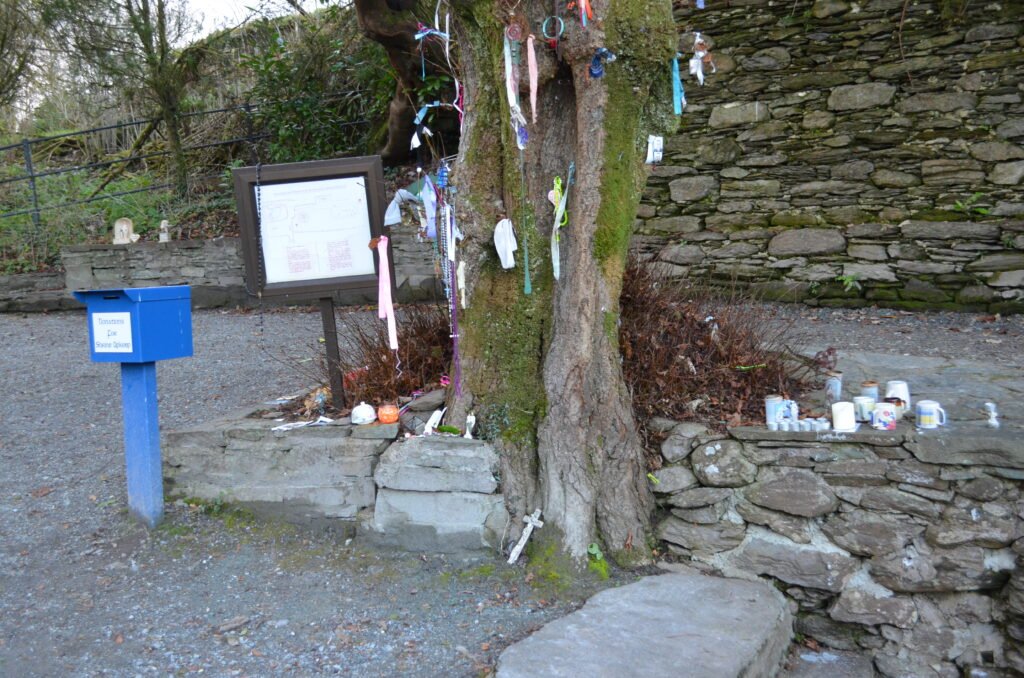
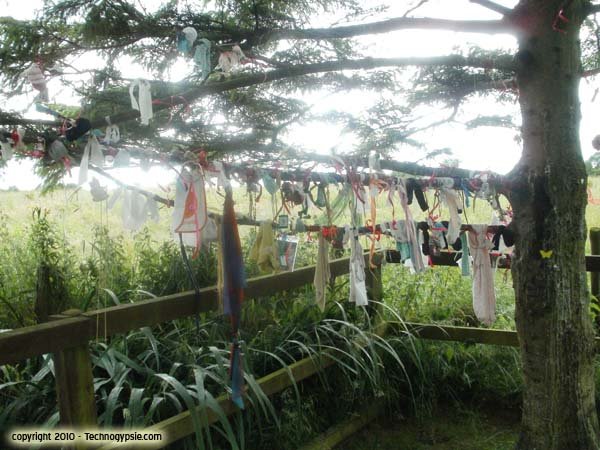
“Wishing Trees” are very common throughout Ireland, England, and Scotland. They are usually individual trees upon which “folk magic”, “folk spells”, “faerie offerings”, or “prayers” are offered. Sometimes it is particular to a specific species, where the tree lives, or how it looks. Many times they are associated with faeries or a particular Deity. They are very common alongside sacred wells in Ireland and the UK. The practice usually involves petitions or offerings made to the tree, a nature spirit associated with the tree, a Saint, a God/dess, or the ancestors with a request for a wish to be fulfilled.

St. Brigid’s Well, Kildare, Ireland

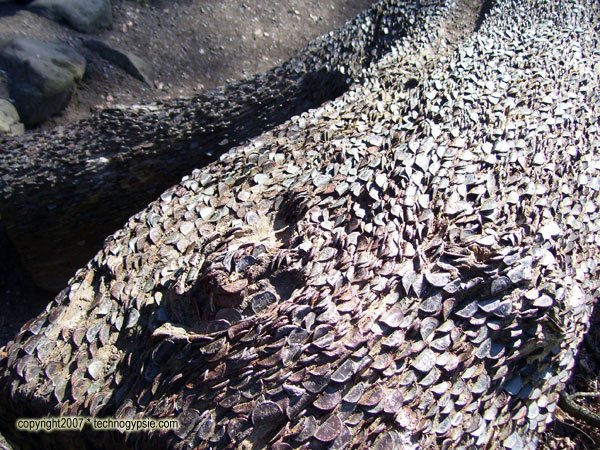
Coin trees involve the offering of coins to a particular tree. These are often hammered into an old trunk, branch, or small tree. Sometimes these are oaks, rowan trees, hawthorns, ash, or thorn trees. Some hawthorns serve for fertility magic such as a common one in Argyll, Scotland by the Ardmaddy House. Sometimes hundreds of coins are hammered into the bark and wood with the belief that a wish will be granted for each of the coins added. A similar one that is well known is the sacred well of Saint Maree in Loch Maree, Gairloch, Scotland which has hundreds of coins hammered into it. Also all over the Yorkshire Dales, such as in the pictures shown here I took during a hike, are found hundreds of coins offered to nature spirits and/or faeries for a granting of a wish.

Penny offerings for good luck and as gifts to the Fae "Wishing Tree" Yorkshire Dales, England

Clootie Wish Trees (a.k.a. Cloughtie or Rag Trees) are found next to sacred wells throughout England, Scotland, and Ireland. This involves the practice of tying a piece of cloth, often called “clouties”, “clooties”, or “cloughties” to ask for an answer to a prayer, a wish, and/or a petition. As the rag decays, so will the illness; or so will the petition come true. It is a form of sympathetic magic. One of the most well-known “wishing trees” is the Madron Well in Cornwall. With the Madron well, a sacred well of healing, it is believed that as the cloth rots, the ailment that one is seeking a cure for disappears. Even Charles Darwin recorded the finding of a “wishing tree” in his travels in Argentina called “Walleechu” which was treated by the local inhabitants as a Deity. It was festooned with offerings such as cigars, food, water, and cloth hung from the branches by bright strips of colored thread. Popular wishing tree in Hong Kong is the “Lam Tsuen Wishing Tree” near the “Tin Hau Temple” in Lam Tsu where paper tied to an orange and thrown up in the trees that stick will grant the petitioner a wish. The wishing tree next to Brigid’s Well in Kildare is a common tree for petitioning healing requests.

The Wishing Tree at Tobar Ghobnatan Holy Well
not only consists of rags, but trinkets, rosaries, jewelry, prayer cards, toys, personal effects, and other items given as offerings. You can see these at Tobar Ghobnatan Wishing Trees. The concept is to leave behind something of yourself or someone that you love that is in need of prayers, healing, or petitions. The concept with the rags is that when it decays so will the illness that it represents. This is a kind of sympathetic magical rite. Unfortunately, some pilgrims to the sites don’t realize how the spell or magic works. You can see this when they tie a piece of a plastic bag on the tree. Plastic will take forever to decay, so will the illness it is to represent. If only they knew! In addition to the rags, others leave coins, jewelry, ri

ngs, prayer cards, figurines, toys, personal effects, clothing items such as belts, shoes, garments, and trinkets. The cloutie and Wish trees found at Tobar Ghobnatan are considered to be dedicated to the Matron Saint of Ballyvourney and sacred Bee-Keeping mistress, Saint Ghobnatan holy pilgrimage site and monastic settlement known as “Tobar Ghobnatan”. This is the legendary home of St. Gobnait/Ghobnatan. It is located a kilometer south of the village of Ballyvourney where her church Móin Mór (a.k.a. Bairnech) was built.

Tobar Ghobnatan Holy Well  - County Cork, Ireland.
Tobar Ghobnatan Holy Well – County Cork, Ireland.

Read More “Rag Trees and Money Trees” »

Glastonbury Tor

Posted on June 7, 2022 By Techno Tink No Comments on Glastonbury Tor
Faerie Hills, Haunted Locations, Living Myth, Mythology, Sacred Sites

One of the most infamous landmarks of Glastonbury is the Tor. It is extremely popular in the Arthurian legends. The Tor is a tall hill that ascends over 158 meters from Glastonbury and hosts panoramic views of the English countryside, viewing the three counties of Somerset, Dorset, and Wiltshire.

Helltown (Boston, Ohio)

Posted on May 19, 2021 By Leaf McGowan No Comments on Helltown (Boston, Ohio)
Living Myth, Magic & The Occult, Media, News, Tales, Mythology, Wendigo, Witchcraft

One of the sites of interest to pop up on my radar was the government take-over eminent domain of a town formerly known as “Boston, Ohio”. It is now fabled in urban legend and called “Helltown.”

Posts pagination

Previous 1 … 3 4 5 … 21 Next

Categories

New Posts

  • Thunder Mountain
  • Area 51
  • The Old Tonopah Cemetery
  • The Clown Motel
  • Thomas the Rhymer / Tam Lin

Pages

  • About Faerie Lore ....
  • Donate
  • Newsletter

Archives

  • Home
  • About Faerie Lore ….
  • Evolution
  • Haunted Locations
  • Herblore
  • Magic & The Occult
  • Media, News, Tales
  • Mythology
  • Folk Songs
  • Giants
  • God/desses
  • Living Myth
  • Monsters
  • Otherkin
  • Prophecies
  • Shadow beings
  • The Undead
  • Urban Legends
  • Religion
  • Traditions
  • Newsletter
  • Donate

Copyright © 2026 Faerie Lore and Legends.

Theme: Oceanly News Dark by ScriptsTown