CHANGELING

One of the most common Fae species known in folklore … “Changelings” are faerie creatures that replace stolen human children. These are sometimes called an “auf” or “oaf.” In fairy lore and myth, there are many tales about fairies stealing a human child and substituting it with a misshapen fairy baby known as a “changeling.” Sometimes, they are replaced not by fairies but by demons, trolls, nereids, or spirits. Sometimes, they replace the child with a piece of wood that appears to be alive under a glamour for a short period of time.

Adults have been reportedly taken and replaced as well, especially in Ireland, Scotland, and Scandinavia. There is also the historic-day event of a man murdering his wife, Bridget Cleary, in Ireland. because they believed she was replaced by a changeling.

Throughout world lore, fairies, for some reason, like to kidnap human adults and children. Some claim the abducted human children are given to demons, faeries, or the devil or imbued into faerie races to strengthen their stock. Sometimes, newlywedded wives and mothers are taken. It is believed that some nursing mothers were kidnapped to provide milk to fairy children.

In the United States, there was an attested case of Miss Kittie Crowe who was believed to have been taken from fairies in 1876. It has been rumored that King Charles I of England (1600-1649) was a changeling as a nursemaid claimed a hooded figure appeared at his bedside and cast a cloak over his cradle with him in it.

The most targeted human victims are usually unbaptized babies, blonde-haired children, those with blue eyes, pretty girls, women touched by the fae, those found walking in a fairy ring, those wandering near fairy mounds at night, and anyone who sleeps under a hawthorn bush. In Catholic folklore, there is a widespread belief that infants are susceptible to demonic possession, which is why baptism is very important.

Changeling Traits

When a parent discovers the baby in their crib is not their own, for whatever reason, certain telltale signs signify it is a fairy surrogate. These changelings could have a deformed appearance, a wizened look, appear thin or weak, sickly or ailing, and not stop crying.

Adult changelings appear to have a voracious appetite, are aging, exhibit unfamiliar behavior and trickery, love dancing and frolicking outside when thinking they are alone not being observed by others, and often comment on their own age.

There is a myth in Ireland that a left-handed child is not human but rather a changeling. A child with a caul (remnant amniotic membrane) across their face was a changeling in Scotland.

Changelings are described as creatures that look like the humans they replace but are often sickly, aged, withered, or just “off.” Sometimes, they possess physical features rare in humans, such as an infant having a beard or long teeth. They come off as being more intelligent or gifted than those usual for their physical age appearance.

Sometimes, if a changeling is raised as a human child and is never detected, they will forget they are fae and continue living a human life. Those that do remember may return to their fae families leaving the human family without warning, while the abducted human may never return.

Around the World

While predominantly ascribed to the legends and lore of Celtic countries, their existence is described worldwide. In European folklore, they are seen as deformed or imbecilic offspring of fairies or elves. The Welsh call this fairy race the “cipenapers” (a contraction of kidnappers). In world folklore, there are many creatures similar to the “changeling.” Many of these are described as creatures left by spirits. They are mentioned in African, Asian, Germanic, and Scandinavian folklore.

In Scandinavia during the Medieval period, trolls were believed to trick humans into raising their offspring. They often targeted unbaptized children since those baptized were protected from trolls. In Scotland, it was said the replacement children gave fairy children a tithe to Hell as discussed in the infamous ballad “Tam Lin.” In Germany, they are called Wechselbalg, Wechselkind, Kielkopf, or Dickkopf. They are said to either be the devil, a female dwarf, a water spirit, or a Roggenmuhme (Rye Mother – a demonic woman living in cornfields and stealing human children). In the Anglo-Scottish border region of Scotland, it was believed that the faeries living in the “elf hills” would spirit away children and adults, taking them back to their world, and a simulation of the victim, usually by an adult male elf left to be suckled by the mother. The elves would treat the human baby well and raise it as one of their own.

In Poland, the Boginka or Mamuna was a Slavic spirit that would exchange babies with changelings that often possessed abnormally large abdomens, small or large heads, humps, thin arms/legs, hair body, and/or long claws. In Spain, it is often a nymph called Xana who would appear to travellers to help them. These little female fairies were born with enchanting beauty and would often deliver babies for humans that they’d swap with fairy babies because Xana could not produce milk. The Igbo people of eastern Nigeria believed that women in the tribe who lost numerous children were being tormented by a malicious spirit known as an ogbanje that reincarnated itself over and over.

Social scientists such as folklorist D.L. Ashliman claim that this myth illustrates the aspect of family survival in pre-industrial Europe. Families then relied on the productive labor of each family member to subsist, and there had to be a solution for those family members who drained the resources. Since changeling’s appetites were known to be voracious, they were seen as a threat to the family. Infanticide was sometimes utilized as the solution to this dilemma.

Some scientists claim that the “changeling” accusation would often be used to explain deformed, developmentally disabled, or neurodivergent children. Various legends have claimed those with symptoms of spinal Bifida, cystic fibrosis, PKU, progeria, Down syndrome, homocystinuria, Williams syndrome, Hurler syndrome, Hunter syndrome, autism spectrum disorder, Prader-Willi syndrome, and cerebral palsy were symptoms of a “changeling.”

As parents had higher expectations of childbirth and when children were born with ailments, they preferred to find a demon to blame for the ailment. Regressive autism has been compared to the marks of a changeling child. Before autism was defined and understood, it was very common for children possessing autistic traits to be labeled as elf-children or changelings because of their strange, inexplicable behavior. The obsession that faeries seem to have with an impulse to count things is now a trait found in autistic cases.

A network of humans today, known as “Otherkin” sometimes identify as being “changelings” (or elves, fairies, faeries, aliens, and were-creatures) often because their life experiences exist with feeling out of place in this world so much that they self-identify as being not human.

In movies, music, books, magazines, art, and literature there has been much focus on “changelings” and its phenomena.

Throughout the world, in folklore, there is a method of detecting changelings, such as eggshells. Arranging empty eggshells around a fireplace or hearth, a changeling can’t help but get up and examine them. They will peer into each other, saying, “This is but a windbag; I am so many hundred years old, and I have never seen the like of this.” Another method is for one to pretend that they are brewing water into the halves of eggshells. The changeling is said to jump up and declare, “I have seen the egg before the hen, I have seen the acorn before the oak, but I have never seen brewing in an eggshell before!” thereby revealing its age such as “I’m 1500 years old in the world and I’ve never seen a brewery of eggshells before!” Other methods are causing it pain or making it laugh. Many child abuse cases in Ireland have excuses that it was done only to reveal the changeling inside. In German and Irish lore, a changeling can be revealed by tricking it to believe its being heated or cooked in a oven. Also whipping, hitting, or abusing the changeling will sometimes force it out.

Füssli- Der Wechselbalg-1780

When a changeling reveals itself, lore states it’ll disappear up a chimney, and the real baby will be found alive and well outside the door or sleeping in its cradle.

Many spells and prayers exist to protect a child from a changeling. One method is leaving pieces of iron beneath the cradle, making rowan wood crosses with red thread, using St. John’s wort, or wrapping a child in its father’s shirt. Keeping an inverted coat or open iron scissors near the bed is also said to deter them. A red ribbon tied around the baby’s wrist or wearing a red hat would prevent an abduction in Poland. Not washing diapers after sunset, not turning one’s head away from a sleeping baby, and keeping a baby out of moonlight would also be protective measures.

In Cornwall, the magical stones known as the “Men an Tol” are believed to be guarded by a faerie who can return stolen children when the changeling baby is based through the stone.

  This article is a work in progress. Please return for more lore. 

Bibliography / Recommended Reading:


Changelings in Media and the Movies:

Changeling – movie, 2008 is about a changeling.

My Little Pony Friendship is Magic – children’s television series featuring shape-shifting pony-like creatures called changelings.

So Weird – Disney Channel episode “Changeling” features a child swapped with a changeling.

Star Trek: Deep Space Nine – race of shape-shifting aliens called “changelings.”

Supernatural – Season 3, “The Kids Are Alright” features changelings.

The Changeling – 2023 Horror fantasy television series by Kelly Marcel and Melina Matsoukas.

The Daisy Chain – 2008 movie about a little girl believing she was a changeling.

The Hole in the Ground – 2019 movie based on changeling folklore.

The Moorchild by Eloise McGraw is a story about a half human – half folk child exchanged for a human child.

The Watchers (PG-13: 2024): Set in Western Ireland, a human woman with changeling aspects gets trapped in the woods only to join three others also captive in a bunker where they have to entertain changelings at night, using them for a plot to escape their imprisonment beneath the surface and within the forest.


Malificent (PG: 2014)

malificent

Malificent (Rated PG – Released May 2014)
Starring: Directed By: Robert Stromberg, Written by Linda Woolverton, Charles Perrault, and others. Starring: Angelina Jolie as Maleficent, Elle Fanning as Aurora, Sharlto Copley as Stefan, Lesley Manville as Flittle, Imelda Staunton as Knotgrass, Juno Temple as Thistlewit, and many others. http://www.imdb.com/title/tt1587310/.
.

I’m really digging the fact that Walt Disney and other major film companies are starting to get on track with depicting fairy tales with “real faeries” as is becoming the artsy trend these days in media, film, and music. They were golden with how they manifested Snow White and the Huntsman I didn’t think the film wizards could do any better with the classics – wrong was I. “Malificent” is in that tradition, embedded deep into the faerie realms and the struggles between humans and the fae, following true folklore about faeries and iron, and much of historical folklore as accurate as they could go. It is the classic retelling (and most probable more authentic of the Sleeping Beauty myth if there was one in history). A young powerful faerie girl well respected in Faerieland as “Malificent” goes and befriends a young human mortal who stumbled into the protected realms. They begin a long childhood friendship which leads up to the guise of “true love” only to meet the ever-told fate between fae and humans that humans will always cross the fae. This throws Malificent into a darkness after she loses her wings and seeks revenge on the wrongdoer. She curses his child into a “sleeping beauty” enchantment that not even she could break, only to be broken by a kiss of true love – which she believed did not exist. As time passes she falls for the young cursed one only to despair that she couldn’t break the curse she cast. Battles between the humans and the magical folk build up high action and turmoil leaving you on the edge of your seat. Ents, Dryads, Pixies, Elves, Dragons, and other magical folk animate your imagination as malificent finds her way back to the fate of her beautiful wings. Just how I would have imagined “Sleeping Beauty”. Rating: 5 stars out of 5 [rating:5]


Rock Close: Fairy Glade (Blarney Castle)

Comments Off on Rock Close: Fairy Glade (Blarney Castle) | Faeries, Mythology, Pixies, Sacred Sites Tags:, , , , , , , , , , ,

120313-088

The Fairy Glade in the Rock Close of Blarney Castle
* The Rock Close * Blarney Castle, Blarney, Ireland * http://www.blarneycastle.ie *

Not much is known of this glade except that fairies are rumored to flitter around the foliage. Of course this is more-less the Victorian image of small insect-like fairies that resemble tiny human-shaped beings with wings (better known as “pixies”) rather than a habitat for the human-form shaped Fae or Faeries like Elves, dryads, naiads, nymphs, faun, trolls, orcs, and various other hundreds of beings known as Faeries. Its a beautiful little garden section with a ring walk around. A new addition I noticed in 2013 was a wood carved stump chair with the Druid’s rays on it. Little altars and offerings abound throughout the glade. Since Faeries or fairies cannot be proven to exist, neither does any sound history or archaeology on this place being that it most likely was dreamt up by the Castle grounds owners in the early 1800’s when they landscaped and created the “Rock Close” around the prehistoric dwellings that were believed to be utilized by Druids and early Celtic peoples.

120313-093

(more…)


Banshee

Banshee
Bunworth Banshee, Fairy Legends and Traditions of
the South of Ireland by Thomas Crofton Croker, 1825

This image is in the public domain because its copyright has expired.
This applies to Australia, the European Union and those countries with a
copyright term of life of the author plus 70 years.

The Banshee

An Irish malevolent female Faerie that is often connected to a family even though she lives in the woods, bog, or forest. They are known to scream like a howling wind or a screeching of an owl plummeting to its prey when a family member’s death is imminent and will continue onwards long after the death in mourning. This is where the common phrase “scream like a banshee” comes from. Some blame the Keener women who wail in mourning at funerals gave birth to the legend of the banshee. They seem to be attached to families that have the Ó or Mac prefix. They harber omens of death and messages from the underworld. Their main purpose is to warn of death by beginning to wail if someone is about to die. Some say they only warn if someone is about to die in a violent means such as a tragic accident, murder, or catastrophe. They are not always seen, mostly heard, especially at night. Some claim the island winds that Ireland, Scotland, and England experiences howling through the windows, shutters, or glass panes sound like a banshee and is the root of the noise. I can attest every windy night I’ve spent in Ireland, I’ve heard what I imagine to be the wail of the banshee. In fact as I write this, the wind is making such noises coming through the windows and wood work. Another logical explanation is that of the owl – Screech Owls have a similar sound to that of banshees and during their nocturnal hunts are known for their chilling screech.

However there are those that claim to have seen them, and when they do, they often appear as an ugly scary looking hag or old woman. Others claim they shape-shift and while can appear as an old hag, can also appear as a young beautiful woman. In addition to appearing as an old hag, they have been described as wearing grey or white gowns with long pale hair that they brush with a silver comb, though this could come from mixing them up with mermaids says scholar Patricia Lysaght. Some Celtic lore suggests that banshees originated from the death of a wash woman who died in childbirth and is why banshees are often seen washing or preening next to pools or fjords in the forest or along the banks of a spring or river. Though this could be a confusion of them with naiads. They are sometimes described as having winds and being in flight, while other legends confine them to walking the land in the dark of night. Some say they’ve been blended by monks descriptions of them with Lilith. Lilith is often depicted as a voluptuous female with feather like hair, wings, owl-like feet, perched atop two male lions binding them together by their waists. Some legends claim the manifestation of a banshee at first would transform into the Irish battle Goddess known as the Morrigan. She has also appeared in anamorphic forms such as a stoat, hare, hooded crow, or weasel. There are counterparts of the Banshee throughout the Western world, such as in Scotland as the “bean sith” or “bean-nighe” that is often seen washing blood stained armor or clothes of those about to die. Reports of sightings of bean sith and banshees were abundant even as of recent times. They are also found in Welsh mythology, Norse mythology, and American folklore.

A report from Kings James I of Scotland in 1437 claimed he was approached by an Irish seer who was later identified as a banshee. She foretold of his murder at the instigation of the Earl of Atholl. Irish history and mythology tell tales of many prophets who were believed to be banshees that advise the local courts of Irish Kings, and the great houses of Ireland. On Rathlin island, legend describes the banshee’s cry as a “thin screeching sound somewhere between the wail of a woman and the moan of an owl.” In Leinster, there are tales of the “bean chaointe” whose wail is so piercing that it shatters glass. In Kerry, tales report of the scream as a low pleasant singing of a song. In Tyrone, reports as the sound resembling two boards being struck together. They have been said to have cried during the death of Brian Boru. 18th century C.E. American folklore talk about banshee tales in Tar River, North Carolina, though could be the report of a ghoul that was mislabeled a banshee. In South Dakota, a banshee is said to wail upon a hill near Watch Dog Butte. None of the American legends associate the wail with a oracle of death.
Bibliography / Recommended Reading:


Banshee

Banshee
Bunworth Banshee, Fairy Legends and Traditions of
the South of Ireland by Thomas Crofton Croker, 1825

This image is in the public domain because its copyright has expired.
This applies to Australia, the European Union and those countries with a
copyright term of life of the author plus 70 years.

The Banshee

An Irish malevolent female Faerie that is often connected to a family even though she lives in the woods, bog, or forest. They are known to scream like a howling wind or a screeching of an owl plummeting to its prey when a family member’s death is imminent and will continue onwards long after the death in mourning. This is where the common phrase “scream like a banshee” comes from. Some blame the Keener women who wail in mourning at funerals gave birth to the legend of the banshee. They seem to be attached to families that have the Ó or Mac prefix. They harber omens of death and messages from the underworld. Their main purpose is to warn of death by beginning to wail if someone is about to die. Some say they only warn if someone is about to die in a violent means such as a tragic accident, murder, or catastrophe. They are not always seen, mostly heard, especially at night. Some claim the island winds that Ireland, Scotland, and England experiences howling through the windows, shutters, or glass panes sound like a banshee and is the root of the noise. I can attest every windy night I’ve spent in Ireland, I’ve heard what I imagine to be the wail of the banshee. In fact as I write this, the wind is making such noises coming through the windows and wood work. Another logical explanation is that of the owl – Screech Owls have a similar sound to that of banshees and during their nocturnal hunts are known for their chilling screech.

However there are those that claim to have seen them, and when they do, they often appear as an ugly scary looking hag or old woman. Others claim they shape-shift and while can appear as an old hag, can also appear as a young beautiful woman. In addition to appearing as an old hag, they have been described as wearing grey or white gowns with long pale hair that they brush with a silver comb, though this could come from mixing them up with mermaids says scholar Patricia Lysaght. Some Celtic lore suggests that banshees originated from the death of a wash woman who died in childbirth and is why banshees are often seen washing or preening next to pools or fjords in the forest or along the banks of a spring or river. Though this could be a confusion of them with naiads. They are sometimes described as having winds and being in flight, while other legends confine them to walking the land in the dark of night. Some say they’ve been blended by monks descriptions of them with Lilith. Lilith is often depicted as a voluptuous female with feather like hair, wings, owl-like feet, perched atop two male lions binding them together by their waists. Some legends claim the manifestation of a banshee at first would transform into the Irish battle Goddess known as the Morrigan. She has also appeared in anamorphic forms such as a stoat, hare, hooded crow, or weasel. There are counterparts of the Banshee throughout the Western world, such as in Scotland as the “bean sith” or “bean-nighe” that is often seen washing blood stained armor or clothes of those about to die. Reports of sightings of bean sith and banshees were abundant even as of recent times. They are also found in Welsh mythology, Norse mythology, and American folklore.

A report from Kings James I of Scotland in 1437 claimed he was approached by an Irish seer who was later identified as a banshee. She foretold of his murder at the instigation of the Earl of Atholl. Irish history and mythology tell tales of many prophets who were believed to be banshees that advise the local courts of Irish Kings, and the great houses of Ireland. On Rathlin island, legend describes the banshee’s cry as a “thin screeching sound somewhere between the wail of a woman and the moan of an owl.” In Leinster, there are tales of the “bean chaointe” whose wail is so piercing that it shatters glass. In Kerry, tales report of the scream as a low pleasant singing of a song. In Tyrone, reports as the sound resembling two boards being struck together. They have been said to have cried during the death of Brian Boru. 18th century C.E. American folklore talk about banshee tales in Tar River, North Carolina, though could be the report of a ghoul that was mislabeled a banshee. In South Dakota, a banshee is said to wail upon a hill near Watch Dog Butte. None of the American legends associate the wail with a oracle of death.
Bibliography / Recommended Reading:


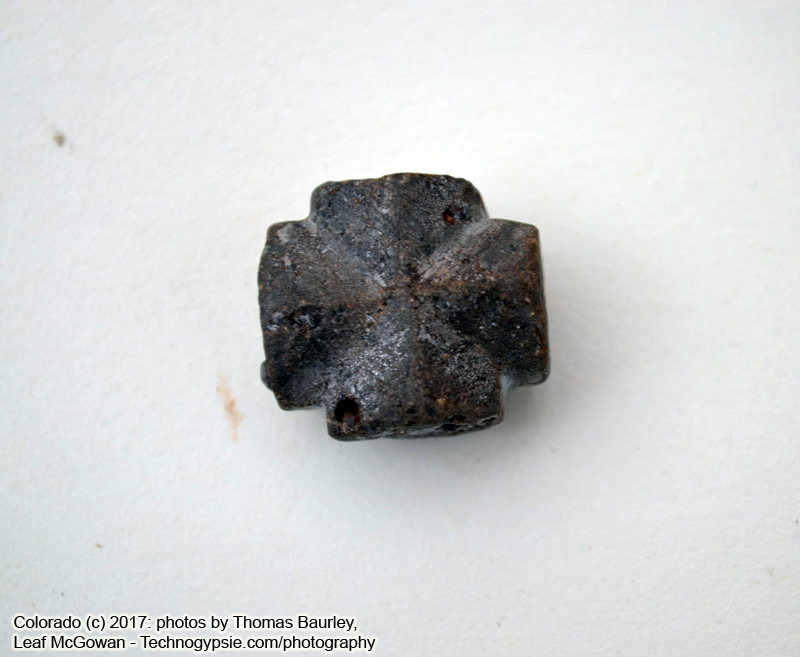
Staurolite: Fairy crosses/stones

FC-005: Celtic Cross Fairy Cross from Taos, New Mexico.


Purchase one here

Fairy Stone / Fairy Cross / Staurolite

Localities: Fairy Stone State Park, Virginia, USA; North Georgia, USA; Little Falls, Minnesota, USA; Taos, New Mexico, USA; Switzerland; Russia; Australia; Brazil; France; Italy; Scotland.

Description: Popular to its folklore and legends, this stone has a State Park in Virginia named after it as it is home to its namesake “fairy stones”. It is also the official stone of the state of Georgia in the USA. Most commonly shaped like Celtic crosses or the St. Andrew’s cross, as an “X” or as a “T” shaped Roman cross, and square Maltese crosses. Color of the Staurolite varies to the region it comes from but can be dark brow, brownish black, grey, or reddish brown.

Geology:Staurolite are a combination of silica, iron, and aluminum. A silicate mineral, with the Chemical formula of Fe2+2Al9O6(SiO4)4(O,OH)2, and a Strunz classification of 9.AF.30, possessing a monclinic prismatic crystal symmetry. It’s H-M symbol is (2/m), with a Space group of C 2/m, and a unit cell a = 7.86, b = 16.6, c = 5.65; ? = 90.45; Z=2. Coloring ranges from yellowish brown, rarely blue, dark reddish brown to blackish brown, pale golden yellow in thin sections with a subvitreous to resinous luster, white to gray streaks, transparent to opague diaphaneity. Specific gravity is 3.74 – 3.83 meas. 3.686 calc. Twinning is commonly as 60 twins, less common as 90 cruciform twins. Subconchoidal fracture, brittle tenacity, mosh scale hardness of 7-7.5. Common to have penetration twinning, or a characteristic cross-shape. It occurs with almandine garnet, micas, kyanite; as well as albite, biotite, and sillimanite in gneiss and schist of regional metamorphic rocks. It is only found in rocks once subjected to great heat and pressure. A rare mineral occurrence in nature, it is only found in certain areas of the world in the fairy cross or Celtic cross shapes. Each are unique and never are identical. True Staurolite crosses are hard enough to scratch glass.

Folklore: Named after the Greek word “Stauros” for “cross”, they are commonly known as “fairy stones” or “fairy crosses”. According to European and Christianity influenced Native American legend on the state park website, “hundreds of years before Chief Powhatan’s reign, the fairies were dancing around a magical spring of water, playing with naiads and wood nymphs, when a elfin messenger arrived from a city far away bringing the news of the death of Christ. When these creatures of the forest heard the story of the crucifixion, they wept, as their tears fell upon the earth they crystallized into beautiful crosses”. During the first meeting of John Smith and Pocahontas, it is said the Indian princess gave John Smith a good luck charm made out of a “fairy cross”. Legend has it that Richard the Lionheart used them during the crusades to heal the wounded. Some say these are the tears of the Cherokee who wept over the loss of their homeland during the exodus on the “Trail of Tears”. Others talk of an ancient race of mountain faeries who were dancing at their favorite meeting places, and upon finding out that the “Great Creator” had died, shed tears, so moved, were crushed in heart and cried, as they wept their tears crystallized into the “fairy crosses”. Others say that during the defeat of the Tuatha de Danann and other faerie races when they were forced under-ground to live in the hills, the faeries around the world shed tears, made of Iron to represent the Iron Age destroying their race, in the shapes of crosses as an omen of the peopling that would destroy the planet next.

    Ay the charms of the fairy stone make you blessed
    through the days of labor and nights of rest
    Where ever you stay, where ever you go,
    May the beautiful flowers of the good Fairies Grow.
    ~ Little Falls Minnesota web page

Well known that Presidents Theodore Roosevelt, Wilson, Thomas A. Edison, Colonel Charles Lindbergh, and other prominent people carried one of these on their person(s).

Magical uses: For centuries these were believed to protect the wearer from sickness, accidents, disaster, and witchcraft. Used to find lost objects. Placed under the pillow to help induce lucid dreaming and astral travel. Used as amulets for good luck. Used to aid stress, anxiety, fear, considered soothing energy, and helpful with grounding. Many believe they embody an energy that will help you make contact with faeries or nature spirits. Some believe wearing the stones will help one stop smoking. Astrologically associated with Pisces. Associated with the base chakra. Healing qualities, good luck, rituals, protection, fever, defeat of malaria, stress, depression, addictive personality traits, time management, smoking cessation.

By Thomas Baurley, Technogypsie Productions and Research Facility.

(more…)


Tiveragh Fairy Hill (Cushendall)

Tiveragh Hill / Fairy Hill of Cushendall, Northern Ireland. June 2, 2012:
Irish Folklore Quest – Northern Ireland, UK. (c) 2012 – photography by Leaf McGowan/Thomas Baurley

The Tiveragh Fairy Hill
Cushendall, Northern Ireland

Legend and lore have it that this very broad-sided hill with steep sides overlooking the small village of Cushendall in Northern Ireland is the gateway to Tir na nOg. A place very well known locally to be haunted by faeries, leprechauns, elves, and pixies … this giant hill is a natural fortress all on its own and easily seen to be claimed as a stronghold by the fae.

Fairy tales mention many stories about it rising on pillars during the twilight evening with a glimmering merriment of faeries frolicking and dining. Many believe that the wee folk live in this hill accessed by a nearby cave. As the warning goes, if ye are mortal, regardless of how appeasing the faerie music may sound, if you wander within, you’ll never be seen again on this plane of existence. Time holds a whole different rhythm in Faerieworlds.

We, however, of fae persuasion, did venture up the hill at the turn of twilight just as the sun went down. We spied the hill with visions of faerie impressions while across the valley atop Ossian’s Grave – the Megalithic tomb believed to be the burial spot of the fabled poet and bard Oisin. Now Oisin was lured into fae, into Tir na nOg, where he lived until he requested to return to the land of mortals to visit his family. Of course due to faerie time, he returned several hundred years later to find them all gone and deceased. He fell off his faerie steed and became a blind old man wandering these fields, eventually dying.

If the faerie tale is accurate, this would be the hill he would have ridden out of, and across the valley would have been his grave overlooking it … curious and more curious. Midway along the way up the base of the hill is one of the most magnificent Faerie Thorn Trees I’ve ever encountered. As usual with these faerie hills, I always find a wee hole just big enough for the Victorian-sized fae to enter within, usually lined with heavy rocks, making it look peculiarly like a miniature mine rather than an animal hole.

We climbed atop as the sun went down, empowered by the feelings of the ancient ones. Archaeologically, though, this may be a massive hillfort. I’m looking for those records and will post my findings here.

And their playing pitch was hardly as big
As my Uncle Barney’s potato rig;
And me there watchin’ them puck and clout
At the back o’ the wall with my eyes stuck out.

When all at once, like the squeal of a hare,
A wee voice shouted, “Who’s that up there?”
And a bit off a thing about nine – inch tall
Came climbing up to the top of the wall.

And he stood there; he stood about pot -size
With his two wee fingers up at my eyes,
And its God’s own truth that I’m speakin’ mind ye,
“Get out o’ that,” says he, “or I’ll blind ye!”

Aye that’s what he said, “I’ll blind ye,” says he,
And by Jing what he said was enough for me,
Did I run? Aye surely; I didn’t miss –
And I haven’t seen Tiveragh from that to this.

~ H.Browne

The Fairy Hill Tiveragh is a fairy hill and near to Cushendall,
And nobody goes there at night, no nobody at all.
The hill is small, the sides are steep.
And I have heard it said That flickering lights go in and out While everyone’s in bed.
And on the top two hawthorns grow, A white one and a red.

~ John Irvine Desmond

~ Yours truly, Leaf McGowan

Tiveragh Hill / Fairy Hill of Cushendall, Northern Ireland
(more…)


June 22-24, 2012 ~ 12th Annual Fairy Human Relations Congress: Twisp, Washington

Comments Off on June 22-24, 2012 ~ 12th Annual Fairy Human Relations Congress: Twisp, Washington | Events, Modern Fae Tags:, , , , , , , , , , ,

The March 15 early registration date is coming up!
Get 3 days of Fairy Congress for $215!

– that’s meals, workshops, rituals, camping, the magic of Skalitude, music
and enough fairy dust to make you shine for the rest of the year!

details at www.fairycongress.com


Friends of the Trees • PO Box 826 • Tonasket, WA 98855

http://www.friendsofthetrees.net


Irish Fairy Forts

Irish Faerie Forts

These intriguing fortresses of old have always fascinated me conceptually once I read about them in the many legends and folklore of the Irish Faeries. However, it wasn’t until the last two years that I’ve had the chance to explore these raths of myths and tales in-depth and personally wondering if they are truly gateways into the Land of the Young, Tir Na Nog or the Faerie Otherworld. “Fairy Forts” are the names given especially by the Irish, Cornish, and other residents of the Isles around Ireland, Scotland, Wales, and Britain who strongly believe in the faerie folk. This is a localized term for the “raths”, “ringforts”, “lios”, “hillforts”, “rounds”, “earthen mounds”, or circular dwellings found in England, Ireland, Scotland, Isle of Man, and Wales.

Fairy Forts / Ring Forts
Fairy Forts / Ring Forts (People’s Park, Ireland)

Archaeologists will tell you these came to be around the late Iron Age and were used upwards to the domain of early Christianization of the land when the Island’s residents dwelled in circular structures (perhaps “roundhouses”) within earthen banks or ditches that were used for defense. These were believed to have been topped with wooden palisades, stone or wood buildings, roundhouses, or structures. Many archaeologists believe that these were primarily made of wooden structures that would have decayed, which is why none of the structures remained, leaving only vague circular marks in the landscape. These “fairy forts” or “raths” are simply large mounds of earth, clay, grass, hedges, bushes, gorse, and thorn that are circular in shape like that believed to be a round banked enclosure. Archaeology tells us the circular bank was formerly the base for a high fence or wall of sharpened logs, sometimes with or without a water-filled moat. Inside the circular enclosure, more often than not, are round wooden thatched dwellings. Also within this enclosure was kept livestock during bad weather and to prevent raiding. There are believed to be over 40,000 ring forts in Ireland alone. In 2009, a team of four photographers supported by Wales Arts International took a road trip across Western Ireland to record and photograph fairy forts. These can be seen at www.fairyfortproject.com. Actual “Sidhe,” or Hills, are most commonly interpreted as burial mounds, passage tombs, or tumuli. Human remains have been found in these to support archaeology. ~ Some claim the Tuatha de Danann were the “Danes” who were legendary “fort builders.”

Passage Tomb - Slieve Gullion Forest Park
Passage Tomb – Slieve Gullion Forest Park

However, this is disputed by many folklorists and archaeologists, as most of the forts took on Gaelic names. According to Archaeology, the forts are attributed to various times and races. Legend even attributes them to belong to the Firbolgs, Tuatha De Danann, the Celts, and the Vikings, as well as mythological individuals such as Aenghus, Eerish, Eir, Farvagh, Cuchuallain, Midir, Croaghan, ‘Lachtna (820-840 C.E.), Brian Boru (980-1014 C.E.), and King Conor (1242-1269 C.E.). Places throughout the Isles are named after faeries, banshees, and other beings or myths surrounding them. tells a different story opposing the archaeologists’ perspective. The land’s myths, legends, and lore tell that these ring forts were “fairy forts” blessed and protected with Druidic prayers, spells, and magic to protect the “faeries” that lived within or under them. Those who believe in Faeries do not alter or trespass on them.

Legend states that the Tuatha De Danann and Fir Bolg had originally inhabited Ireland as a mythical race of magical folk who dominated Ireland. Around the time of the Iron Age (oddly enough corresponding to archaeology’s dating of raths), when the Milesians came to Ireland and defeated the Tuatha De Danann, the Tuatha was forced to relocate to the Other World, A Faerie dimension, or down below the hills, to Middle Earth as an agreement that only the Milesians ~ the humans ~ could dwell above ground. The Faeries, the “Good Neighbours” had to move underground or to their “Faerie Isles”. They were to retreat into the hills or mounds called “sidhe” which became a word for the “faeries“. These were often described as circular barrows or ringforts. These “hollow hills” have traditionally become known as the home of Faeries. “Sidhe” in Gaelic means “people of the hills.”

According to the Book of Armagh, they are the Gods of the Earth known as the Tuatha de Danann. Sometimes seen as God/desses, other times as Druids or sorcerers, and on an odd occasion as aliens, the Tuatha have rich mythology firmly embedded into Irish lore. Some Irish call them the “Sidheog”. To many Christian groups, faeries are believed by some to be fallen angels who are too good ever to be allowed in Hell and too devilish to be accepted into Heaven. From these myths, these defensive forts were seen to be the domain of the Tuatha De Danann as entrances to their world. They are to be respected and avoided because of respect and fear of “war” retaking place between faeries and humans. The actual mounds are also seen as potential burial or sacred resting places.

As Archaeology has found many burials within such mounds, such as at Newgrange and Tara, hillforts and mounds are avoided out of superstition. A good farmer wouldn’t even mess with the moat, the walls, cut brush from it, remove stones, or damage it. If they did, hard luck and even death could follow. Most respected on these “fairy forts” were the white thorns, the ash, the gorse, or the “sceach” around its boundaries never to be cut for that would most likely lead to death. In MacCraith’s “Triumphs of Torlough” the “fairy forts” are labelled as the lodgings of appalling apparitions. Many stories of the hills lit up by strange lights at night. Sometimes, this is described as the hill rising up on pillars, opening to the night sky, revealing brilliant lights of Faeries processing from one hill to another, especially during Lammas tide (August 2nd through 7th). November 11th, during Hollantide, is when the Manx fear their Hogmen or Hillmen the most as it is the time these particular Fae choose to move from one hill to another.

Hill of Tara
Hill of Tara

Irish lore and ghost stories tell much about the supernatural stature of “Fairy forts.” Many believe “leprechauns” live in them and hide their pots of gold within the mounds as expressed in Rudyard Kipling’s 1906 novel “Puck of Pook’s Hill”. In addition to the Ringforts, Dolmen were considered faerie homes or dwellings. A legend tells of a lady who lived in one and became deranged, thought her lover was a dragon, and jumped at him. Many unexplained phenomena take place in or around the fairy forts. Local lore tells tales of a man who tried to blast down a dolmen resulting in a septic hand while the dolmen remained unscathed; the local astronomer who tried to blast the Inchiquin Barony dolmen was severely injured with his hand as well; a Templenaraha oratory demolition (which was in a ringfort) collapsed a calf shed onto its occupants for building the unstable structure; the 1840 tale of workmen at Dooneeva who were trying to level earthworks in a fairy fort had apparently turned up dead (though his mystic wife ran to a “fairy spot” to work magic to bring him back to life); The Lissardcarney and Ballyhee fairy forts in Templemaley Parish were always known to be faerie strongholds with troops of faeries garrisoned within them (1839 stories); Songs were reputedly heard from the Cahernanoorane in Inchiquin and Liskeentha near Noughaval; tales of faeries haunting the Tobersheefra holy well; the 1892 tale of Nihill a farmer who wrecked and removed the out wall of a triple stone fort near Quin leading to his father stricken with acute pain and only recovering from it when the work was stopped; a landlord losing the use of an eye from the dust of an explosion when blasting a rock in an earth fort being removed in northeast Clare; and in 2011 developer Sean Quinn found financial ruin after he moved a fairy fort.

Another tale tells of a cow that grazed in a fairy fort and was found with broken legs whose owner then ate its meat only to find the cow in the fairy fort a year later. The farmer was told by the faeries they substituted an old stray horse to make him believe it was his cow as they needed his cow’s milk, and they then let him take his cow home afterwhich he became very prosperous for the loan. Another tale tells of another farmer who couldn’t understand why none of the cows would enter the fairy fort on their property, and upon investigation by his son, found an old fairy in the fort who asked the man to help him get a young human girl to become his wife. The farmer’s son would not give a young girl to the old fairy but instead married the girl himself, leading to rage from the old fairie, who destroyed the farmer’s property. Outraged, the farmer’s son and the girl rode to her parent’s house to tell her three brothers. Her brothers then went to the fort to dig for the old fairy’s house, upon finding his sizeable flat stone, he begged them to save him his home, which they did in exchange for restoring for what he had taken. Some ringforts are more dangerous than others, such as in the case of the Croaghateeaun stone ring wall near Lisdoonvarna. One of the most modern cases of faerie wraith damaging faerie forts was believed to be the invocation of an ancient curse of the Hill of Tara when the government destroyed sites by the construction of the M3 Motorway. In 2007 the Minister for the Environment, Dick Roche supposed befell against bad financial luck after signing a order to destroy the Lismullion Henge. By Faerie wraith, he lost his job, was demoted, and held up by an armed gang in the Druids Glen Hotel. The Minister for Transport, Martin Cullen, afterward nearly got sucked out of a helicopter when the door fell off. A falling tree at Rath Lugh seriously injured the Chief Health and Safety officer. A worker was killed while being trapped at Fairyhouse, where there have been many accidents on that particular stretch of road. There is much concern about being taken by the fairies.

Fears from stories like these may be responsible for the incredible preservation of these forts, hills, raiths, and mounds across the countryside. In many areas, the raiths and fairy forts are protected by Irish law for heritage preservation, preventing construction or building within 30 meters of them. However, the Irish government and more giant corporations somehow skirt these laws often when they find the need to destroy them for construction projects or building motorways.

Drumdowney Fairy Fort in Ireland

Drumdowney Fairy Fort in Ireland

Littering the landscape are also pathways that some call “fairy paths.” Some align these with what they believe to be mystical geo-magnetic gridlines called “leylines”. Many believe these connect together using faerie sites or faerie forts. Many old buildings in Ireland are missing parts of the structure out of the belief that part obstructs a faerie path. Other faerie sites include mounds, isles, wells, and faerie trees or bushes. These sites are often dressed and adorned with “rags” or “wishing trees” with offerings to faeries for blessings.

Today, many believe that milk, butter, and/or honey offerings would appease the Good Neighbours at these places. However, not much histories or archaeological record make that proved to be true. This seems to come more from Swedish folklore in “elf mills,” which is found in the covers of more than one of these structures and large bullauns or basins at others. Modern belief is to leave out food and drink for the faeries, often on plates and cups at the faerie forts. Evidence of this is found at Inchiquin and Moyarta Baronies and on the Shannon bank where the slopes were thrown out and clean plates, water, chairs, and a well swept hearth was left for the faerie guests. Fairy forts, isles, and mounds are not the only doorways to the land of Tir Na n’Og believed to exist. Cave entrances in Ireland are also believed to be passages as well. Two of the most famous are Lough Gur in County Limerick and Rathcrogan in County Roscommon. One of Ireland’s famous fairy forts is at the Knocknashee mountain. Here it is believed, that if you make a wish, turn around three times with your eyes closed, and if you wind up facing Knocknashee when you open your eyes, the wish will come true. A “fairy” amusement park for kids is also at the base of this mountain dedicated to the “faeries.”

Some say the entrance to the Otherworld will appear if you walk nine times clockwise around the fairy fort, mound, or isle during the full moon. Invitations into the faerie domain can be prosperous or fateful. Such invitations, especially food and drink offers, should be taken carefully by humans. Some legends warn that partaking of food and drink will lead to perpetual enslavement and a loss of time, space, or continuum.

Some myths state that after the Tuatha de Danann lost the battle with the Milesians, in addition to being forced underground, they were shrunk in size and stature. They are often described as “human-like” in appearance, sometimes with animal features, paler skin tone, and green eyes. Throughout the history of Ireland, faeries, especially as personified as belonging to the Tuatha, litter the landscape. Some families claim that their ancestors crossed the fae, and thereby invoked neverending hauntings by Banshees. The banshee is often depicted as a Irish female faerie that comes out at night drawing a comb through her long silvery hair screaming and wailing, mainly when predicting the death of one of their family members. Some lore suggests that the Banshee haunts families with surnames preceded by an O’.

The earliest writer of describing faeries was in 1014 C.E. while describing the terrors of the battles between the Norse and Irish speaking of a “bird of valor and championship fluttering over Merchad’s head and flying on his breath” as well as flying dark and merciless bodbh screamingly fluttering over the combatants while the bannanaig or styrs, idiots, maniacs of the glens, witches, goblins, ancient birds, and destroying demons of the air and skies arose to accompany the warriors in combat. A 1350 C.E. writer wrote about the 1286 C.E. King Torlough returning from a successful raid ravaging the English lands around the mountains of eastern County Limerick and northern Tipperary where he was greeted by a lovely maiden in” modest, strange in aspect, glorious in form, rosy-lipped, soft-taper-handed, pliant-wavy-haired, white-bosomed” appearance as the “Sovereignty of Erin” to rebuke the chief for letting de Burgh dissuade him from attempting the reconquest of all Ireland thereby vanishing in a lustrous cloud within an area graced with fairy forts, dolmen, and tumuli. It is also here that it was written that the soldiers of Donchad were also disturbed by phantoms and delusive dreams of lights shining on the fairy forts. Poetry took over describing these battles and the soldiers witnessing the “waves of Erin” groaning “the deep plaint resounded from the woods and streams” as shades were seen and hollow groans heard while gazing at the hills and forts.

I can speak from first hand while sleeping in homes near such forts, that the winds making noises through the shutters and windows, along the rocks and bushes, whisper and cry like a siren in angst. These are the same described in faerie tales of the forts and beings coming up from the underground caverns, streams, hills, and forts. Sightings of Faeries have dwindled significantly from the 18th to the 20th centuries. Though many Irish today still have stories of their parents and grandparents telling them of faerie abductions, sightings, or wrath. Some say the movement of Faeries causes the dusty whirlwinds along the roadside or in the fields. Some places are still reputed to be “fairy hotspots” to this day.

Drumdowney Faerie Isle

 One such is the low earth mound at Newmarket-on-Fergus, where one apparition has reliably manifested for the last ten years. This one appears as a little old man dressed in green walking on Ennis road, thought to be a leprechaun perhaps. Much of modern legend has mutated into actual individuals today who claim to have faerie blood, kindred, or to be faeries living amongst humans. This has led to many novels, books, and movies in the 20th century addressing this new lore. This however is not completely new, as many through history have claimed to be of Faerie lineage. A Faerie monarch in Clare was the “Donn of the Sandhills” near the Doogh castle near Lehinch, is listed as a fairy prince named Donn within a list of the divine race of the Tuatha De Danann and family of the Dagda, lineal descendant of the ancient Ana, Mother of the Gods. He was addressed with a political petition in 1730 by Andrew MacCurtin, a well known Irish scholar and antiquarian for neglecting the gentry and praying for any menial post at his court. He was never answered, lived under the hospitality of the Kilkee MacDonnells and the Ennistymon O’Briens. Donn’s heartless conduct supposedly met poetic justice as he lacked a sacred bard and became forgotten through history.

Changelings are another case and another type of faerie within the “Fae” races that are commonly found in folklore and mythology. History worldwide refers to them or some derivative of the belief. Most of the folklore make faeries out to be extremely malevolient towards humans. Much of legend suggests that faeries are envious of humans, often wanting to steal the secrets of their magic, even to the point of changing out human infants with faerie children called “changelings.” The changeling would look “identical” to the stolen child. The only way to tell if it wasn’t your child is if the personality suddenly changed inexplicably. This led to many folk customs, beliefs, spells, and practices to protect children from faeries. Sometimes, these were as simple as dressing up boys to look like girls, placing iron in the child’s bed, dropping a small drop of human urine on a child, keeping dirty water in the house, protective charms, and various woods, herbs, or stones.

Bibliography / References:

Articles can be purchased in magazines, printed, or reproduced on websites. Photos are copyrighted and cannot be reproduced without permission of authors Tom Baurley or Leaf McGowan. Photos can be purchased via Technogypsie.com at Techno Tink Photography Services for nominal use fees.

The Fairy-Go-Round Ring Fort on the Dingle Peninsula, County Kerry, Ireland:

The Fairy-Go-Round Ring Fort, Dingle Peninsula, Co. Kerry, Ireland


Faeries

The Tree Leaves’ Oracle icon flower fairy

The Victorian Flower Fairy or Nature Sprite

Flower Fairies are believed to be the fairy spirit essence of various flowers; they are portrayed as tiny creatures that rarely are larger than 20 cm. tall. Most of these depictions come from Victorian art and is a common ‘model’ for what most people think of what is a fairy. They live in tree tops, marshes, forests, gardens, fields, and waysides. It is believed by many that when a seed sprouts a flower fairy is born. Each flower fairy lives upon its host plant and not found too far from it. They sleep within the flower. As the flower grows so does the fairy. The flower fairy exists to tend and watch over the flower. If the flower dies, so too does the fairy. Disembodied spirits, elves, fairies or daemons; often the term used for the Air elemental known as “sylphs,” or as the name of the elementals of Spirit. Flower fairies are often also referred to as nature sprites or spirits. Some define sprites as a being who are beginning a course of evolutionary growth and in the elemental states of their growth. In some ways, this is the concept, in the life of a flower, what makes a flower fairy a sprite. Examples: http://www.flowerfaeries.com/flowerfairies.shtml; http://www.flowerfairies.com/US_version/home.html.

(more…)


Archives

Categories