Dryad's Saddle

Bracket or Shelf Fungi

Bracket or Shelf Fungi, Congaree National Park, Columbia, SC

Bracket fungi, or shelf fungi
(science page: http://www.treeleavesoracle.org/treelore/?p=641)
Common Names:
Bracket fungi, shelf fungi, conks, oysters, wood rot fungi, sulphur shelf, birch bracket, dryad’s saddle, artist’s conk, turkey tail.
The Polyporus squamosus, or Dryad’s Saddle has the appearance of a “perfect seat or ride for a wood nymph” which is possible for its namesake. This next tidbit, whether fantasy, RPG, or actual folklore lends suggestion it is a popular mushroom to the Fae. That which is called the “Shelfung” mythologically is also referred to as the Squilla in mythical Sarvonia and considered an edible fungus popular among the orcs, elves, brownies, hobbits, and thergerim, and humans as a spice for various foods such as for leveret, force bread, and poultry. The Tharian call it “Shelfung”, the Orcs call it “Kroch’tlor”, and the Thergerimtaal call it “Urtumua”. Orcs believe this fungus will strengthen the blood for fighting and their name for it translates to “Good Blood”. The Blaa’kr tribe on the Isles of R’unor believe it enhances sexual potency. Hobbits (not a actual species of Fae, created by Tolkien) say it will increase one’s wisdom.
[Santharia.com: http://www.santharia.com/herbarium/squilla_fungus.htm ] Research still pending.
Bibliography/ Recommended Reading/ Resources:


The Lizard Man of South Carolina

This brings me back to a crazed David Icke conspiracy theorist named Purple Crow in Vancouver BC when I think of lizard men, or the famous telvision show “V”. The Lizard Man of Scape Ore Swamp or the Sumter Lizard Man, the Lizard Man of Lee County, or the South Carolina Lizard Man are all titles of a mythological modern-day creature haunting the backwoods and swamps of South Carolina. Native American legend with oral lore from 1972 in the area is claimed that the Inzignanin near Chicora by the South/North Carolina border told of fishy humanoids covered in scales, 5 feet tall, with fairly inflexible tales 18 inches long, and webbed hands. He was first reported being seen on June 29, 1988 and ever since has been popping up in urban folklore. He has been described as a reptilian humanoid cryptid living either in the South Carolina swamps or within abandoned subways or sewers in towns near the swamps. He is described as standing over 7 feet tall, bipedal, muscular, covered in scaly lizard-like skin with dark hair (similar to big foot). He has been said to have only three toes on each foot and three fingers on each hand and maybe flaunting a tail. In June of 1988, a 17 year old boy named Christopher Davis claimed to have been attacked by the creature on his way home from work when he was changing a flat. He claimed the creature tried to grab at his car and climbed onto his roof as he sped off to escape the attack. He claimed the creature damaged his side mirror and scratched his roof. He claimed it was lizard like with red glowing eyes, three big fingers, long black nails, and green rough skin – all green and angry, grunting, and chasing him. That month there were several more reports by others of being attacked, with unusual scratches and bite marks found on cars parked close to the swamp, all within three mile radius of the swamps of Bishopville, South Carolina. Police at the time were perplexed, trying to balance between disbelief and humor to concern and intrigue, thinking it was actually a bear not a lizard man. Two weeks later, the sheriff’s department made several plaster casts of what appeared to be three-toed footprints, measuring 14 inches in length, that were later labelled unclassifiable. They were cited as not belonging or matching any other footprints of any other recorded animal on record. Tourists and cryptid hunters began plaguing South Carolina in search of the beast, with even radio stations such as WCOS offering a million dollar reward to anyone who could capture it alive. On August 5th, an airman from Shaw Air Force base named Kenneth Orr, filed a report with the police claiming to have encountered the creature on Highway 15 and having shot/wounded it. He gave to evidence several scales and some blood. He later confessed to inventing the sighting after being cited for unlawfully carrying a gun and a misdemeanor offense for filing a false police report. 2004 reports of a creature trying to snatch and drag a young girl into the river was blamed on the Lizard Man, but later theorized to have been an alligator. In 2005, the South Carolina Lottery used the creature in their television advertisements, and later that year a woman from Newberry claimed to have seen two Lizard man creatures outside her home. In 2008, Bob and Dixie Rawson, a couple in Bishopville South Carolina reported being attacked and damage to their car with traces of blood and claims that these creatures killed their cats. Police claim it was a wolf or coyote. After investigating the claim, E.J. Melvin, the Lee County Sheriff discovered a dead cow and coyote in a field next to the Rawson homestead. History Channel’s “MonsterQuest” investigated the legend, showing that it was not possible for a canine to have caused such damage on the Rawson’s car, it would have taken over 300 lbs of torgue to cause that kind of damage. By 2010, the show “Destination Truth” investigated the legend claiming the footprints were a hoax and the creature fabricated as a means of tourism, extensive local merchandising, and fandom. Lee County Chamber of Commerce hosts a 5 km Lizard Man run, sells Lizard Man shirts, and a Lizard patrol shirt. Another report in 2011 by a couple claiming to have had their car mauled by something tall with similar damage as the others. Reptilian humanoid creatures have been reported through history – the Greek God of the cold north wind, Boreas was described as a winged man with serpents instead of legs; Crecrops I was a half-man, half-snake mythical king of Athens; Chinese Mythology has reptilian humaoid dragon kings as well as a serpentine figure named Fu Xi; There is the snake God named Glycon who has a human head; The Lord of the Tree of Life from the Epic of Gilgamesh links Ningizzida with the water serpent constellation Hydra; the Chinese Dragon thunder God Shenlong is depicted with a human head and dragon’s body; the Ancient Egyptian God Sobek has a crocodile head; the Aztec God Tlaloc has snake fangs; the Greek “Father of all monsters” Typhon was a man from the waist up with a mass of seething vipers from the waist down; the Zoroastrian God Zahhak grows a serpent on either of his shoulders; The wife of Typhon is a half-woman half-snake Goddess named Echidna; in Portugese and galician folklore there is a snake goddess named Moura with long blond hair and a snake body; and of course MEdusa and the Gorgons in Greek mythology; the Lamia – a Greek female demon as half-woman, half snake; Islamic mythology depicts some djinn as half human and half-serpentine; Indian Naga were reptilian beings living underground and interacting with humans atop; the Genesis creation of the Serpent identified with Satan was known to be either male/female in mythology.


Legend of the Third Eye Man (Columbia, SC)

Comments Off on Legend of the Third Eye Man (Columbia, SC) | Cyclops, Monsters, Sightings Tags:, , , , , ,

Now that we’re residents of Columbia, South Carolina … its time to look into the legends and lore of these intriguing lands. The Legend of the Third Eye Man was the first to find, whether it be an urban legend or a true creature or spirit, time will tell. Apparently there is a massive network of catacombs and steam tunnels underneath the University of South Carolina. Haunting these halls is supposedly a phantom cyclops. He was first spotted on November 12th, 1949 on the campus of USC. Records state he is a strange looking man dressed in bright silver who was spotted opening a man-hole cover on the corner of Green street and Sumter street, opposite the haunted historic Long street Theater. He became known as “the sewer man” at that point. Six months later on April 7th, 1950 he re-surfaced and was sighted again by a university police office on patrol who discovered two mutilated chickens behind the theater. He reported chicken parts to be strewn all over the loading dock. When he returned to his car to report the scene, thinking it was a fraternity prank, he returned to the scene to find a silver man huddled over the chicken parts. He shined his flashlight on him to find a very disturbing face, grotesque in color and shape, and a third eye in the middle of his forehead like that of a cyclops, staring back at him. He retreated from the scene, called backup, and was laughed at when nothing was found on the docks but a few feathers and chicken bones. By the 1960’s students started hunting down and invading the tunnels. When a fraternity had three pledges down in the tunnels for a challenge, from the basement of Gambrell, they ran into a crippled looking man dressed in all silver and reported the sighting to the police. He charged at the students with a lead pipe, knocking student Matthew Tabor to the ground, suffering minor cuts and shock. The first official man-hunt for this attacker took place coming up with nothing, but that started the tedious task of sealing off many of the entrances to the catacombs and making them off limits. The catacombs do exist, as photos of them are rampant online. Whether or not this mysterious hominid exists is a whole different story. Legend tells that these tunnels link various venues of the government to the USC campus allowing undetected and protected transportation between them, some say even to Fort Jackson. Some say they go back to the days of the confederate war. Many say the Three Eyed Man is also the ghoul that haunts the Longstreet Theatre, and instead of living in the tunnels, he lives in the theater late at night. He has played the terror and villian in many a fraternity initiation through the years.
More info:
http://www.mostlyghosts.com/index.php/the-third-eye-man-of-usc/
http://www.waymarking.com/waymarks/WM6JAB_The_Legend_of_the_Third_Eye_Man_Columbia_South_Carolina


The Brennivin Ghost

Comments Off on The Brennivin Ghost | Ghosts Tags:, , , , ,


Icelandic Wonders Museum, Iceland

The Brennivin Ghost of Iceland

While visiting the Icelandic wonders museum, we learned about the infamous Brennivín Ghost, haunting the region where the original Icelandic Schnapps is named. Haunting the halls at Kolviðarhóll, who is the apparition of the Danish “Assistant” who worked in the Sunchenberg Store in Reykjavik. His job was to keep count of liquor in the store, and as a avid lover of the spirits, would travel by horse back to Kolvidarhóll and Marardalur to drink. He passed away in his bed while in Reykjavik. He apparently haunts the stores, halls, and the meadows on Kolviðarhóll.
The first recording of his apparition was two men the following winter from Suarnes travelling over the heath and stopping to sleep at the refuge hut in Kolviaarholl. As they entered the hut, heard chanting in the loft, and were greeted with a vision of a man sitting alone, striking, and elegant with a large top hat and wig, drinking a big container of brennivin. Other reports were as similar. The Icelandic Wonders Museum claims the ghost watches over them.

    “The Brennivin Ghost: One of many acquaintances Kolviaarholl was the Brennivin Ghost. He was believed to be the ghost of the Danish ‘Assistant’ Sunchenberg store in Reykjavik. He had the responsibility of counting the beverages in the store, but he was very keen on the beverages. It was his custom, summer after summer on holy days, to ride his horse up to Kolviaarholl and into Marardalur to consume a substantial amount of the libation. He thought that those trips were his greatest pleasure in life … Now, this man passed away in his sickbed in Reykjavik, but the following winter two men from Suaurnes went over the heath and were planning to sleep at the refuge hut at Kolviaarholl. When they opened the hut, they were shocked when they heard a chant up in the loft. The two men weren’t expecting anyone to be there, because they didn’t see anything outside that indicated that someone was there. When the two men went inside the house and up to the loft, the most surreal vision awaited them when they opened the hatch. On the floor, just by the window, there was a man sitting alone who seemed to be very mellow. He was striking to see and very elegant, with a large top hat and a wig, and was wearing clothes with silver buttons on both lapels. Between his feet on the floor, he had a biggish container full of brennivin, from which a sweet smell emanated. In one hand the man had a tin mug that he used to take brennivin from the container, and then he drank from the mug and tipped the rest of the brennivin back into the container. He looked roguishly at what he was doing. The two men greeted the strange man and made his see how surprised they were about his behavior and how well stocked he seemed to be with beverages. He didn’t respond to their greetings, but instead he extended one of his feet, on which there was a Danish shoe, and said a little verse with his dark voice. Then he stood up and swung out his hand with the bennivin mug. With that he disappeared in an instant with a bright glow, and the loft became dark. The two men felt uncomfortable and a little shaken, and ran down the stairs and out into the bright spring night, after whch they started to feel better. Needless to say, the two men continued over the heath until they reached Reykir in Olfus early next morning.” ~ museum sign in Icelandic Wonders Museum.


Icelandic Wonders Museum, Iceland


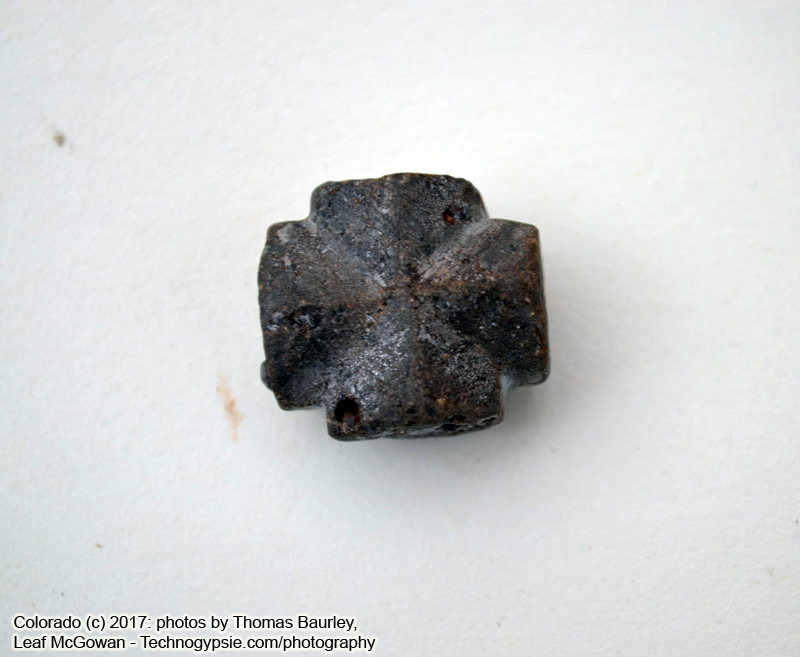
Staurolite: Fairy crosses/stones

FC-005: Celtic Cross Fairy Cross from Taos, New Mexico.


Purchase one here

Fairy Stone / Fairy Cross / Staurolite

Localities: Fairy Stone State Park, Virginia, USA; North Georgia, USA; Little Falls, Minnesota, USA; Taos, New Mexico, USA; Switzerland; Russia; Australia; Brazil; France; Italy; Scotland.

Description: Popular to its folklore and legends, this stone has a State Park in Virginia named after it as it is home to its namesake “fairy stones”. It is also the official stone of the state of Georgia in the USA. Most commonly shaped like Celtic crosses or the St. Andrew’s cross, as an “X” or as a “T” shaped Roman cross, and square Maltese crosses. Color of the Staurolite varies to the region it comes from but can be dark brow, brownish black, grey, or reddish brown.

Geology:Staurolite are a combination of silica, iron, and aluminum. A silicate mineral, with the Chemical formula of Fe2+2Al9O6(SiO4)4(O,OH)2, and a Strunz classification of 9.AF.30, possessing a monclinic prismatic crystal symmetry. It’s H-M symbol is (2/m), with a Space group of C 2/m, and a unit cell a = 7.86, b = 16.6, c = 5.65; ? = 90.45; Z=2. Coloring ranges from yellowish brown, rarely blue, dark reddish brown to blackish brown, pale golden yellow in thin sections with a subvitreous to resinous luster, white to gray streaks, transparent to opague diaphaneity. Specific gravity is 3.74 – 3.83 meas. 3.686 calc. Twinning is commonly as 60 twins, less common as 90 cruciform twins. Subconchoidal fracture, brittle tenacity, mosh scale hardness of 7-7.5. Common to have penetration twinning, or a characteristic cross-shape. It occurs with almandine garnet, micas, kyanite; as well as albite, biotite, and sillimanite in gneiss and schist of regional metamorphic rocks. It is only found in rocks once subjected to great heat and pressure. A rare mineral occurrence in nature, it is only found in certain areas of the world in the fairy cross or Celtic cross shapes. Each are unique and never are identical. True Staurolite crosses are hard enough to scratch glass.

Folklore: Named after the Greek word “Stauros” for “cross”, they are commonly known as “fairy stones” or “fairy crosses”. According to European and Christianity influenced Native American legend on the state park website, “hundreds of years before Chief Powhatan’s reign, the fairies were dancing around a magical spring of water, playing with naiads and wood nymphs, when a elfin messenger arrived from a city far away bringing the news of the death of Christ. When these creatures of the forest heard the story of the crucifixion, they wept, as their tears fell upon the earth they crystallized into beautiful crosses”. During the first meeting of John Smith and Pocahontas, it is said the Indian princess gave John Smith a good luck charm made out of a “fairy cross”. Legend has it that Richard the Lionheart used them during the crusades to heal the wounded. Some say these are the tears of the Cherokee who wept over the loss of their homeland during the exodus on the “Trail of Tears”. Others talk of an ancient race of mountain faeries who were dancing at their favorite meeting places, and upon finding out that the “Great Creator” had died, shed tears, so moved, were crushed in heart and cried, as they wept their tears crystallized into the “fairy crosses”. Others say that during the defeat of the Tuatha de Danann and other faerie races when they were forced under-ground to live in the hills, the faeries around the world shed tears, made of Iron to represent the Iron Age destroying their race, in the shapes of crosses as an omen of the peopling that would destroy the planet next.

    Ay the charms of the fairy stone make you blessed
    through the days of labor and nights of rest
    Where ever you stay, where ever you go,
    May the beautiful flowers of the good Fairies Grow.
    ~ Little Falls Minnesota web page

Well known that Presidents Theodore Roosevelt, Wilson, Thomas A. Edison, Colonel Charles Lindbergh, and other prominent people carried one of these on their person(s).

Magical uses: For centuries these were believed to protect the wearer from sickness, accidents, disaster, and witchcraft. Used to find lost objects. Placed under the pillow to help induce lucid dreaming and astral travel. Used as amulets for good luck. Used to aid stress, anxiety, fear, considered soothing energy, and helpful with grounding. Many believe they embody an energy that will help you make contact with faeries or nature spirits. Some believe wearing the stones will help one stop smoking. Astrologically associated with Pisces. Associated with the base chakra. Healing qualities, good luck, rituals, protection, fever, defeat of malaria, stress, depression, addictive personality traits, time management, smoking cessation.

By Thomas Baurley, Technogypsie Productions and Research Facility.

(more…)


Pendulums

Pendulums

One of the most common forms of divination, pendulums are used to tell the sex of unborn children, detect pregnancy, tell the future, answer life’s questions, prophecy, divining, and a common place magic trick. No one really fully understands the process of how the pendulum works. Pendulums are easy to make as it simply involves attaching a small weight to a length of chain, thread, or cord. The process of using it is even easier, as all one has to do is place their elbow on a table, face the pendulum which is looped over the index finger, and asked questions – to which the weight will move and provide answers. People often ask the pendulum if they should take trips, make life choices, if someone likes/loves them, relationship issues, if they should make purchases, if they are sick, allergic, and/or pregnant. Some use the pendulum to determine allergies. Others use pendulums to locate lost items, find places on a map, hidden treasure, water, caves, graves, or secrets of the unknown. Albeit easy to use, the pendulum does take a bit of rhythmn, practice, and tuning for precision results. Pendulums can be constructed of simply a lead fishing weight, a coin (such as a Norwegian kronos), a ring, a crystal, stone, or needle attached to a length of string or chain. Some choose to purchase simple to elaborate ones from Metaphysical, Pagan, New Age, Witch, or Occult shops. Some “experts” claim a true pendulum needs to be made using certain guidelines, including requirements of something that weighs at least three ounces and attached to 4-6 inches of cord. In my experience, the cord should be roughly the length of your hand from your wrist to the tip of your middle finger. As far as weight, that varies, as I’ve had much success if a pin definitely weighing under 3 ounces.

The best success with pendulums use I’ve found is to hold the cord between the thumb and first finger of your right or left hand (depending on what handedness you are – though some claim it must be the right hand. I am however left-handed and find it works perfectly with my usual orientation) or drooped over your index finger pinned by your thumb. Then resting your elbow on a table allow the pendulum to swing freely an inch or so above the surface of a table. You can also purchase a pendulum board for clearer and a more “fancy” presentation. Stop the movement of the weight with your free hand and then ask the pendulum your question. Ask it to answer “yes” and make note of the movement of the swing. Ask it to answer “no” and make note of the movement of the swing. Generally though, if it swings the direction of your head when nodding “yes” (to and from your face), then that is a “yes”. If it moves side to side, like the movement of the head in western culture for “no” it is a no. There is some dispute that the movements vary based on cultural views of body language for yes/no answers. The pendulum can also move diagonal meaning “maybe”, “don’t want to answer”, “right question”, or “don’t know”. It can also move in circles (clock-wise or counter-clockwise). Once the pendulum indicates an answer, which can be answered with mini swings to full swinging motions your answer should be revealed. There is also some debate that you should be asking Deity, spirits, ancestors, faeries, angels, and/or the undead directly your question while others believe you can just do it directing the question to the pendulum itself. (A debate similar to the usage of a ouija board) Your questions don’t need to be limited, just make sure you really want to know the real answer to your question. It is also very possible to mentally influence and override the movements of a pendulum if you think to hard on a particular response or too personally engaged with the result. In this case, its best to have someone not attached to the matter to do the pendulum reading for you. It is advised not to use the pendulum flippantly nor to let it rule your life. Place intuition, instinct, and common sense into action for your commitment with results from the pendulum. Pendulums are used also for dowsing. The intent behind the dowsing or divination sometimes dictates whether the pendulum is made of crystal, metal, or other materials. Stage magicians have audience members seal items in envelopes and presented to him/her to which a pendulum is used to “dowse” whether the item belongs to a male or a female. They can be held over a pad or cloth with yes/no written on it as well for audience demonstration. In Radiesthesia, pendulums are used for medical diagnosis.

Scientifically we know the pendulum swings by the influence of gravity, making it swing back and forth along a circular arc. The time it takes for a pendulum to oscillate from the peak of the swing on one side to the other and back is called the period of vibration, which depends on the length of the pendulum, the magnitude of gravitational acceleration where the pendulum is located, and the amplitude of the swing. A small amplitude has no effect on the period and the period is given by the equation T=2p l/g where T is the period of vibration, l is the length of the pendulum, and g is the local gravitational acceleration. The Greek letter ? (pi) is a constant with an approximate value of 3.1416. Pendulums are used in science for the uniformity of its period especially for keeping time, demonstrating the earth’s rotation, and determining gravitational acceleration at a particular location. The first recorded use of a pendulum, according to Science, was in 1620 when the British scientist Francis Bacon proposed using a pendulum to measure gravity, suggesting taking one up a mountain to see if gravity varies with altitude. According to “science” its use for pseudo-science broke out from the knowledge of the foucault pendulum. In 1851, Jean Bernard Léon Foucault showed that the plane of oscillation of a pendulum, like a gyroscope, tends to stay constant regardless of the motion of the pivot, and that this could be used to demonstrate the rotation of the Earth. He did this by suspending a pendulum free to swing in 2 dimensions from the dome of the Panthéon in Paris. The length of the cord was 67 m and once in motion, the plane of swing was observed to precess or rotate 360° clockwise in about 32 hours thus becoming the first demonstration of the Earth’s rotation that didn’t depend on celestial observations. After this, it was believed that “pendulum mania” broke out and utilized in various sub-cultures, groups, demonstrations, and New age spirituality.

~ By Leaf McGowan

    Bibliography, References, Recommended Reading:

  • About.com: How to use a Pendulum. Website referenced July 2012. http://healing.about.com/cs/tools/ht/How_pendulums.htm
  • Calacademy: The Pendulum. Website referenced July 2012. http://www.calacademy.org/products/pendulum/page1.htm
  • How Stuff Works: Science – The Pendulum. Website referenced July 2012. http://science.howstuffworks.com/pendulum-info.htm
  • Llewellyn Publications: The Pendulum. Website referenced July 2012. http://www.llewellyn.com/journal/article/471.
  • Pendulums.com. Website referenced July 2012. http://www.pendulums.com/


Gogmagog or Gog and Magog

Gogmagog: Gog and Magog
Goemagot, Goemagog or Gogmagoc; He of the Two Horns, He of the Two Ages, Gogmagog and Corineus

These ancient Giants (i.e. Titans, titans, fomorians, ancient ones) known as “Gog” and “Magog” in Paganism are descendants of early pre-Christian Giants of early English pageantry who were very tied to early Britain. The myth states that the Roman Emperor Diocletian had 33 wicked daughters whom he married off to 33 husbands who curbed their unsettling ways. However the daughters were so wicked, led by the eldest sister Alba, they plotted to cut the throats of their husbands as they slept. As punishment for this crime, they were set adrift in a boat with a half year’s rations of food, shunned forever. They drifted ashore the isles of what later became “Albion” (named after the eldest). Fornicating and coupling with demons, they populated the wild windswept island with a race of giants. Some say this was the Islands of what is known as modern day “Ireland” and became to be the legendary giant race of Fomorians while others claim it was the island of “Britain” and were the Giants who lived in these lands. When Brutus, great-grandson of Æneas, in company of his most able-bodied warrior Corineus, fled the fall of Troy, they by fate found themselves on these islands of Giants. Brutus was impressed with these isles so much that he named the Islands after himself, which later became called “Britain”. The leader of the Giants was a detestable monster named Goëmagot (Gogmagog), who stood in stature twelve cubits, and of such prodigious strength that at one shake he pulled up an oak as if it had been a hazel wand. Brutus and Corineus faced “Gogmagog“, had combat, and hurled him from a high rock to his death. (This place, called “The Giant’s Leap”, “Langnagog”, are disputed being in Ireland as well as Cornwall) As a reward for this defeat, Corineus was given the western part of the island, which many say is how Cornwall was called after him. After this defeat, Brutus travelled to the East and founded the city of New Troy, which eventually became known as “London”. [Geoffrey of Monmouth’s 12th century Historia Regum Brittaniae] Some correspond these myths to the biblical tale of Samson and Greek mythology of Hercules. Others argue that Gogmagog was a corruption of Gawr Madoc (Madoc the Great).

Another mythos to their origins tell that the 33 infamous daughters of Diocletian who were captured and chained at the gates of Guildhall as guardians had given birth to numerous sons who were deemed to be “Giants”. The last two survivors of these offspring, were “Gog” and “Magog”. This comes from the lore around the carved giants guarding the gates of Guildhall during the reign of Henry V. They were added to the Lord Mayor’s Show in 1554 which were labelled in 1605 as Corineus and Gogmagog. After much destruction of London by the great fires in 1666, they were resurrected in the Guildhall with the intent that they were to be seen daily all year and never to be demolished again such as the dismal violence as happened to their predecessors during the fires. Since these were made of wicker and pasteboard, they didn’t last very long, as they were eaten by rats. In 1708 they were replaced by a pair of wooden statues carved by Captain Richard Saunders which lasted for 200 years until destruction in the blitz. In 1953 they were replaced by the current carvings in the Guildhall created by David Evans as a gift to the City by Alderman Sir George Wilkinson who had been the Lord Mayor in 1940. Gog and Magog came to symbolize the links between the modern business institutions of the City to its ancient history. They have been coronated by Thomas Boreman in his “Gigantick History” of 1741 as:


    “Corineus and Gogmagog were two brave giants who richly valued their honour and exerted their whole strength and force in the defence of their liberty and country; so the City of London, by placing these, their representatives in their Guildhall, emblematically declare, that they will, like mighty giants defend the honour of their country and liberties of this their City; which excels all others, as much as those huge giants exceed in stature the common bulk of mankind.”

Another mythos could be relating them to Gyges or Gugu, the king who made Lydia a significant power. Some say the prophet Ezekiel utilized his history symbolically to tell this tale and referring to Asia Minor origins for convenience. Alexander the Great was also associated with Gog and Magog, identified as such in works glorifying the life and deeds of Alexander as someone who personally strove to keep Gog and Magog out of the civilized lands. This is related to the impenetrable wall he built to block off a pass in the Caucasus. The Quran also makes reference to a wall built to keep out Gog and Magog, which will be destroyed in the last days. Some equate this wall with Alexander’s, others with the Great Wall of China, and others as the Iron Curtain.

Gog and Magog don’t only have a place within Paganism, more so found Within much of J-C-I mythology (Judaism, Islam, Christianity), is an abundance of their existence in the lore, history, and beliefs of these peoples and/or faiths, especially as they pertain to future prophecies and catastrophism. Found in the Qur’an, Book of Ezekiel, Book of Genesis, and the Book of Revelation. These “supernatural beings” are also referred to as “demons” and “races” that once predated upon the Earth. According to Islam and Christianity of this being(s) were “war” incarnate, and was a great and righteous ruler (He of the Two Horns) or one that impacts two ages (He of Two Ages), would travel the world in three directions, until he found a tribe threatened by himself, or who were of an evil and destructive nature and caused great corruption upon the Earth. Often humans would offer tribute to Gog and Magog for his protection with the hope that he’d agree to help them. However, Gog and Magog notoriously declined the tribute. Because of this, according to legend, humanity constructed a great wall that all the hostile nations could not penetrate, trapping them there until doomsday, that their escape will be a sign of the end … “The War of Gog and Magog” would precede the return of Jesus.

(more…)


Ossian's Grave (Cloghbrack/Cushendall, Northern Ireland)

Comments Off on Ossian's Grave (Cloghbrack/Cushendall, Northern Ireland) | Faerie Hills, Living Myth, Mythology, Sacred Sites Tags:, , , , , , , , ,

Ossian’s Grave
* Cloghbrack * Cushendall * Northern Ireland *

The fabled site of where the wandering poet, bard, and seer “Oisin” is believed to be buried. Atop a hill overlooking the valley and down into the Glen as well as over the Channel to be able to see Scotland on a clear day, the location for this small megalithic tomb is spectacular. The Tomb faces East, South-east next to an oval cairn dedicated to poet John Hewitt. Oisin’s Grave / Ossian’s tomb is a small megalithic semi-circular court opening into a two-chambered burial gallery. The back chamber is composed of two sidestones at the southwest, a back or sidestone at the northeast, with a pair of transverse jambs higher than the other stones as if they may have been originally designed as portals. The Forechamber is in very poor shape with only 2 sidestones intact with a pair of portal stones. Within the chamber lies a fallen stone that may have been the displaced roof-stone. The large court dominates the tomb, but additional stones suggest that the court may have belonged to two periods, relating to a back chamber and subsequent fore-portals.

A great irish poet, John Hewitt was very impressed with Ossian’s grave and the megalithic tomb that exists on this hill. So much that he wrote a poem about the site called “Oisin’s Grave: the horned cairn at Lubitavish, Co. Antrim”. Because of this, a stone cairn in Hewitt’s memory was constructed here in 1989 commemorating him as the “Poet of the Glens”.

    We stood and pondered on the stones
    whose plan displays their pattern still;
    the small blunt arc, and, sill by sill,
    the pockets stripped of shards and bones.
    The legend has it, Ossian lies

    beneath this landmark on the hill,
    asleep till Fionn and Oscar rise
    to summon his old bardic skill
    in hosting their last enterprise.

    This, stricter scholarship denies,
    declares this megalithic form
    millennia older than his time –
    if such lived ever, out of rime –
    was shaped beneath Sardinian skies,
    was coasted round the capes of Spain,
    brought here through black Biscayan storm,
    to keep men’s hearts in mind of home
    and its tall Sun God, wise and warm,
    across the walls of toppling foam,
    against this twilight and the rain.

    I cannot tell; would ask no proof;
    let either story stand for true,
    as heart or head shall rule. Enough
    that, our long meditation done,
    as we paced down the broken lane
    by the dark hillside’s holly trees,
    a great white horse with lifted knees
    came stepping past us, and we knew
    his rider was no tinker’s son.

Nearby in Glenariff Park, there is a myth that Oisin had once tried to outrun a band of Vikings in this forest. When they closed in on him, he climbed down a steep gully, as just as he was about to plunge to his death, a mysterious grey rope-like column appeared, he grabbed on to it, and climbed up to safety. When he reached the top he found it to be the tail of a white horse grazing in the field above. He thanked the horse and asked for its help. She turned into a mountain mist, falling to the ground as water, thereby washing away the Norsemen who pursued him. This is now the waterfall in the park known as the “Grey Mare’s Tail”. (myth as told from Causeway Coast and Glens Myths Tour).

Official information: http://www.doeni.gov.uk/niea/nismrview.htm?monid=1476
Related Documents…

ossians1.jpg (215.0 KB)
ossians2.jpg (259.5 KB)
More Information about these Documents…Opens in new window
CLOGHBRACK, OSSIAN’S GRAVE
 
SMR Number ANT 019:006                                   Additional Information…
Edited Type COURT TOMB: OSSIAN’S GRAVE OR CLOGHBRACK
Townland
LUBITAVISH
Council MOYLE
County ANT
Grid Ref D2129028460
Protection State Care and Scheduled
Parish LAYD
Barony GLENARM LOWER
Town
General Type MEGALITHIC TOMB
Condition SUBSTANTIAL REMAINS
General Periods  [description of Periods]Opens in new window
NEOLITHIC
PREHISTORIC
Specific Type Specific Period
COURT TOMB NEOLITHIC
Bibliography
BORLASE,W. 1897, I, 262-3
EVANS,E.E. & GAFFIKIN,M. B.N.F.C. SURVEY OF ANTIQUITIES:
GRAY,W. JRSAI 16, 1883-4, 360
GRAY,W. P.B.N.F.C., 1883-4, APP.236 NO.6
HISTORY OF IRELAND (?)
MEGALITHS AND RATHS. I.N.J. 1935, V, 247
O.S. FIELD REPORT NIO.132
O’LAVERTY,J. 1887, VOL.IV, 542
PSAMNI 1940, 9
UJA 13, 1907, 84, PLAN & PHOTO

(more…)


There are no mermaids: US government

Comments Off on There are no mermaids: US government | Living Myth, Mermaids, Zombies Tags:, , , , , ,

You know there has to be something incredible about to be revealed when after thousands of years of myth and legend, all of the sudden the Government has to address fairy tales and telling people that such things “PROBABLY” do not exist … ~ Leaf McGowan
[cross post via WordPress PressThis ]
http://news.yahoo.com/no-mermaids-us-government-212628320.html

AFP
AFP – 3 hrs ago

The United States government has assured its citizens that, much like zombies, mermaids probably do not exist, saying in an official post: “No evidence of aquatic humanoids has ever been found.”

“Mermaids — those half-human, half-fish sirens of the sea — are legendary sea creatures,” read the online statement from the National Ocean Service (NOS).

The agency, charged with responding to natural hazards, received letters inquiring about the existence of the sea maidens after the Discovery Channel’s Animal Planet network broadcast “Mermaids: The Body Found” in May.

File photo of Hannah the Mermaid in the Mermaid Lagoon exhibit at the Sydney Aquarium. The United States government has assured citizens that much like zombies, mermaids probably do not exist. "Mermaids -- those half-human, half-fish sirens of the sea -- are legendary sea creatures." (AFP Photo/Torsten Blackwood)
File photo of Hannah the Mermaid … The show “paints a wildly convincing picture of the existence of mermaids, what they may look like, and why they’ve stayed hidden… until now,” a Discovery Channel press release says.

Conversely, the US government declaration offered no conclusive proof to deny the existence of mermaids.

The statement comes after another government agency, this time the US Centers for Disease Control and Prevention (CDC), declared there was no conclusive evidence for the existence of zombies.

The CDC had published instructional materials on how to survive a “zombie apocalypse,” in what the agency now calls “a tongue in cheek campaign to engage new audiences with messages of preparedness messages.”

The campaign was followed by a series of cannibalistic attacks in North America.
People dressed as zombies march around the streets of San Francisco to promote a new game for the iPhone in May 2012. The US Centers for Disease Control and Prevention (CDC) has declared there was no conclusive evidence for the existence of zombies. (AFP Photo/Kimihiro Hoshino)
People dressed as zombies march …

In one such attack on May 26, a 31-year-old Miami man stripped naked and chewed off most of a homeless man’s face.
The Twittersphere was suddenly alive with people talking about the real and present danger of a zombie apocalypse.
The CDC was quick to respond to allegations of corpses rising from the dead to eat the living.
(more…)


Tiveragh Fairy Hill (Cushendall)

Tiveragh Hill / Fairy Hill of Cushendall, Northern Ireland. June 2, 2012:
Irish Folklore Quest – Northern Ireland, UK. (c) 2012 – photography by Leaf McGowan/Thomas Baurley

The Tiveragh Fairy Hill
Cushendall, Northern Ireland

Legend and lore have it that this very broad-sided hill with steep sides overlooking the small village of Cushendall in Northern Ireland is the gateway to Tir na nOg. A place very well known locally to be haunted by faeries, leprechauns, elves, and pixies … this giant hill is a natural fortress all on its own and easily seen to be claimed as a stronghold by the fae.

Fairy tales mention many stories about it rising on pillars during the twilight evening with a glimmering merriment of faeries frolicking and dining. Many believe that the wee folk live in this hill accessed by a nearby cave. As the warning goes, if ye are mortal, regardless of how appeasing the faerie music may sound, if you wander within, you’ll never be seen again on this plane of existence. Time holds a whole different rhythm in Faerieworlds.

We, however, of fae persuasion, did venture up the hill at the turn of twilight just as the sun went down. We spied the hill with visions of faerie impressions while across the valley atop Ossian’s Grave – the Megalithic tomb believed to be the burial spot of the fabled poet and bard Oisin. Now Oisin was lured into fae, into Tir na nOg, where he lived until he requested to return to the land of mortals to visit his family. Of course due to faerie time, he returned several hundred years later to find them all gone and deceased. He fell off his faerie steed and became a blind old man wandering these fields, eventually dying.

If the faerie tale is accurate, this would be the hill he would have ridden out of, and across the valley would have been his grave overlooking it … curious and more curious. Midway along the way up the base of the hill is one of the most magnificent Faerie Thorn Trees I’ve ever encountered. As usual with these faerie hills, I always find a wee hole just big enough for the Victorian-sized fae to enter within, usually lined with heavy rocks, making it look peculiarly like a miniature mine rather than an animal hole.

We climbed atop as the sun went down, empowered by the feelings of the ancient ones. Archaeologically, though, this may be a massive hillfort. I’m looking for those records and will post my findings here.

And their playing pitch was hardly as big
As my Uncle Barney’s potato rig;
And me there watchin’ them puck and clout
At the back o’ the wall with my eyes stuck out.

When all at once, like the squeal of a hare,
A wee voice shouted, “Who’s that up there?”
And a bit off a thing about nine – inch tall
Came climbing up to the top of the wall.

And he stood there; he stood about pot -size
With his two wee fingers up at my eyes,
And its God’s own truth that I’m speakin’ mind ye,
“Get out o’ that,” says he, “or I’ll blind ye!”

Aye that’s what he said, “I’ll blind ye,” says he,
And by Jing what he said was enough for me,
Did I run? Aye surely; I didn’t miss –
And I haven’t seen Tiveragh from that to this.

~ H.Browne

The Fairy Hill Tiveragh is a fairy hill and near to Cushendall,
And nobody goes there at night, no nobody at all.
The hill is small, the sides are steep.
And I have heard it said That flickering lights go in and out While everyone’s in bed.
And on the top two hawthorns grow, A white one and a red.

~ John Irvine Desmond

~ Yours truly, Leaf McGowan

Tiveragh Hill / Fairy Hill of Cushendall, Northern Ireland
(more…)


Archives

Categories