Skip to content

Faerie Lore and Legends

Exploring the Unknown, Myths, Lores, and Legends

  • Home
  • England

Tag: England

King Arthur

Posted on August 30, 2018 By Techno Tink No Comments on King Arthur
Living Myth, Mythology

King Arthur England’s Mythology is imbued with the spirit of the legendary ruler “King Arthur” of their country in every aspect of its history. According to legend, Medieval histories, Romances, and the faith of the people, it was King Arthur who led the defense of Britain from the Saxon invasions during the 5th-6th centuries C.E. … Read More “King Arthur” »

St. Werburgh and the Goose

Posted on December 31, 2015 By Techno Tink No Comments on St. Werburgh and the Goose
Mythology, Naiads / Undines, Religion

A Mercian princess who converted over at an early age to become a Benedictine nun, through her life became the Patroness of Chester, Abbess of Weedon, Trentham, Hanbury, Minster in Sheppey, and Ely.

Gogmagog or Gog and Magog

Posted on July 25, 2012 By Techno Tink
Giants, Mythology, Religion, The Fomorians

Gogmagog: Gog and Magog
Goemagot, Goemagog or Gogmagoc; He of the Two Horns, He of the Two Ages, Gogmagog and Corineus

These ancient Giants (i.e. Titans, titans, fomorians, ancient ones) known as “Gog” and “Magog” in Paganism are descendants of early pre-Christian Giants of early English pageantry who were very tied to early Britain. The myth states that the Roman Emperor Diocletian had 33 wicked daughters whom he married off to 33 husbands who curbed their unsettling ways. However the daughters were so wicked, led by the eldest sister Alba, they plotted to cut the throats of their husbands as they slept. As punishment for this crime, they were set adrift in a boat with a half year’s rations of food, shunned forever. They drifted ashore the isles of what later became “Albion” (named after the eldest). Fornicating and coupling with demons, they populated the wild windswept island with a race of giants. Some say this was the Islands of what is known as modern day “Ireland” and became to be the legendary giant race of Fomorians while others claim it was the island of “Britain” and were the Giants who lived in these lands. When Brutus, great-grandson of Æneas, in company of his most able-bodied warrior Corineus, fled the fall of Troy, they by fate found themselves on these islands of Giants. Brutus was impressed with these isles so much that he named the Islands after himself, which later became called “Britain”. The leader of the Giants was a detestable monster named Goëmagot (Gogmagog), who stood in stature twelve cubits, and of such prodigious strength that at one shake he pulled up an oak as if it had been a hazel wand. Brutus and Corineus faced “Gogmagog“, had combat, and hurled him from a high rock to his death. (This place, called “The Giant’s Leap”, “Langnagog”, are disputed being in Ireland as well as Cornwall) As a reward for this defeat, Corineus was given the western part of the island, which many say is how Cornwall was called after him. After this defeat, Brutus travelled to the East and founded the city of New Troy, which eventually became known as “London”. [Geoffrey of Monmouth’s 12th century Historia Regum Brittaniae] Some correspond these myths to the biblical tale of Samson and Greek mythology of Hercules. Others argue that Gogmagog was a corruption of Gawr Madoc (Madoc the Great).

Another mythos to their origins tell that the 33 infamous daughters of Diocletian who were captured and chained at the gates of Guildhall as guardians had given birth to numerous sons who were deemed to be “Giants”. The last two survivors of these offspring, were “Gog” and “Magog”. This comes from the lore around the carved giants guarding the gates of Guildhall during the reign of Henry V. They were added to the Lord Mayor’s Show in 1554 which were labelled in 1605 as Corineus and Gogmagog. After much destruction of London by the great fires in 1666, they were resurrected in the Guildhall with the intent that they were to be seen daily all year and never to be demolished again such as the dismal violence as happened to their predecessors during the fires. Since these were made of wicker and pasteboard, they didn’t last very long, as they were eaten by rats. In 1708 they were replaced by a pair of wooden statues carved by Captain Richard Saunders which lasted for 200 years until destruction in the blitz. In 1953 they were replaced by the current carvings in the Guildhall created by David Evans as a gift to the City by Alderman Sir George Wilkinson who had been the Lord Mayor in 1940. Gog and Magog came to symbolize the links between the modern business institutions of the City to its ancient history. They have been coronated by Thomas Boreman in his “Gigantick History” of 1741 as:


    “Corineus and Gogmagog were two brave giants who richly valued their honour and exerted their whole strength and force in the defence of their liberty and country; so the City of London, by placing these, their representatives in their Guildhall, emblematically declare, that they will, like mighty giants defend the honour of their country and liberties of this their City; which excels all others, as much as those huge giants exceed in stature the common bulk of mankind.”

Another mythos could be relating them to Gyges or Gugu, the king who made Lydia a significant power. Some say the prophet Ezekiel utilized his history symbolically to tell this tale and referring to Asia Minor origins for convenience. Alexander the Great was also associated with Gog and Magog, identified as such in works glorifying the life and deeds of Alexander as someone who personally strove to keep Gog and Magog out of the civilized lands. This is related to the impenetrable wall he built to block off a pass in the Caucasus. The Quran also makes reference to a wall built to keep out Gog and Magog, which will be destroyed in the last days. Some equate this wall with Alexander’s, others with the Great Wall of China, and others as the Iron Curtain.

Gog and Magog don’t only have a place within Paganism, more so found Within much of J-C-I mythology (Judaism, Islam, Christianity), is an abundance of their existence in the lore, history, and beliefs of these peoples and/or faiths, especially as they pertain to future prophecies and catastrophism. Found in the Qur’an, Book of Ezekiel, Book of Genesis, and the Book of Revelation. These “supernatural beings” are also referred to as “demons” and “races” that once predated upon the Earth. According to Islam and Christianity of this being(s) were “war” incarnate, and was a great and righteous ruler (He of the Two Horns) or one that impacts two ages (He of Two Ages), would travel the world in three directions, until he found a tribe threatened by himself, or who were of an evil and destructive nature and caused great corruption upon the Earth. Often humans would offer tribute to Gog and Magog for his protection with the hope that he’d agree to help them. However, Gog and Magog notoriously declined the tribute. Because of this, according to legend, humanity constructed a great wall that all the hostile nations could not penetrate, trapping them there until doomsday, that their escape will be a sign of the end … “The War of Gog and Magog” would precede the return of Jesus.
Read More “Gogmagog or Gog and Magog” »

Wishing Trees

Posted on December 16, 2010 By Techno Tink No Comments on Wishing Trees
Faeries, God/desses, Living Myth, Mythology, Religion, Sacred Sites, Sidhe
Brigid’s well, Kildare, Ireland

Wishing Trees
“Wishing Trees” are very common throughout Ireland, England, and Scotland. They are usually individual trees upon which “folk magic”, “folk spells”, “faerie offerings”, or “prayers” are offered. Sometimes it is particular to a specific species, where the tree lives, or how it looks. Many times they are associated with faeries or a particular Deity. They are very common alongside sacred wells in Ireland and the UK. The practice usually involves petitions or offerings made to the tree, a nature spirit associated with the tree, a Saint, a God/dess, or the ancestors with a request for a wish to be fulfilled.

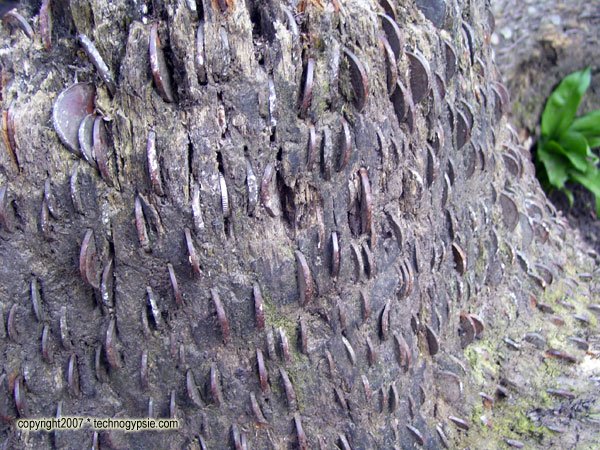
Coin trees involve the offering of coins to a particular tree. These are often hammered into an old trunk, branch, or small tree. Sometimes these are oaks, rowan trees, hawthorns, ash, or thorn trees. Some hawthorns serve for fertility magic such as a common one in Argyll, Scotland by the Ardmaddy House. Sometimes hundreds of coins are hammered into the bark and wood with the belief that a wish will be granted for each of the coins added. A similar one that is well known is the sacred well of ST. Maree in Loch Maree, Gairloch, Scotland has hundreds of coins hammered into it. Also all over the Yorkshire Dales, such as in the pictures shown here I took during a hike, are found hundreds of coins offered to nature spirits and/or faeries for a granting of a wish.

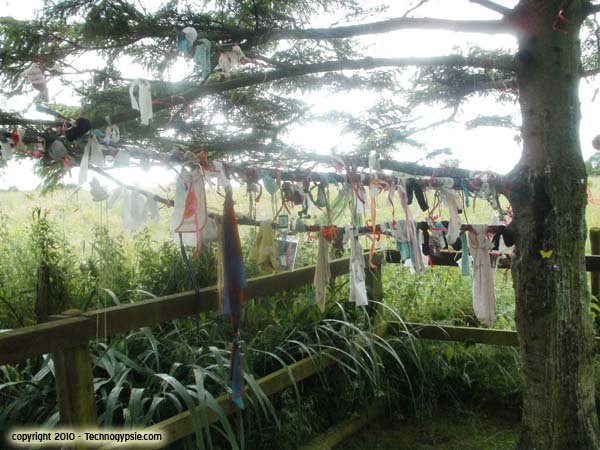
Clootie Wish Trees (a.k.a. Cloughtie or Rag Trees) are found next to sacred wells throughout England, Scotland, and Ireland. This involves the practice of tying a piece of cloth, often called “clouties”, “clooties”, or “cloughties” to ask for an answer to a prayer, a wish, and/or a petition. As the rag decays, so will the illness; or so will the petition come true. It is a form of sympathetic magic. One of the most well-known “wishing trees” is the Madron Well in Cornwall. With the Madron well, a sacred well of healing, it is believed that as the cloth rots, the ailment that one is seeking a cure for disappears. Even Charles Darwin recorded the finding of a “wishing tree” in his travels in Argentina called “Walleechu” which was treated by the local inhabitants as a Deity. It was festooned with offerings such as cigars, food, water, and cloth hung from the branches by bright strips of colored thread. A popular wishing tree in Hong Kong is the “Lam Tsuen Wishing Tree” near the “Tin Hau Temple” in Lam Tsu where paper is tied to an orange and thrown up in the trees that stick will grant the petitioner a wish. The wishing tree next to Brigid’s Well in Kildare is a common tree for petitioning healing requests.

Penny offerings for good luck and as gifts to the Fae "Wishing Tree" Yorkshire Dales, England

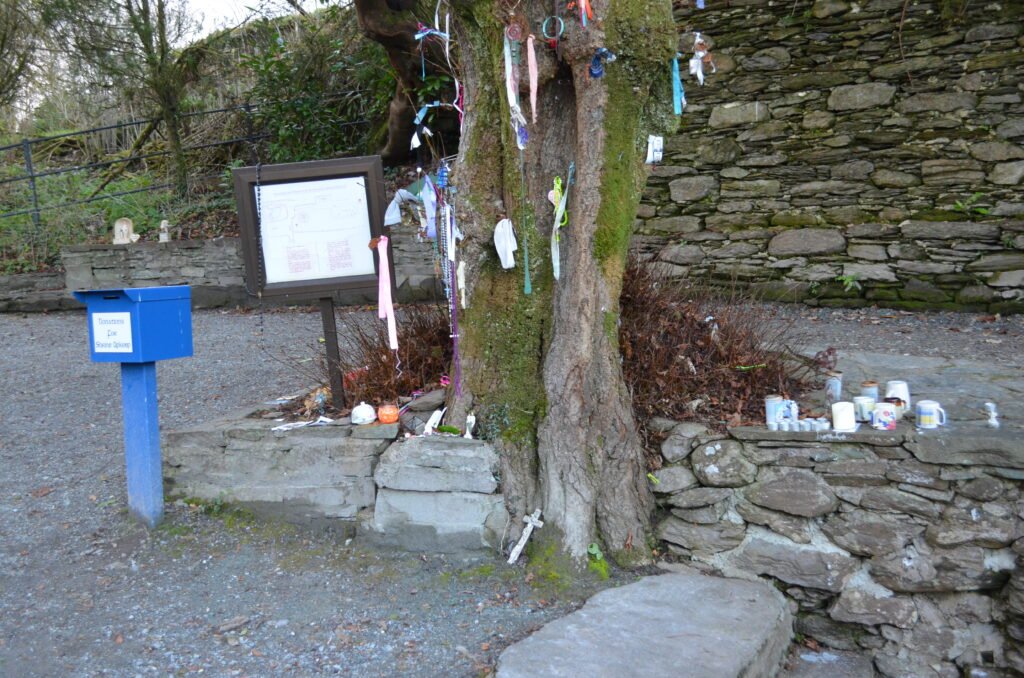
The Wishing Tree at Tobar Ghobnatan Holy Well
not only consists of rags, but trinkets, rosaries, jewelry, prayer cards, toys, personal effects, and other items given as offerings. You can see these at Tobar Ghobnatan Wishing Trees. The concept is to leave behind something of yourself or someone that you love who is in need of prayers, healing, or petitions. The concept with the rags is that when it decays so will the illness that it represents. This is a kind of sympathetic magical rite.

Unfortunately, some pilgrims to the sites don’t realize how the spell or magic works. You can see this when they tie a piece of a plastic bag on the tree. Plastic will take forever to decay, and so will the illness it is to represent. If only they knew! In addition to the rags, others leave coins, jewelry, rings, prayer cards, figurines, toys, personal effects, and clothing items such as belts, shoes, garments, and trinkets. The cloutie and Wish trees found at Tobar Ghobnatan are considered to be dedicated to the Matron Saint of Ballyvourney and sacred Bee-Keeping mistress, Saint Ghobnatan holy pilgrimage site and monastic settlement known as “Tobar Ghobnatan”. This is the legendary home of St. Gobnait/Ghobnatan. It is located a kilometer south of the village of Ballyvourney where her church Móin Mór (a.k.a. Bairnech) was built.

Tobar Ghobnatan Holy Well

Read More “Wishing Trees” »

Faerie Trees

Posted on November 3, 2010 By Techno Tink No Comments on Faerie Trees
Faeries, Mythology, Sacred Sites, Sidhe


Fairy Tree, the Curraugh, Kildare, Ireland

Faerie Trees
United Kingdom and Ireland
Faerie trees are mythical hotspots of otherworldly and/or faerie activity. Faerie trees are seen as the haunts of Faeries. They are fiercely protected by the Fae. It is believed that any human foolish enough to pass by a host-tree late at night will find their arms bruised or pinched by small faerie fingers. Three thorn trees growing closely together are especially potent. Thorn trees hung with ribbons or rags are good gifts to faeries of the tree. Faerie trees are most associated with the Oak, Ash, and Thorn. Sometimes it is associated with the Rowan tree. Others claim its the Elder, Blackthorn, Hazel, and/or Alder. The trees most twisted together are the most notorious of faerie trees – and this is common amongst the Elder. If two thorns and an elder are found together it warns of great danger as do Oak, Ash, and Thorn. In the British Isles, the Rowan is believed to protect one from witchcraft and enchantment. Its berries opposite its stalk display tiny five pointed stars or pentagrams which are notable protective symbols. Color red, as in the flavor of the berry, is also seen as a protection against enchantment. The tree is believed to afford protection to the dwellings by which it grew and often people would take branches of the tree to be carried for personal protection from witchcraft. The belief in them go back to classical mythology, whereas legends tell us that ‘Hebe’, the Goddess of youth, once dispensed rejuvenating ambrosia to the Gods from her magical chalice. When she lost this cup to demons, the Gods sent an eagle to recover the cup. The feathers and drops of blood which the eagle bled in the fight, fell to the earth, whereas each one of them turned into a Rowan tree – the legendary Faerie Tree. It is because of this it is believed that the Rowan derived the shape of its leaves from eagle’s feathers and its berries look like the droplets of blood. The Rowan is also prominent in Norse mythology as being the tree from where the first woman was made. The Mountain Ash were also associated as Faerie Trees which are the most well-known of the Rowan. The wood of the Rowan is often used for staves, wands, divining rods, and walking sticks. Berries are often used to make alcoholic drinks.


The Curraugh, Kildare, Ireland

Read More “Faerie Trees” »

Categories

New Posts

  • Thunder Mountain
  • Area 51
  • The Old Tonopah Cemetery
  • The Clown Motel
  • Thomas the Rhymer / Tam Lin

Pages

  • About Faerie Lore ....
  • Donate
  • Newsletter

Archives

  • Home
  • About Faerie Lore ….
  • Evolution
  • Haunted Locations
  • Herblore
  • Magic & The Occult
  • Media, News, Tales
  • Mythology
  • Folk Songs
  • Giants
  • God/desses
  • Living Myth
  • Monsters
  • Otherkin
  • Prophecies
  • Shadow beings
  • The Undead
  • Urban Legends
  • Religion
  • Traditions
  • Newsletter
  • Donate

Copyright © 2026 Faerie Lore and Legends.

Theme: Oceanly News Dark by ScriptsTown