Legend of the Blarney Stone Blarney Castle, Blarney, Co. Cork, Ireland * Phone: 00 353 21 4385252 * http://www.blarneycastle.ie/
One of Ireland’s most valuable and mesmerizing mythical collections is the infamous Blarney Stone. Called “Cloch na Blarnan” in Irish, it is the legendary stone for the gift of gab. “Blarney” means “Clever, Flattering, or coaxing talk”. The Blarney Stone is a block of bluestone that is built within the battlements of Blarney Castle, locaed approximately 8 kilometers from Cork, Ireland. It is believed that whoever kisses the stone is endowed with the gift of gab, great eloquence, or the skill at flattery. It allows the gifted to impart the ability to deceive without offending. Its not an easy task to kiss the stone, as one needs to be held upside down atop a drop of a tall tower to reach the kissing spot. The stone became part of the tower in 1446 and has become one of Ireland’s most notable tourist sites.
Where does the stone come from? There are many myths and legends surrounding the stone and its origins, the earliest of which involves the Goddess Clíodhna. It is believed that the Castle’s builder, Cormac Laidir MacCarthy, was in a lawsuit and sought out Clíodhna for her assistance. She told him to kiss the first stone he found in the morning on his way to court, and as he did, he gained eloquence and won the court case. Flabberghasted by this magical event he took the stone and added to the castle’s stones. Many believe that it was a piece of the Stone of Scone. Others believe it to be the rock that Moses struck with his staff to produce water for the Israelites during their exodus from Egypt. Others believe it to be the stone that Jacob used as a pillow and was later brought to Ireland by the prophet Jeremiah. It is said that it then became the Lia Fail, or Fatal Stone and was used as an oracular throne of the Irish kings. Some say its the Stone of Ezel which David hid behind on Jonathan’s advice while fleeing King Saul and brought to Ireland during the Crusades. Others believe it to be the rock pillow used by St. Columba of Iona on his deathbead. Some believe that the stone was first presented to Cormac McCarthy by Robert the Bruce in 1314 to recognize his support in the Battle of Bannockburn. Some say that the stone was previously in Ireland then taken to Scotland and brought back to Ireland in 1314. It is also said that during the time of Queen Elizabeth I, Dermot McCarthy, had been required to surrender his fortress to the Queen as proof of his loyalty. He told her he would be delighted to do so, but something always happened at the last moment to prevent his surrender. Many believe this was the charm of the Blarney Stone in effect. The Queen replied to this as “Odds bodikins, more Blarney talk!” Kissing the Stone has been performed by literally ‘millions of people’ in the world, including world statesmen, literary giants, and legends of the silver screen. Kissing the stone is kissing all of these people by proxy, and by the magical law of contact – gaining the gift of gab that all these people possess. Its not an easy kiss and its important for the lips to touch the bluestone. This quest involves ascending to the castle’s peak, leaning over backwards on the parapet’s edge, entrusting a stranger (Castle guard) with your life by holding on to you. Today, safety wrought-iron guide rails and protective crossbars help prevent death or serious injury. Prior to these installations, the kisser was in danger of serious life risk as they were grasped by their ankles and dangled from the plummet. According to the Sherlock Holmes radio dramatization in “The Adventure of the Blarney Stone” (March 18, 1946) reported a man attempting the kiss plummeting to his death – but determined to be a murder as his boots had been greased before the attempt. The cautious and germ phoebic consider the Blarney Stone to be the most unhygienic tourist attraction in the world, as ranked as such by Tripadvisor.com in 2009. When I attended, I watched the guards use antiseptic wipes after every kiss and had hand sanitizer on the spot. Urban legends are amiss that claim locals go up to the Blarney stone at night and piss on it. Of course, anyone who has ever been to the Blarney stone, knowing the tight and tiny ascension up the treacherous tower (that is locked after hours and guarded) that even with breaching security and risking royal criminal punishment, would have to be damn good aim to hit the Blarney stone. Much of the urban legend comes from the incident in the film “Fight Club” where the narrator urinates on the Blarney Stone during his visit to Ireland as his first act of vandalism.
‘Tis there’s the stone that whoever kisses
He never misses to grow eloquent;
‘Tis he may clamber to a lady’s chamber, Or become a member of Parliament.
“A noble spouter he’ll sure turn out, or An out and outer to be let alone;
Don’t try to hinder him, or to bewilder him, For he is a pilgrim from the Blarney stone.”
Many nation’s around the world have attempted to obtain the Blarney Stone. There are quite a few imposters out and about. The one and true stone is in the Blarney Castle. According to a tradition at Texas Tech University, a stone fragment on display since 1939 outside the old Electrical Engineering Building claims to be a missing piece of the Blarney Stone.
One can kiss the stone from monday thru saturday, 9 am to 6:30 pm in September and May, 9 am to 7 pm from June through August, and 9 am to sundown from October to April. On sundays, kissing can commence from 9 am to 5:30 pm during the summer, and 9 am to sundown during the winter.
Faerie Trees United Kingdom and Ireland
Faerie trees are mythical hotspots of otherworldly and/or faerie activity. Faerie trees are seen as the haunts of Faeries. They are fiercely protected by the Fae. It is believed that any human foolish enough to pass by a host-tree late at night will find their arms bruised or pinched by small faerie fingers. Three thorn trees growing closely together are especially potent. Thorn trees hung with ribbons or rags are good gifts to faeries of the tree. Faerie trees are most associated with the Oak, Ash, and Thorn. Sometimes it is associated with the Rowan tree. Others claim its the Elder, Blackthorn, Hazel, and/or Alder. The trees most twisted together are the most notorious of faerie trees – and this is common amongst the Elder. If two thorns and an elder are found together it warns of great danger as do Oak, Ash, and Thorn. In the British Isles, the Rowan is believed to protect one from witchcraft and enchantment. Its berries opposite its stalk display tiny five pointed stars or pentagrams which are notable protective symbols. Color red, as in the flavor of the berry, is also seen as a protection against enchantment. The tree is believed to afford protection to the dwellings by which it grew and often people would take branches of the tree to be carried for personal protection from witchcraft. The belief in them go back to classical mythology, whereas legends tell us that ‘Hebe’, the Goddess of youth, once dispensed rejuvenating ambrosia to the Gods from her magical chalice. When she lost this cup to demons, the Gods sent an eagle to recover the cup. The feathers and drops of blood which the eagle bled in the fight, fell to the earth, whereas each one of them turned into a Rowan tree – the legendary Faerie Tree. It is because of this it is believed that the Rowan derived the shape of its leaves from eagle’s feathers and its berries look like the droplets of blood. The Rowan is also prominent in Norse mythology as being the tree from where the first woman was made. The Mountain Ash were also associated as Faerie Trees which are the most well-known of the Rowan. The wood of the Rowan is often used for staves, wands, divining rods, and walking sticks. Berries are often used to make alcoholic drinks.
“Knocknashee”, legendary ” Hill of the Faeries” County Sligo, Ireland
Knocknashee is known as the legendary “Hill of the Faeries” and is one of Ireland’s seven most sacred hills. The name comes from the Irish “knock” (cnoc) meaning “hill” and “shee” meaning “fairy”. Its older name is Mullinabreena or “Fairy Palace”. The hill fort is located near Lavagh, Ballymote, and rises 900 feet high with a flat top, green and lush, with a diameter of a square mile. Oddly, unlike any other hill in the area, it has absolutely no heather. At its base stands the ruins of Court Abbey and its 90 foot high tower that was built in the 15th century by the O’Haras for the Franciscans. This legendary “Hill of the Fairy Mansion or Palace” as “Mullinabreena” or “Knocknashee” is a sacred site for Faeries and those who worship or believe in them being the mythical headquarters or high court of the Fae. Geologically the hill is a 276 m Marilyn located in the Ox Mountains of County Sligo, Ireland with the River Moy at its foot. It consists of a limestone top with shales underlying the lower slopes. The hill is culturally rich with archaeology as it was discovered to be a hilltop fort in 1988 during a Office of Public Works aerial survey of the county with the observbation of the remains of limestone ramparts containing cairns, burial chambers, and hutsites on its top. The fort is 700 meters long and 320 meters wide, enclosed by two earth and stone ramparts covering an area of 53 acres. There are two cairns, the remains of over 30 circular house sites, and two earth/stone ramparts. The hill has a panoramic view of the Connacht plains. The lower exposures of the hill show irregularly bedded limestone with a diverse fauna of colonial and solitary corals, with very well preserved fossils in silica that were deposited some 340 million years ago. Hilltop is covered with a thin peat. A popular play was made in tribute of the hill called “Knocknashee” by the Irish playwright Deirdre Kinahan in 2002. A traditional Irish song was also named after the hill called “The Hills of Knocknashee” with “The River Moy so gently flows from there unto the sea. Farewell to you, farewell to all from the hill of Knocknashee”.
Directions: Knocknashee is a table-top plateau 7 kilometres NEN of Tobercurry. From Tobercurry take the N17 north for 5 kilometres to Carrowclare then take a left to a T-Junction then a right about 1/2 kilometre on your left is a farm house ask here for permission to climb the hill. Portal Tombs around Knocknasee: http://www.irishmegaliths.org.uk/sligo.htm
Gillighans World * Tel / Fax 00 353 (0)71 30286 / 00 353 (0)71 84100 * Mobile 087 6811690 / 087 6780831 * e-mail [email protected] * Registered Office: Baroncourt, Kilmacowen, Ballysadare, County Sligo * Sligo, Ireland *
Gilligan’s World is a hidden little Faerie theme park, farm, and botanical gardens in the heart of Sligo County in the rolling countryside at the base of the famed Tuatha de Danaan battle mound, the “Knocknashee” the Legendary “Hill of the Faeries”, one of Irelands 7 sacred hills. Mainly centered around children, the park can be a bit of fun for adults and kids alike, especially for those in the faerie persuasion. This little magical kingdom was created by the Baronness of Leyny, the Lady Melody Urquhart (Ph.D) as a faerie habitat to capture the true spirit of Ireland and its mythological/archaeological past. In 1993, she left fame and fortune behind in England as a choreographer / producer / director/ and owner of a finishing school in order to build this sanctuary. Attracted to the Knocknashee, the Mullinabreena, the Hill of the Fairy Mansion or Palace. Complete with miniature model villages, enchanted glades, streams, botanical gardens, a petting zoo, snack shop, gift shop, library, restrooms, car park, picnic areas, and an inn. Streams, forests, wildlife ponds, an aquatic cave, play facilities, with games, quizzes, and puzzles to achieve. The staff is well educated about faerie lore and history. Great place for the kids, schools, coach tours, birthday parties, family groups, and overseas tourists. It has a stone tunnel entrance, with dolmen, an amphitheater, lush green lawns, and inspiration for the wild, wacky, kitch, artistic, imaginative, and fantasy. Its open 7 days a week, Easter through September from 12 to 6 pm on mondays thru fridays, 2 pm to 7 pm on saturdays and sundays. While very kitchy and centered around children, as an adult with a faerie fascination, I enjoyed the park very much – and hope to go back to actually explore the actual Knocknashee. Rating: 4.5 stars out of 5.
Newgrange: Brú na Bóinne, Ireland
One of Ireland’s most infamous monuments and archaeological sites, Newgrange is amongst the Bru na Boinne World Heritage sites next to Knowth and Dowth. It is popular like Stonehenge with its Solstice astronomical line-ups and viewing of the sun as it appears through its portal. The monument is a large mound complex shaped like a giant kidney covering an area of about an acre of land and is surrounded by 97 kerbstones most of which are decorated by megalithic rock art. Newgrange is one of the best examples in Ireland and Western Europe of a passage grave or tomb. Constructed around 3200 BCE, this site is older than the Egyptian pyramids and a 1,000 years older than Stonehenge. Located along a elongated ridge on the Boyne River, five miles west of Drogheda, and close to the location where the Battle of the Boyne took place in 1690. Built entirely wih stone tools the Faerie Sidhe (folklore) or Passage Grave (Archaeology) is an impressive monument: The purpose of the monument is disputed greatly as there is no evidence that Newgrange was used as a repository for bodies, bones, burial artifacts or ash. Mythology tells us that the Tuatha Dé Danann, legendary first rulers of Ireland, built Newgrange as a burial place for their chief – the Dagda Mór with his three sons. The site is also believed to be where the hero Cúchulainn was conceived by his mother Dechtine. Also listed in mythology as a Faerie Mound, it was believed to have been the home of Oenghus, the God of Love. Other theories are that it was a place of worship for a “cult of he dead” or for astronomically-based faiths. Visitors can only access Newgrange via bus shuttle from the visitor center at Brú na Bóinne and those wishing to see the Winter Solstice sunrise light-up has to be awarded via lottery for the experience with a select few other lottery winners. A 19 meter long inner passage leads to a cruciform chamber with a corbelled roof. At the end of the passage are three small chambers off the larger central chamber. Each of the smaller chambers has a large flat ‘basin stone’ which is where it is believed the bones of the dead were originally deposited. During the Winter Solstice, lights of the rising sun enters the roofbox – lighting up the passage, and shining onto the floor of the inner chamber – illuminating the room for 17 minutes. Megalithic Rock Art surrounds the monument with some world notable pieces such as the triskel carved on the entrance stone, Kerbstone 1 and 52. Other rock art carvings fit into one of ten categories, five of which are curvilinear (circles, spirals, arcs, serpentiniforms, and dot-in-circles), and the other five are rectilinear (chevrons, lozenges, radials, parallel lines and offsets). Intriguing archaeological finds were found throughout the site, including Roman coins, an iron wedge, and a stone phallus. It is believed to have taken 20 years to build with a work force dedicated all of those years full time of 300 individuals. Under the burial tomb theory, it is believed to have been sealed and closed for several millenia after which the local folklore and mythology of the faeries were believed to be assigned to the mound. The site was used for ritual purposes well into the Iron Age. The Passage tomb was re-discovered in 1699 when material for road building was being harvested from the mound. A large excavation of the mound took place in 1962 as well as the rebuilding of the original facade of sparkling white quartz stones found at the site. Newgrange has been compared to the Gavrinis passage tomb in Brittany for which it is very similar to. The Gavrinis cairn is 5,500 years old; 60 meters in diameter, and covers a passage and chamber that is lined with elaborately engraved stone. Newgrange is built of alternating layers of earth and stone with grass growing atop, and the front reconstructed facade is of flattish white quartz stone studded at intervals with large rounded cobbles covering the circumference.
Brú na Bóinne * aka “Palace of the Boyne” or “Bend of the Boyne” * Knowth/Newgrange, Donore, Co. Meath, Ireland * UNESCO World Heritage Site *
“Bru na Boinne” is the name of a Boyne River Valley section that is home to the World Heritage sites consisting of the Tumulus Sidhe known as “Knowth”, “Dowth”, and “Newgrange”. These monuments are the largest and one of the most important prehistoric megalithic sites in Europe that consist of a complex of neolithic chamber tombs, standing stones, henges, and other prehistoric enclosures dating as early as 35th century B.C.E. (predating the Egyptian pyramids) The Palace is centrally the name for the visitor center that is home to a museum, cafe, interpretive displays, information center, and central shuttle bus location for visitors to get to Knowth and Newgrange. It is located in County Meath near the village of Donore along the south bank of the Boyne River. The large oval stones in the water feature are 330 million-year-old naturally occurring concretions that make the site a geological attraction as well. The Sidhe/Tumulus of Newgrange and Knowth are to the north of the Boyne.
The site covers over 780-hectare acres with over 40 passage graves, prehistoric sites, henge stones, circles, and features as well as substantial Megalithic rock art. Each of the monuments is on a ridge within the river bend, with Knowth and Newgrange containing stones re-used from earlier monuments at the site. The sites were visited repeatedly and re-used during various ages such as the Bronze Age, Iron Age, and Medieval periods adding assortments of artifacts, features, and enclosures to the site throughout the years. In addition to the famous tombs/tumulus of Knowth, Dowth, and Newgrange are also the ceremonial complexes known as Cloghalea Henge, Townleyhall passage grave, Monknewtown henge and ritual pond, and the Newgrange cursus.
Newgrange stands as the central mound of the Boyne Valley passage grave cemetery. Each of these three main tumulus sites has archaeo-astronomical significance and alignments. Newgrange and Dowth have Winter Solstice solar alignments, and Knowth has an Equinox solar alignment. The complex areas are surrounded on the south, west, and east by the Boyne River, and to the north by the Mattock River.
The River Boyne The Goddess Boann A grandiose River in Leinster, Ireland that runs a course of over 112 kilometers (70 miles) passing by the Brú na Bóinne complex and World Heritage site, by the ancient city of Trim, Trim Castle, the Hill of Tara, Navan, the Hill of Slane, Mellifont Abbey, and the medieval city of Drogheda. It starts at Trinity Well in Kildare and flows towards the Northeast through County Meath where it empties into the Irish Sea. The river is abundant with Salmon and trout that hosts much Irish mythology on the passage of knowledge down the river. The river is notorious for its historical, archaeological, and mythological connotations. Ptolemy drew out the river in his mapping of Ireland and he called it ????????? (Bououinda). According to Irish mythology, the river was created by the Goddess Boann and the river is named after her as well as representative of her. It is also the river where Fionn mac Cumhail captured Fiontan, the Salmon of Knowledge. It is also home to the infamous “Battle of the Boyne” which took place near Drogheda in 1690. The archaeological remains of a Viking ship were found in 2006 in the river bed near Drogheda.
From the dawn of religious thought there has been belief in an Underworld and/or an Otherworld. A place where we are trapped when we die, disturbed or without resolution, that sits upon our world, sometimes referred to as Limbo, Hades, The Waiting Place, and the Inbetween. Many believe in a Hell and a Heaven. Others believe in a Summerland. Others do not. Some believe in Reincarnation. But just about everyone has an opinion about where we go when we die.
The Otherworld is one place that many deduce is where human spirits reside after death. But it’s not just a place for ghosts and poltergeists. Still, it is also often labeled as a place of residence for all of the undead and supernatural, from zombies to vampires, from faeries to trolls, from Gods to Goddesses, and the elemental spirits of nature.
Celtic mythology calls “The Otherworld” (Orbis Alia) the “Realm of the Dead, the Home of the Deities, or the stronghold of other spirits, and the Mighty Sidhe.” Folklore depicts the Otherworld as existing over the western sea or underground, such as in the Sidhe mounds of Ireland and the British Isles, or as a realm layered like a transparency over the world of the living but invisible to our physical sight. I’m more of an advocate of the belief that the Elemental and Faerie Realm, Realm of Deities, and the Land of the Dead are all ‘separate’ realms … layered on top of each other as transparency-like layers of an onion in the worlds within worlds that make up the cosmology of universes in which we live.
The Irish described their Otherworld as underground and sometimes on islands in the Western Sea. I believe they actually saw it as a separate realm from the land of Faeries and the Sidhe, and scholars or folklorists, not being very well versed in the different dimensions, just lumped these worlds into one solitary world separate from the land of the living. There are many different references by the Irish to these realms, including Tir na mBeo (“the Land of the Living”), Mag Mell (“Delightful Plain”), and Tir na nog (“Land of the Young”), among other names.
This is one of the reasons I believe the Irish truly believed them to be different places. Irish mythology talks of these places as a country where the inhabitants never grew old, got sick, or died, where they were eternally at peace and happiness, and one year of occupation in that realm would equate to 100 human years.
The Greeks spoke of a similar place called the “Elysium” (Greek mythology). Of course, the Greeks and the Irish may have a shared origin in ancient Proto-Indo-European religion, so that might make sense. There are many folktales in both cultures where a beautiful young woman often approaches the hero and sings of these happy lands, offering him an apple or the promise of her love in exchange for his assistance in battle. The myths have him following her on a journey over the sea, and they are never seen again.
Mythological and folklore elements involve boats of glass, chariots, horses, food, drink, and lures of love. Sometimes, the mortal man returns to the human realm to find his previous family and friends deceased for ages and, while believed to have been gone for a few years, were actually gone for hundreds of years. (ex: Tale of Oisin, Thomas the Rymer, Rip Van Winkle, Tale of Bran and Branwen, etc.) There are quests in the tales, and a magical mist always seems to descend upon them. They are always changed and affected by their contact with the Otherworld. How many of these individuals cross over from the human realm to the land of spirits or the dead is abundant in Indo-European folklore and stories. These seem to occur in liminal places, gateways, or on special days of the year.
The Gaelic festival of Samhain (November 1st), as well as Beltane (May 1st), are believed to date when the boundaries between the worlds become even more permeable than usual, and visitors from both realms can travel in between the realms, sometimes on purpose other times accidentally. Folklore is obsessed with the concern about preventing the intrusion of spirits into the human world and the loss of humans to the Otherworlds. Many spells, charms, superstitions, and rituals exist throughout history to prevent the crossing over of humans and entities between these dimensions. Some believe that Irish folklore is a heaven of sorts. Interpreters of Irish poetry and storytelling claim the Otherworld is simply a land of paradise, happiness, and summer.
I am of the opposite view that the realms those stories tell about are a completely different world than the land of the Dead. I believe that there is a land of Faeries (Sidhe, Faerieland or Faerieworld), a land of the Dead (Otherworld), a land of Demons (Underworld / Hades / Hell), a land of Deities (Summerland or Heaven).
Land of the Dead is what I refer to when I discuss the Otherworld. Brittany sees this as an island someplace west of Great Britain. When the souls of the dead leave the human body, they go to the homes of fishermen and knock desperately on their doors for the ferry to these islands. The fishermen would leave their homes and ferry the dead to these lands in ghostly ships called “Bag a Noz.” Christian beliefs on the British Isles talk about a Galicia northern coastal village called ‘San Andres de Teixido’ where a little hermitage consecrated to Saint Andrew houses his bones. Tacitus says this is where the ‘heavens, seas, and earth end.’ It is believed by many that if you don’t visit this place when you are living, you must visit after you die in the form of a serpent or lizard to take your journey to the land of the dead, according to words from Jesus through Andres. Many Spanish authors also claim this is the starting place for the souls of the dead on their trip to the Other World.
The Irish God of Gateways and the Sea, Manannon Mac Lir, is often seen as a gatekeeper between these Isles of the Dead and the Lands of the Living. In modern fantasy, such as in the tales of the television series “Buffy the Vampire Slayer,” the gateway to the realms of the dead or the world of demons is called “The Hellmouth.” This serves as a magical portal between the worlds. Supposedly, it is a place of increased supernatural energy and a gate that attracts demons and other supernatural creatures as a hot spot. While completely created by the filmmakers, the concept is based on the gateways to the realm of the dead found in mythologies.
The “Otherworld” as the “Spirit World” or “Land of the Dead” is seen as a habitation realm of spirits. The belief in spirits comes from the theory that the Earth itself and all living things on the Earth have spirit counterparts that existed before the physical creation, and a living soul consists of a spirit body united with a physical body. The spirit’s existence is composed of organized and refined spirit matter that extends to all life, including plants, animals, and humans.
Even the Christian bible refers to plant spirits as being created as spirits before they were created with physical bodies (Moses 3:5, 9). Under these beliefs, there are premortal and postmortal spirit worlds. Premortal spirits exist initially in “heaven,” where monotheistic faiths believe their God lives. There is the belief by many that the spirit, after leaving the body from death, yet before the resurrection, is taken by an angel or a reaper to the home of God who gave them life; they are then often judged and/or assigned to a place of paradise or a place of hell and ‘outer darkness.’ Postmortal spirits inhabit a world where they reside and converse together in the same way as they do in the human world. There is the belief that they conduct similar activities, labor, and life as they did when they were living; it is a place where they learn and prepare for the next life as an extension of mortality. Those at unrest or unfinished with their mortal existence often haunt or are trapped in between the human realm and the Otherworld or the Underworld. Some equate these realms to be located in Middle Earth or akin to Hollow Earth Theory.
Mythological Placenames
The Underworld
is often a realm corresponding to what some call ‘the Otherworld.’ In the studies of religion and mythology, this is a generic term that applies to ‘the afterlife’ or any place where newly dead souls go. It is often seen as a neutral or dystopic realm in the afterlife, instead of Heaven or Hell, so prophesized by the religion of Christianity. Many also believe it is a realm that resides atop our own where the unrested / disturbed / or spirits reside until they can pass on to the land of the dead. To some, it is a waiting place or a limbo. Others label the Underworld as Hell or Hades. The Underworld is referred to as Mctlan by the Aztec, Kurnugia by the Babylonians, Naraka or Niraya by the Buddhists, Annwn or Mag Mell by the Celts, Yum gan (??) by the Chinese, Aaru / Anubis / Duat / or Neter-khertet by the Egyptians, Toonela by the Estonians, Tuonela by the Finnish, Elysium / Asphodel Meadows / Hades / Tartaros by the Greeks, Sheol / Gehenna by the Hebrew, Naraka / Yamaloka by the Hindu, Uku Pacha by the Inca, Adlivun by the Inuit, Jahannam / Narr / Janna / Barzakh / Araf by the Islam, Yomi / Jigoku by the Japanese, “Ji-Ok” ?? ?? by the Koreans, Aizsaule by the Latvians, Hawaiki by the M?ori, Pellumawida / Degin / Wenuleufu / Ngullchenmaiwe by the Mapuche, Metnal / Xibalba by the Maya, Bulu / Burotu / Murimuria / Nabangatai / Tuma by the Melanesians, Gimle / Hel / Niflheim / Valhall / Vingolf by the Norse, Ekera by the Oromo, Kasanaan / Empiyerno by the Philippine, Avaika (and other names) by the Polynesians, Shipap by the Pueblo, Inferno / Avernus / Orcus / Hades / Pluto by the Romans, Podsvetie / Peklo / Nava by the Slavs, Dilmun / Kur / Irkalla by the Sumerians, Guinee by the Vodou, and Hiyoyoa by the Wagawaga.
The Underworld is ruled by demons, spirits, veli, Cerberus, ghosts, and other supernatural guardians, as well as Baiame / Eingana by the Aboriginal, Allu / Anu / Anunnaku / Ereshkigal / Etemmu / Gallu / Humbaba / Mamitu / Nergal / Utnapishtim by the Akkadians, E Bukura e Dheut by the Albanians, Spandaramat by the Armenians, Mictlantecuhtli / Mictecacihuatl/ Chalmecacihuilt/ Chalmecatl by the Aztec, Erra / Nergal / Ninlil / Sursunabu / Ur-shanabi / Utnapishtim by the Babylonians, Batara Kala / Setesuyara by the Balinese, gNyan by the Bon, Yama / Emma-0- / Yanluo by the Buddhist, Mot by the Canaanites, Aed / Arawn / Cwn Annwn / Donn / Gwyn ap Nudd / Mannanon Mac Lire / Pwyll / Sluagh by the Celts, Gui / Yanluo by the Chinese, Demons / Devil / Satan / Lucifer by the Christians, Aken / Aker / Am-heh / Amunet / Ammit / Andjety / Anubis / Apep / Apis / Astennu / Ha / Imiut / Isis / Mehen / Naunet / Nehebkau / Nephthys / Nun / Nut / Osiris / Ptah / Seker / Thoth by the Egyptian, Jabru by the Elamites, Vanapagan by the Estonians, Charun / Culsu / Februus / Mania / Mantus / Nethuns / Tuchulcha / Vanth by the Etruscans, Kalma / Kipu-Tytti / Kivutar / Lovitar / Surma / Tuonen akka / Tuonetar / Tuoni / Vammatar by the Finnish, Cerberus / Charon / Hades / Keres / Persephone / Styx / Thanatos / Tartaros by the Greeks, Sasuleti by the Georgians, Ta’xet / Tia by the Haida, Yamaraja by the Hindu, Kachina by the Hopi, Ala by the Ibo, Supay / Vichama by the Incan, Dwi Shri / Ndara by the Indonesian, Pana / Sedna by the Inuit, Mala’ikah by Islam, Hisa-Me / Hotoke / Ika-Zuchi-no-Kami / Jikininki / Shiko-Me / Shiti Dama / Shi-Ryo / Yama by the Japanese, Dur by the Kassite, Preas Eyssaur by the Khmer, Veli / Velu mate / Zemes mate by the Latvian, Mot by the Levantine, Kalunga by the Lunda, Kewa by the Maori, Xibalba by the Maya, Egei / Ratumaibulu / Samulayo by the Melanesian, Chepi by the Narragansett, Estanatelhi by the Navajo, Mctanteot by the Niguiran, Garmr / Hel / Ran by the Norse, Angra Mainyu / Azhi Dahaka / Peri by the Persians, Bathala / Demonyo Demon / Lucifer / Dyablo Diablo / Satan / Diyos God by the Philippine, Horo by the Phoenicians, Men by the Phrygian, Hikuleo (and many others) by the Polynesians, Picullus by the Prussians, Iyatiku by the Pueblo, Cereberus / Dea Tacita / Dis Pater / Egestes / Fames / Inferi Dii / Larenta / Letum / Libitina / Mors / Orcus / Pluto / Proserpina / Viduus by the Romans, Dyavol / Satanaya by the Russians, Yambe-akka by the Saami, Amotken by the Salish, Chebeldei / Kul by the Siberians, Crnobog / Flins / Marzana / Nyia by the Slavs, Edimmu / Ekimmu, Urshanabi (and many others) by the Sumerians, Cur by the Tamil, Heros by the Thracian, Erlik by the Turkic, Baron Cimetiere / Baron La Croix / Baron Samedi / Ghede / Maman Brigitte / Marassa Jumeaux by the Vodoun, Tumudurere by the Wagawaga, Oya by the Yoruba, Nga by the Yurak, and Uhepono by the Zuni. [Retrieved from “http://en.wikipedia.org/wiki/Underworld”]
Many believe the underworld is hidden within the depths of the Earth; some say the center of the Earth. According to Greek Mythology, it is the Kingdom of the Dead and is ruled over by Hades (residing at the very depths), who is only concerned with increasing the population of the Underworld. It is surrounded by a series of rivers such as the Acheron (river of Woe), Cocytus (river of lamentation), Phlegethon (river of fire), the Styx (river of unbreakable oath), the Lethe (river of forgetfulness). Across the rivers lies the gate to the mortal realm guarded by Cerberus. Many believe the dead area is ferried across the Acheron by Charon to Hermes, who leads them to the gates. Only those who can afford the fare, with coins on their lips or eyelids, receive passage. The rest are trapped between the worlds.
Once in the Underworld, you cannot leave. At the Gates, those are judged by Rhadamanthus, Minos, and Aeacus, who pass sentence – those who are good go to the Elysian Fields, and the rest go through ordeals and often to the depths of the Underworld. Many see the Underworld as an unpleasant realm of misery, death, despair, darkness, and shadow.
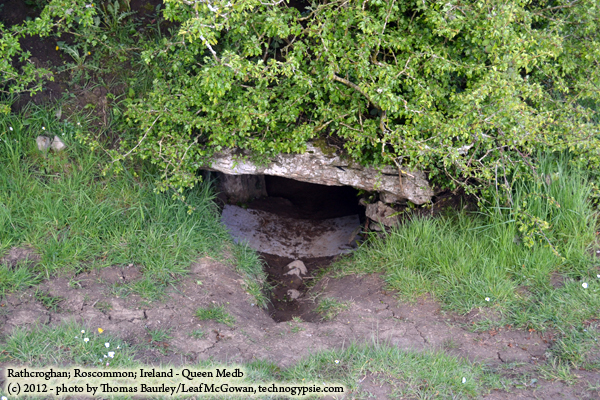
Oweynagat Cave – Cave of the Cats – Gateway to the Underworld and the Morrigan’s Palace.
The Sidhe or the Lands of the Fae
Ireland and the British Isles talk of an underground dimension or lands across the western seas hidden by mists where the original inhabitants of Ireland now live. The Mighty Sidhe, the Tuatha De Danann, and perhaps the Fomorians were all driven to this Underworld by waves of invaders such as the Gaels, who came from Spain and were led by chieftain Mil Espeine. It is believed they had no choice but to take refuge under the sidhe, which denotes ‘hills where the long barrows lay and which is also used to name a special kind of fairies in Ireland and the Scottish Highlands, the daoine sidhe.’ There are believed to be Knocks (Irish cnoc), which are hollow hills inhabited by large communities of faeries often led by a King and/or Queen.
The most common sites are located in Ireland and known as Knockma (ruled by Finvarra of the Connaught fae), Knockany (ruled by Aine of the Munster Fae), and Newgrange in county Meath where the Angus og myth takes place, and archaeological ruins still exist; and in Brittany, the Castro of Altamira led by Xana Mega, the Queen of the Fairies.
Many believe that during certain times of the year, humans can find sidhe as the faeries can often be seen dancing under the moonlight. Others believe faerie gates or portals connect these realms, from archways in trees, holes in stones, and fairie rings of mushrooms. The Sacred Isles of the Western Sea are known as Isles of Paradise, where supernatural beings reside, from Sirens to Mer-folk and the Lands of the Young. The waters surrounding these isles have magical properties.
Sterile women perform rituals at La Lanzada Beach (Galicia), where nine successive waves wash over them to help them become pregnant in these lands. On some of these Islands, the Gods, Goddesses, and Heroes reside. Anglesey (Min), located on the Northern Welsh Coast, is a sacred island of the druids of Britain; the Scilly islands, where archaeological remains of proto-historical temples have been found; and some of the Hebrides Islands, which were, in the Gaelic tradition, home of ghosts and demons: on one of them, Skye, the Irish hero Cuchulainn was educated by the war goddess Scathach. [wikipedia]