The Headless Horseman of Sleepy Hollow

062713-155

The Legend of Sleepy Hollow

Based in the town of “Sleepy Hollow”, New York formerly known as “North Tarrytown” experiencing the name change to honor this story in 1996. The tale is not documented as an actual legend, but rather a tale by the American author Washington Irving while he was traveling abroad in Birmingham, England. He was a resident of North Tarrytown, New York and used the area as a setting for his short story. Irving included it in a collection of short stories and essays he wrote in 1820 called the “Sketch Book of Geoffrey Crayon, Gent.” “The Legend of Sleepy Hollow” is a classic example of American fiction, alongside his masterpiece “Rip Van Winkle” which made Washington Irving become a legend in the literary world. As of an “actual” headless horsemen, there exists no evidence of a prior legend or reporting in the means of how Washington Irving told the tale, though there does exist a headless corpse buried in a unmarked grave in the Old Dutch Burying Ground (Sleepy Hollow Cemetery) that matches the “Headless Horseman’s” lack of a head and being a Hessian soldier. (The Full legend and short story can be read here: http://www.sleepyhollowcemetery.org/sleepy-hollow-country/the-legend/. )

062713-148

The story details Sleepy Hollow and its inhabitants living there in 1790 around the historical Tarrytown as it existed in that day. The area was inhabited by all Dutch settler descendants who moved to this sleepy little glen called “Sleepy Hollow” by Irving’s story which was already basked in myths and legends making it a dreamy and drowsy place even before this tale came to be. Full of ghost stories and the paranormal, Sleepy Hollow was the perfect place for the existence of the spirit of a Headless Horseman. He was seen by some as the most popular curse upon the village, as he was apparently a ghost of a angry Hessian trooper who lost his head by a stray cannonball during the American Revolution and “rides forth to the scene of battle in nightly quest of his head” eager to victimize those of ego and arrogance. The tale involves the local superstitious ego-centric school master named Ichabod Crane who was after the hand in marriage of 18 year old farmer’s daughter Katrina Van Tassel. He was in competition for the proposal with the town mischief maker named Abraham “Brom Bones” Van Brunt. Crane was after the farmer’s wealth, Van Tassel estate, and saw marriage to Katrina as a way to obtain that status. “Brom Bones” however, also interested in Katrina, was interested in her for love. In his fight for the bride, he tries to mishap and veer Ichabod away from Katrina by performing numerous pranks on Crane, based around Crane’s paranoia and superstitions. Tensions become high, and during the annual Van Tassel harvest party, Crane is told ghostly legends of the area by Brom Bones and the locals. Crane is made so jumpy and nervous on that night that his intended proposal to Katrina was interrupted. He rides home “heavy-hearten and crest fallen” through the ghostly woods that the locals and Brom Bones told the tales of … edgy and spooked traveling from the Van Tassel farm to the Sleepy Hollow settlement. He passes by the tulip tree that had been struck by lightning and was reputedly haunted by Major André, the British spy. Instead of seeing that specter, he sees a cloaked rider at an intersection to the menacing swamp. This cloaked rider approaches him and rides alongside Crane. The man, large stature and size, appears to Crane not to have a head on his shoulders, but rather a decapitated cranium sitting on his saddle. Crane becomes spooked and races off to the bridge next to the Old Dutch cemetery. Upon reaching the bridge, the Headless Horseman vanished “in a flash of fire and brimstone” upon crossing the bridge. Ichabod crosses the bridge, but not before the specter re-appears on the bridge and hurls his head into Crane’s face. The next day, Ichabod could not be found except for his wandering horse, trampled saddle, discarded hat, and a mysterious shattered pumpkin. With Ichabod Crane nowhere in sight, the match with “Brom Bones” for Katrina’s hand in marriage was forfeited. Brom and Katrina married. Suspicion amongst the villagers bounced between believing the legend and “Brom Bones” being the villain who had the stature and size of the Headless Horseman. Many believe it was Brom in disguise, playing on Ichabod’s fears, and as a prank used to scare off Crane. However the Old Wives tales prevailed, stating that Crane indeed was “spirited away by supernatural means” and thereby increasing stories (mainly fabricated) of numerous sightings of the Headless Horseman to this very day.

Folklorists compare the American short story to the German folktale of “the Wild Huntsman” when a phantom races through the woods atop a horse scaring trespassers out of the forest. This tale most probably was the one that inspired Irving during this travels through Germany to concoct the tale of the Headless Horseman of Sleepy Hollow.

The German folklorist Karl Musäus states that the Headless horsemen was a staple of Northern European storytelling especially in Germany (“The Wild Huntsman”), Ireland (“Dullahan”), Scandinavia (“the Wild Hunt”), and English legends. These “headless” horsemen would race through the countryside with their decapitated heads tucked under their arms, often followed by hordes of coal-black hounds with fiery tongues (demon dogs). Folklore would talk of these as being omens of ill-fortune for those who chose to disregard their apparitions. These ghosts would mainly focus on individuals who had egos and arrogance, were overly proud, and/or scheming persons with misguided intentions such as the likes of Ichabod Crane. There are other folk tales and poems of a supernatural wild chase including Robert Burns’ 1790 “Tam o’ Shanter” and Bürger’s Der wilde Jäger, translated as the 1796 “The Wild Huntsman”.

The legend of Sleepy Hollow is classified as a fictional tale. It was set on a local bridge in Sleepy Hollow that crossed the Pocantico River into the Sleepy Hollow Cemetery. Irving most likely incorporated local residents as characters in the tale, whereas Katrina’s character has been matched by folklorists to local resident Elanor Van Tassel Brush. However, there is ample evidence to make it an actual legend based on place names, characters, and history leading to the fabricated tale by Washington Irving. There was a farm owned by Cornelius and Elizabeth Van Tassel that was raided by English and Hessian soldiers in November 1777. They tried to fight off the invaders which led to their farmhouse being burnt down and their family being held hostage. While they watched in horror as their farmhouse was burning, Elizabeth could not find their baby Leah anywhere, and upon trying to run into the flames to search for her baby, was interrupted by a Hessian soldier who led her to a shed where Leah was safely wrapped up in a blanket safe and sound. The family was so grateful to this soldier for the safety of their baby. After the event, when a Hessian soldier was found in Tarrytown (around the area now called Sleepy Hollow) dead missing his head, they gave him a proper Christian burial and buried him in the Old Dutch Burial Ground (now Sleepy Hollow Cemetery) in case he was the soldier who saved their baby.

062713-133

Tarrytown and Sleepy Hollow was one of the historical sites where many battles and events of the American Revolutionary War took place, and was a great backdrop for this invented myth as many matching actual reports of hauntings and ghostly sightings that pervade the area. After these battles were done, a 30 mile stretch of scorched desolated lands were left to outlaws, raiders, and the corpses of the dead. One of those corpses was indeed a headless corpse of a Hessian soldier nicknamed Mr. Jäger found in Sleepy Hollow after a violent skirmish took place there. He corpse was buried by the Van Tassel family in a unmarked grave at the Old Dutch Burying Ground. While Washington Irving served New York Governor Daniel D. Tompkins, he had met an army captain named Ichabod Crane during an inspection tour of the fortifications in 1814. This meeting took place in Sackets Harbor, New York and not Sleepy Hollow. This meeting most likely inspired him to name the character as the schoolmaster for the name, and the schoolmaster image as Jesse Merwin, a local teacher in Kinderhook, New York he also inspired Irving.

This short story has been one the most well studied and examined of tales of its time and of Washington Irving’s works. Numerous re-tellings and re-writings have come about through the ages. Numerous plays, films, and television shows were done to memorialize the legend such as Edward Venturini’s silent 1922 silent film “The Headless Horseman” playing Will Rogers as Ichabod Crane; 1948 Broadway Musical “Sleepy Hollow”; Walt Disney’s “The Adventures of Ichabod and Mr. Toad” in 1949; Disney’s 1958 “The Legend of Sleepy Hollow”; the 1980 Henning Schellerup “Legend of Sleepy Hollow” television classic; 1988 PBS adaption; The one-act stage adaptation by Kathryn Schultz Miller in 1989 called “The Legend of Sleepy Hollow”; Nickelodeon’s 1992 “Are You Afraid of the Dark?” episode “The Tale of the Midnight Ride”; Rocko’s Modern Life “Sugar-Frosted Frights” parodie; Canadian television’s 1999 “The Legend of Sleepy Hollow”; The 1999 Speaker and Orchestra 15-minute composition by Robert Lichtenberger called “The Legend of Sleepy Hollow”; and the most famous 1999 Tim Burton’s “Legend of Sleepy Hollow” starring Johnny Depp, Christina Ricci, Casper Van Dien, and Christopher Walken. The Legend continued through film and audio tellings with the 1999 computer animated classic “The Night of the Headless Horseman” by Fox; Porchlight Entertainments 2002 “The Haunted Pumpkin of Sleepy Hollow”; Steven J. Smith, Jr.’s 2004 “The Legend of Sleepy Hollow in Concert”; the television movie by ABC Family Channel in 2004 called “The Hollow”; 2004 “Charmed” episode of “The Legend of Sleepy Halliwell”; PBS “Wishbone” series “Halloween Hound: The Legend of Creepy Collars”; The 2009 Opera “The Legend of Sleepy Hollow” by Robert Milne; William Withem and Melanie Helton’s 2009 Legend of Sleepy Hollow Opera; the Jim Christian and Tom Edward Clark 2009 Musical “Sleepy Hollow”; The 2011 Hunter Foster book and play called “The Hollow”; Darkstuff Productions 2012 adapted Legend of Sleepy Hollow; and in 2013 a Fox TV series pilot called “Sleepy Hollow” is in production as a modern tale.

North Tarrytown in 1996 changed their name to “Sleepy Hollow” as a memorial to Washington Irving, and its local high school team are called “The Horsemen”, by 2006 a large statue of the Headless Horseman chasing Ichabod Crane was erected, and since 1996 at the Philipsburg Manor holds a Legend Weekend where the story is retold and played out just before Halloween.

062713-097

(more…)


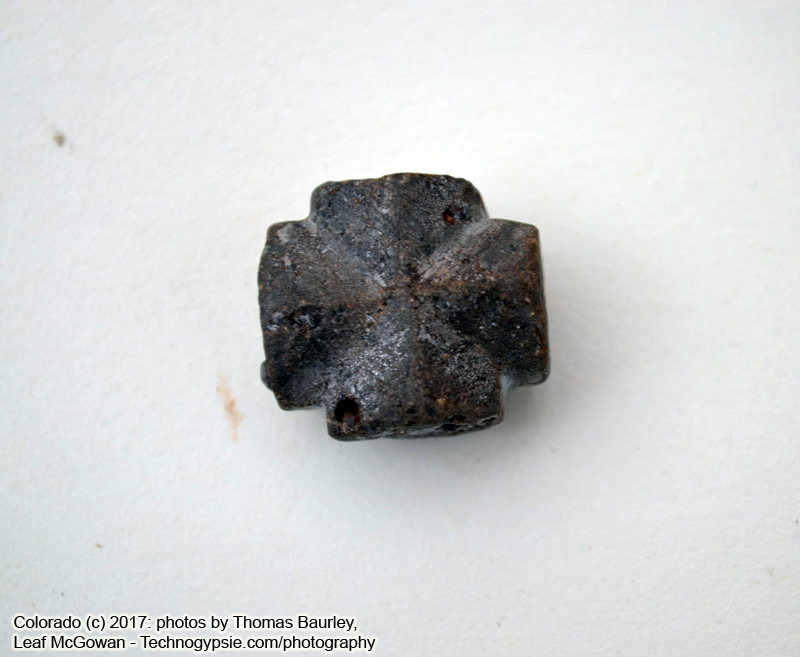
Staurolite: Fairy crosses/stones

FC-005: Celtic Cross Fairy Cross from Taos, New Mexico.


Purchase one here

Fairy Stone / Fairy Cross / Staurolite

Localities: Fairy Stone State Park, Virginia, USA; North Georgia, USA; Little Falls, Minnesota, USA; Taos, New Mexico, USA; Switzerland; Russia; Australia; Brazil; France; Italy; Scotland.

Description: Popular to its folklore and legends, this stone has a State Park in Virginia named after it as it is home to its namesake “fairy stones”. It is also the official stone of the state of Georgia in the USA. Most commonly shaped like Celtic crosses or the St. Andrew’s cross, as an “X” or as a “T” shaped Roman cross, and square Maltese crosses. Color of the Staurolite varies to the region it comes from but can be dark brow, brownish black, grey, or reddish brown.

Geology:Staurolite are a combination of silica, iron, and aluminum. A silicate mineral, with the Chemical formula of Fe2+2Al9O6(SiO4)4(O,OH)2, and a Strunz classification of 9.AF.30, possessing a monclinic prismatic crystal symmetry. It’s H-M symbol is (2/m), with a Space group of C 2/m, and a unit cell a = 7.86, b = 16.6, c = 5.65; ? = 90.45; Z=2. Coloring ranges from yellowish brown, rarely blue, dark reddish brown to blackish brown, pale golden yellow in thin sections with a subvitreous to resinous luster, white to gray streaks, transparent to opague diaphaneity. Specific gravity is 3.74 – 3.83 meas. 3.686 calc. Twinning is commonly as 60 twins, less common as 90 cruciform twins. Subconchoidal fracture, brittle tenacity, mosh scale hardness of 7-7.5. Common to have penetration twinning, or a characteristic cross-shape. It occurs with almandine garnet, micas, kyanite; as well as albite, biotite, and sillimanite in gneiss and schist of regional metamorphic rocks. It is only found in rocks once subjected to great heat and pressure. A rare mineral occurrence in nature, it is only found in certain areas of the world in the fairy cross or Celtic cross shapes. Each are unique and never are identical. True Staurolite crosses are hard enough to scratch glass.

Folklore: Named after the Greek word “Stauros” for “cross”, they are commonly known as “fairy stones” or “fairy crosses”. According to European and Christianity influenced Native American legend on the state park website, “hundreds of years before Chief Powhatan’s reign, the fairies were dancing around a magical spring of water, playing with naiads and wood nymphs, when a elfin messenger arrived from a city far away bringing the news of the death of Christ. When these creatures of the forest heard the story of the crucifixion, they wept, as their tears fell upon the earth they crystallized into beautiful crosses”. During the first meeting of John Smith and Pocahontas, it is said the Indian princess gave John Smith a good luck charm made out of a “fairy cross”. Legend has it that Richard the Lionheart used them during the crusades to heal the wounded. Some say these are the tears of the Cherokee who wept over the loss of their homeland during the exodus on the “Trail of Tears”. Others talk of an ancient race of mountain faeries who were dancing at their favorite meeting places, and upon finding out that the “Great Creator” had died, shed tears, so moved, were crushed in heart and cried, as they wept their tears crystallized into the “fairy crosses”. Others say that during the defeat of the Tuatha de Danann and other faerie races when they were forced under-ground to live in the hills, the faeries around the world shed tears, made of Iron to represent the Iron Age destroying their race, in the shapes of crosses as an omen of the peopling that would destroy the planet next.

    Ay the charms of the fairy stone make you blessed
    through the days of labor and nights of rest
    Where ever you stay, where ever you go,
    May the beautiful flowers of the good Fairies Grow.
    ~ Little Falls Minnesota web page

Well known that Presidents Theodore Roosevelt, Wilson, Thomas A. Edison, Colonel Charles Lindbergh, and other prominent people carried one of these on their person(s).

Magical uses: For centuries these were believed to protect the wearer from sickness, accidents, disaster, and witchcraft. Used to find lost objects. Placed under the pillow to help induce lucid dreaming and astral travel. Used as amulets for good luck. Used to aid stress, anxiety, fear, considered soothing energy, and helpful with grounding. Many believe they embody an energy that will help you make contact with faeries or nature spirits. Some believe wearing the stones will help one stop smoking. Astrologically associated with Pisces. Associated with the base chakra. Healing qualities, good luck, rituals, protection, fever, defeat of malaria, stress, depression, addictive personality traits, time management, smoking cessation.

By Thomas Baurley, Technogypsie Productions and Research Facility.

(more…)


Ossian's Grave (Cloghbrack/Cushendall, Northern Ireland)

Comments Off on Ossian's Grave (Cloghbrack/Cushendall, Northern Ireland) | Faerie Hills, Living Myth, Mythology, Sacred Sites Tags:, , , , , , , , ,

Ossian’s Grave
* Cloghbrack * Cushendall * Northern Ireland *

The fabled site of where the wandering poet, bard, and seer “Oisin” is believed to be buried. Atop a hill overlooking the valley and down into the Glen as well as over the Channel to be able to see Scotland on a clear day, the location for this small megalithic tomb is spectacular. The Tomb faces East, South-east next to an oval cairn dedicated to poet John Hewitt. Oisin’s Grave / Ossian’s tomb is a small megalithic semi-circular court opening into a two-chambered burial gallery. The back chamber is composed of two sidestones at the southwest, a back or sidestone at the northeast, with a pair of transverse jambs higher than the other stones as if they may have been originally designed as portals. The Forechamber is in very poor shape with only 2 sidestones intact with a pair of portal stones. Within the chamber lies a fallen stone that may have been the displaced roof-stone. The large court dominates the tomb, but additional stones suggest that the court may have belonged to two periods, relating to a back chamber and subsequent fore-portals.

A great irish poet, John Hewitt was very impressed with Ossian’s grave and the megalithic tomb that exists on this hill. So much that he wrote a poem about the site called “Oisin’s Grave: the horned cairn at Lubitavish, Co. Antrim”. Because of this, a stone cairn in Hewitt’s memory was constructed here in 1989 commemorating him as the “Poet of the Glens”.

    We stood and pondered on the stones
    whose plan displays their pattern still;
    the small blunt arc, and, sill by sill,
    the pockets stripped of shards and bones.
    The legend has it, Ossian lies

    beneath this landmark on the hill,
    asleep till Fionn and Oscar rise
    to summon his old bardic skill
    in hosting their last enterprise.

    This, stricter scholarship denies,
    declares this megalithic form
    millennia older than his time –
    if such lived ever, out of rime –
    was shaped beneath Sardinian skies,
    was coasted round the capes of Spain,
    brought here through black Biscayan storm,
    to keep men’s hearts in mind of home
    and its tall Sun God, wise and warm,
    across the walls of toppling foam,
    against this twilight and the rain.

    I cannot tell; would ask no proof;
    let either story stand for true,
    as heart or head shall rule. Enough
    that, our long meditation done,
    as we paced down the broken lane
    by the dark hillside’s holly trees,
    a great white horse with lifted knees
    came stepping past us, and we knew
    his rider was no tinker’s son.

Nearby in Glenariff Park, there is a myth that Oisin had once tried to outrun a band of Vikings in this forest. When they closed in on him, he climbed down a steep gully, as just as he was about to plunge to his death, a mysterious grey rope-like column appeared, he grabbed on to it, and climbed up to safety. When he reached the top he found it to be the tail of a white horse grazing in the field above. He thanked the horse and asked for its help. She turned into a mountain mist, falling to the ground as water, thereby washing away the Norsemen who pursued him. This is now the waterfall in the park known as the “Grey Mare’s Tail”. (myth as told from Causeway Coast and Glens Myths Tour).

Official information: http://www.doeni.gov.uk/niea/nismrview.htm?monid=1476
Related Documents…

ossians1.jpg (215.0 KB)
ossians2.jpg (259.5 KB)
More Information about these Documents…Opens in new window
CLOGHBRACK, OSSIAN’S GRAVE
 
SMR Number ANT 019:006                                   Additional Information…
Edited Type COURT TOMB: OSSIAN’S GRAVE OR CLOGHBRACK
Townland
LUBITAVISH
Council MOYLE
County ANT
Grid Ref D2129028460
Protection State Care and Scheduled
Parish LAYD
Barony GLENARM LOWER
Town
General Type MEGALITHIC TOMB
Condition SUBSTANTIAL REMAINS
General Periods  [description of Periods]Opens in new window
NEOLITHIC
PREHISTORIC
Specific Type Specific Period
COURT TOMB NEOLITHIC
Bibliography
BORLASE,W. 1897, I, 262-3
EVANS,E.E. & GAFFIKIN,M. B.N.F.C. SURVEY OF ANTIQUITIES:
GRAY,W. JRSAI 16, 1883-4, 360
GRAY,W. P.B.N.F.C., 1883-4, APP.236 NO.6
HISTORY OF IRELAND (?)
MEGALITHS AND RATHS. I.N.J. 1935, V, 247
O.S. FIELD REPORT NIO.132
O’LAVERTY,J. 1887, VOL.IV, 542
PSAMNI 1940, 9
UJA 13, 1907, 84, PLAN & PHOTO

(more…)


There are no mermaids: US government

Comments Off on There are no mermaids: US government | Living Myth, Mermaids, Zombies Tags:, , , , , ,

You know there has to be something incredible about to be revealed when after thousands of years of myth and legend, all of the sudden the Government has to address fairy tales and telling people that such things “PROBABLY” do not exist … ~ Leaf McGowan
[cross post via WordPress PressThis ]
http://news.yahoo.com/no-mermaids-us-government-212628320.html

AFP
AFP – 3 hrs ago

The United States government has assured its citizens that, much like zombies, mermaids probably do not exist, saying in an official post: “No evidence of aquatic humanoids has ever been found.”

“Mermaids — those half-human, half-fish sirens of the sea — are legendary sea creatures,” read the online statement from the National Ocean Service (NOS).

The agency, charged with responding to natural hazards, received letters inquiring about the existence of the sea maidens after the Discovery Channel’s Animal Planet network broadcast “Mermaids: The Body Found” in May.

File photo of Hannah the Mermaid in the Mermaid Lagoon exhibit at the Sydney Aquarium. The United States government has assured citizens that much like zombies, mermaids probably do not exist. "Mermaids -- those half-human, half-fish sirens of the sea -- are legendary sea creatures." (AFP Photo/Torsten Blackwood)
File photo of Hannah the Mermaid … The show “paints a wildly convincing picture of the existence of mermaids, what they may look like, and why they’ve stayed hidden… until now,” a Discovery Channel press release says.

Conversely, the US government declaration offered no conclusive proof to deny the existence of mermaids.

The statement comes after another government agency, this time the US Centers for Disease Control and Prevention (CDC), declared there was no conclusive evidence for the existence of zombies.

The CDC had published instructional materials on how to survive a “zombie apocalypse,” in what the agency now calls “a tongue in cheek campaign to engage new audiences with messages of preparedness messages.”

The campaign was followed by a series of cannibalistic attacks in North America.
People dressed as zombies march around the streets of San Francisco to promote a new game for the iPhone in May 2012. The US Centers for Disease Control and Prevention (CDC) has declared there was no conclusive evidence for the existence of zombies. (AFP Photo/Kimihiro Hoshino)
People dressed as zombies march …

In one such attack on May 26, a 31-year-old Miami man stripped naked and chewed off most of a homeless man’s face.
The Twittersphere was suddenly alive with people talking about the real and present danger of a zombie apocalypse.
The CDC was quick to respond to allegations of corpses rising from the dead to eat the living.
(more…)


Tiveragh Fairy Hill (Cushendall)

Tiveragh Hill / Fairy Hill of Cushendall, Northern Ireland. June 2, 2012:
Irish Folklore Quest – Northern Ireland, UK. (c) 2012 – photography by Leaf McGowan/Thomas Baurley

The Tiveragh Fairy Hill
Cushendall, Northern Ireland

Legend and lore have it that this very broad-sided hill with steep sides overlooking the small village of Cushendall in Northern Ireland is the gateway to Tir na nOg. A place very well known locally to be haunted by faeries, leprechauns, elves, and pixies … this giant hill is a natural fortress all on its own and easily seen to be claimed as a stronghold by the fae.

Fairy tales mention many stories about it rising on pillars during the twilight evening with a glimmering merriment of faeries frolicking and dining. Many believe that the wee folk live in this hill accessed by a nearby cave. As the warning goes, if ye are mortal, regardless of how appeasing the faerie music may sound, if you wander within, you’ll never be seen again on this plane of existence. Time holds a whole different rhythm in Faerieworlds.

We, however, of fae persuasion, did venture up the hill at the turn of twilight just as the sun went down. We spied the hill with visions of faerie impressions while across the valley atop Ossian’s Grave – the Megalithic tomb believed to be the burial spot of the fabled poet and bard Oisin. Now Oisin was lured into fae, into Tir na nOg, where he lived until he requested to return to the land of mortals to visit his family. Of course due to faerie time, he returned several hundred years later to find them all gone and deceased. He fell off his faerie steed and became a blind old man wandering these fields, eventually dying.

If the faerie tale is accurate, this would be the hill he would have ridden out of, and across the valley would have been his grave overlooking it … curious and more curious. Midway along the way up the base of the hill is one of the most magnificent Faerie Thorn Trees I’ve ever encountered. As usual with these faerie hills, I always find a wee hole just big enough for the Victorian-sized fae to enter within, usually lined with heavy rocks, making it look peculiarly like a miniature mine rather than an animal hole.

We climbed atop as the sun went down, empowered by the feelings of the ancient ones. Archaeologically, though, this may be a massive hillfort. I’m looking for those records and will post my findings here.

And their playing pitch was hardly as big
As my Uncle Barney’s potato rig;
And me there watchin’ them puck and clout
At the back o’ the wall with my eyes stuck out.

When all at once, like the squeal of a hare,
A wee voice shouted, “Who’s that up there?”
And a bit off a thing about nine – inch tall
Came climbing up to the top of the wall.

And he stood there; he stood about pot -size
With his two wee fingers up at my eyes,
And its God’s own truth that I’m speakin’ mind ye,
“Get out o’ that,” says he, “or I’ll blind ye!”

Aye that’s what he said, “I’ll blind ye,” says he,
And by Jing what he said was enough for me,
Did I run? Aye surely; I didn’t miss –
And I haven’t seen Tiveragh from that to this.

~ H.Browne

The Fairy Hill Tiveragh is a fairy hill and near to Cushendall,
And nobody goes there at night, no nobody at all.
The hill is small, the sides are steep.
And I have heard it said That flickering lights go in and out While everyone’s in bed.
And on the top two hawthorns grow, A white one and a red.

~ John Irvine Desmond

~ Yours truly, Leaf McGowan

Tiveragh Hill / Fairy Hill of Cushendall, Northern Ireland
(more…)


Shannon Pot and the Salmon of Knowledge

Shannon Pot and the search for the Salmon of Knowledge

(crossposted via WordPress PressThis: Article by Rob Wildwood – visit link for full article)

I was becoming intrigued by the Celtic tales of magical fish living in holy wells. My experience at the Pigeon Hole near Cong, on the border between County Galway and County Mayo in Ireland had only served to increase my fascination. There I had meditated and when I opened my eyes had actually seen the magic trout swimming in the water before me (see The Pigeon Hole and the Magic Trout )

My investigations led me deeper and deeper in Celtic mythology until inevitably I came across the most famous of all Celtic fish legends, the tale of the Salmon of Knowledge, said to live in a pool overhung by nine hazel trees who’s nuts carried the source of all wisdom and poetry.
The stories start in mythological times when the fairy folk ruled Ireland, the Tuatha De Danann:

“And they had a well below the sea where the nine hazels of wisdom were growing; that is, the hazels of inspiration and of the knowledge of poetry. And their leaves and their blossoms would break out in the same hour, and would fall on the well in a shower that raised a purple wave. And then the five salmon that were waiting there would eat the nuts, and their colour would come out in the red spots of their skin, and any person that would eat one of those salmon would know all wisdom and all poetry. And there were seven streams of wisdom that sprang from that well and turned back to it again; and the people of many arts have all drank from that well.”
Read More at Rob Wildwood’s

Shannon Pot and the search for the Salmon of Knowledge ….


February 1st-2nd: Imbolc or Oimelc, Candlemas, St. Brigid’s Day

Comments Off on February 1st-2nd: Imbolc or Oimelc, Candlemas, St. Brigid’s Day | Events, Living Myth, Mythology, Religion Tags:, , , , , , , , , , ,

Imbolc or Imbolg a.k.a. Candlemas, Groundhog Day, St.Brigid’s Day, L’ Fh’ill Br’ghde, L’ Fh’ile Bride, Feast Day of St. Brigid, Spring Festival.

Celebrated February 1st or 2nd annually in the northern hemisphere, and August 1st or 2nd in the southern hemisphere.

Cultures: Gaels, Irish, Scottish, Manx, Neo-Pagans, Celtic Reconstructionists, Neo-Druids, Wiccans, Druids, Pagans.

Represents hearth, home, lengthening days, early signs of Spring, the birthing of ewes, milking of Ewes, milk, first stirrings of Spring, St. Brigid, candles, and first feasts.

“I mbolg” is Irish for “in the belly” and refers to the pregnancy of ewes. It has also been referred to as Oimelc referring to “Ew’s milk”. Imbolc is a popular Pagan holiday celebrating the marking of the first stirrings of Spring. Most commonly taking place traditionally on February 1st or 2nd, can take place also as late as February 12th in the Northern Hemisphere, and by new European settlers in the southern hemisphere celebrated around August 1st.

It is a cross-quarter sabbat in modern Pagan faiths as a halfway mark between the Winter Solstice (Yule) and the Spring Equinox. The festival was first recorded to have been celebrated in the Middle Ages in Gaelic Ireland and was referred to as the “Tochmarc Emire of the Ulster Cycle” and was a cross-quarter day festival in Irish Mythology as one of four. The other four cross-quarter day festivals were Samhain, Beltane, and Lughnasad.

Many believe it first celebrated the Goddess Brigid and later turned to represent Saint Brigid. With the growth of the Neo-Pagan movement of Shamanism, Celtic Spirituality, Druidism, Wicca, and Witchcraft, especially in relation to Celtic reconstructionism, “Imbolc” was revitalized as a Neo-pagan religious festival. As it was followed by Candlemas on February 2nd, as the Irish “L Fh’ile Muire na gCoinneal” or “feast day of Mary of the Candles”, Welsh “G?yl Fair y Canhwyllau” the two festivals became blended together.

Because some Irish Neolithic monuments are aligned to this date, such as the Mound of the Hostages at Tara, it is believed the holiday was celebrated much earlier than the Middle Ages. It appears however for the first time from folklore collected during the 19th-20th century in Rural Ireland and Scotland. The holiday represents the hearth, home, lengthening days, early signs of Spring, the birthing of ewes, milking of Ewes, milk, first stirrings of Spring, St. Brigid, candles, and first feasts. It is celebrated with hearth fires, butter, milk, bannocks, divination, seeking of prophecy, omens, oracles, candles, bonfires, weather divination, Groundhogs, badgers, snakes, festivals of light, early Spring celebrations, celebrations of Fire, purification, the Goddess Brigid, or St Brigid.

The Annals of the Four Masters records Brigit to having died February 1st, 525 AD. Others believe this was the date of her birth. Because St. Brigid was believed to have died or born on February 1st, the date has been dedicated to her. The date also coincides with the Festival of St. Brigid of Kildare at this time. The association with Brigid / Brighid / Bride / Brigit / Brid, the festival is also related to holy wells, Brigid’s crosses, sacred flames, healing, poetry, smithcraft, and magic.

In Gaelic tradition, Imbolc also is the time of the “Hag” or the “Cailleach” who gathers her firewood for the rest of winter. If she desires a longer winter, she makes sure the weather on this date is bright and sunny so she can gather more wood. If she’s ready for it to be over, this date will be overcast, cold, or with foul weather. If the snakes come out of their holes, badgers come to the surface, or the groundhog sees its shadow, there will be more winter. If they do not come out, then they are asleep and winter is almost over.

The lighting of fires, candles, bonfires, and hearths represents the return of warmth and the growing power of the sun. As the Feast of St. Brigid, L’ Fh’ile Bride, and Li Feabhra – Candlemas and Imbolc is celebrated as the official first day of Spring. Craft-wise this is honored by the handcrafting of Brigid’s Bed when young unmarried girls would create a corn dolly representing Brigid called the Brideog (Little Brigid) adorned with ribbons, shells, and stones lying on a bed.

On St. Brigid’s Eve (January 31st) the girls would gather in a house for an all-nighter sleepover with the Brideog, only later to be visited by the single young men of the community to come to treat them and the corn dolly with tribute. As Brigid is believed to manifest of Imbolc Eve, another tradition is the leaving of a strip of cloth or clothing outside for Brigid to bless.

Fires that night when extinguished would have their ashes raked smooth, and in the morning, the fire caretakers would inspect the ash for any kinds of markings for a sign that Brigid came through the hearth. Cloth and clothing left out that night would be brought back into the house and believed to possess magical healing and protective energies. On Imbolc, the girls carry the Brideog through the community from house to house where offerings are given to her. The date is also celebrated by the weaving of Brigid’s Cross.

Neopagan celebrations of this festival vary from tradition to tradition, religion to religion. Much of the traditional rites associated with the practices today are based on reconstructionist theory in its beginnings evolving to new traditions today. As previously said, it is a time of purification, and therefore a time of initiations and new beginnings.

Bibliography/References:

    • Adler, Margot. 1979: “Drawing Down the Moon”. Boston: Beacon Press.
    • Bonewits, Isaac. 2006: “Essential Guide to Druidism”. New York: Kensington Publishing.
    • Carmichael, Alexander. 1992: “Carmina Gadelica: Hymns and Incantations”. Hudson: New York, Lindisfarne Press.
    • Chadwick, Nora. 1970: “The Celts”. London, Penguin books.
    • Cultural Heritage Ireland. “Festival of Imbolc and St. Brigit”. Website referenced March 2012. http://www.culturalheritageireland.ie/index.php/irish-history-from-the-annals/80-irish-history-from-the-annals/174-the-festival-of-imbolc-and-st-brigit
    • Danaher, Kevin. 1972: “The year in Ireland: Irish Calendar Customs”. Dublin, Mercier Books.
    • Hutton, Ronald. 1996: “The Stations of the Sun: A History of the Ritual Year in Britain”. New York: Oxford University Press.
    • MacKillop, James. 1998: “Dictionary of Celtic Mythology”. New York: Oxford University Press.
  • Wikipedia: The Free Encyclopedia. “Imbolc”. Website referenced March 2012. http://www.wikipedia.org.
Photos are copyrighted and cannot be reproduced without the permission of authors Tom Baurley or Leaf McGowan. Photos can be purchased via Technogypsie.com at Techno Tink Photography Services for nominal use fees. Articles and Research papers are done at the Author’s expense. If you donate below, you’ll help contribute to the costs of the research that provided this article.  

These articles are done by the writer at no payment unless it is a requested piece and the costs for travel, service, and lodging was covered. If you enjoy this article or research and want to see more, why not buy our researcher a drink to motivate them to write more? or help cover the costs they went through to do this research?


Irish Fairy Forts

Irish Faerie Forts

These intriguing fortresses of old have always fascinated me conceptually once I read about them in the many legends and folklore of the Irish Faeries. However, it wasn’t until the last two years that I’ve had the chance to explore these raths of myths and tales in-depth and personally wondering if they are truly gateways into the Land of the Young, Tir Na Nog or the Faerie Otherworld. “Fairy Forts” are the names given especially by the Irish, Cornish, and other residents of the Isles around Ireland, Scotland, Wales, and Britain who strongly believe in the faerie folk. This is a localized term for the “raths”, “ringforts”, “lios”, “hillforts”, “rounds”, “earthen mounds”, or circular dwellings found in England, Ireland, Scotland, Isle of Man, and Wales.

Fairy Forts / Ring Forts
Fairy Forts / Ring Forts (People’s Park, Ireland)

Archaeologists will tell you these came to be around the late Iron Age and were used upwards to the domain of early Christianization of the land when the Island’s residents dwelled in circular structures (perhaps “roundhouses”) within earthen banks or ditches that were used for defense. These were believed to have been topped with wooden palisades, stone or wood buildings, roundhouses, or structures. Many archaeologists believe that these were primarily made of wooden structures that would have decayed, which is why none of the structures remained, leaving only vague circular marks in the landscape. These “fairy forts” or “raths” are simply large mounds of earth, clay, grass, hedges, bushes, gorse, and thorn that are circular in shape like that believed to be a round banked enclosure. Archaeology tells us the circular bank was formerly the base for a high fence or wall of sharpened logs, sometimes with or without a water-filled moat. Inside the circular enclosure, more often than not, are round wooden thatched dwellings. Also within this enclosure was kept livestock during bad weather and to prevent raiding. There are believed to be over 40,000 ring forts in Ireland alone. In 2009, a team of four photographers supported by Wales Arts International took a road trip across Western Ireland to record and photograph fairy forts. These can be seen at www.fairyfortproject.com. Actual “Sidhe,” or Hills, are most commonly interpreted as burial mounds, passage tombs, or tumuli. Human remains have been found in these to support archaeology. ~ Some claim the Tuatha de Danann were the “Danes” who were legendary “fort builders.”

Passage Tomb - Slieve Gullion Forest Park
Passage Tomb – Slieve Gullion Forest Park

However, this is disputed by many folklorists and archaeologists, as most of the forts took on Gaelic names. According to Archaeology, the forts are attributed to various times and races. Legend even attributes them to belong to the Firbolgs, Tuatha De Danann, the Celts, and the Vikings, as well as mythological individuals such as Aenghus, Eerish, Eir, Farvagh, Cuchuallain, Midir, Croaghan, ‘Lachtna (820-840 C.E.), Brian Boru (980-1014 C.E.), and King Conor (1242-1269 C.E.). Places throughout the Isles are named after faeries, banshees, and other beings or myths surrounding them. tells a different story opposing the archaeologists’ perspective. The land’s myths, legends, and lore tell that these ring forts were “fairy forts” blessed and protected with Druidic prayers, spells, and magic to protect the “faeries” that lived within or under them. Those who believe in Faeries do not alter or trespass on them.

Legend states that the Tuatha De Danann and Fir Bolg had originally inhabited Ireland as a mythical race of magical folk who dominated Ireland. Around the time of the Iron Age (oddly enough corresponding to archaeology’s dating of raths), when the Milesians came to Ireland and defeated the Tuatha De Danann, the Tuatha was forced to relocate to the Other World, A Faerie dimension, or down below the hills, to Middle Earth as an agreement that only the Milesians ~ the humans ~ could dwell above ground. The Faeries, the “Good Neighbours” had to move underground or to their “Faerie Isles”. They were to retreat into the hills or mounds called “sidhe” which became a word for the “faeries“. These were often described as circular barrows or ringforts. These “hollow hills” have traditionally become known as the home of Faeries. “Sidhe” in Gaelic means “people of the hills.”

According to the Book of Armagh, they are the Gods of the Earth known as the Tuatha de Danann. Sometimes seen as God/desses, other times as Druids or sorcerers, and on an odd occasion as aliens, the Tuatha have rich mythology firmly embedded into Irish lore. Some Irish call them the “Sidheog”. To many Christian groups, faeries are believed by some to be fallen angels who are too good ever to be allowed in Hell and too devilish to be accepted into Heaven. From these myths, these defensive forts were seen to be the domain of the Tuatha De Danann as entrances to their world. They are to be respected and avoided because of respect and fear of “war” retaking place between faeries and humans. The actual mounds are also seen as potential burial or sacred resting places.

As Archaeology has found many burials within such mounds, such as at Newgrange and Tara, hillforts and mounds are avoided out of superstition. A good farmer wouldn’t even mess with the moat, the walls, cut brush from it, remove stones, or damage it. If they did, hard luck and even death could follow. Most respected on these “fairy forts” were the white thorns, the ash, the gorse, or the “sceach” around its boundaries never to be cut for that would most likely lead to death. In MacCraith’s “Triumphs of Torlough” the “fairy forts” are labelled as the lodgings of appalling apparitions. Many stories of the hills lit up by strange lights at night. Sometimes, this is described as the hill rising up on pillars, opening to the night sky, revealing brilliant lights of Faeries processing from one hill to another, especially during Lammas tide (August 2nd through 7th). November 11th, during Hollantide, is when the Manx fear their Hogmen or Hillmen the most as it is the time these particular Fae choose to move from one hill to another.

Hill of Tara
Hill of Tara

Irish lore and ghost stories tell much about the supernatural stature of “Fairy forts.” Many believe “leprechauns” live in them and hide their pots of gold within the mounds as expressed in Rudyard Kipling’s 1906 novel “Puck of Pook’s Hill”. In addition to the Ringforts, Dolmen were considered faerie homes or dwellings. A legend tells of a lady who lived in one and became deranged, thought her lover was a dragon, and jumped at him. Many unexplained phenomena take place in or around the fairy forts. Local lore tells tales of a man who tried to blast down a dolmen resulting in a septic hand while the dolmen remained unscathed; the local astronomer who tried to blast the Inchiquin Barony dolmen was severely injured with his hand as well; a Templenaraha oratory demolition (which was in a ringfort) collapsed a calf shed onto its occupants for building the unstable structure; the 1840 tale of workmen at Dooneeva who were trying to level earthworks in a fairy fort had apparently turned up dead (though his mystic wife ran to a “fairy spot” to work magic to bring him back to life); The Lissardcarney and Ballyhee fairy forts in Templemaley Parish were always known to be faerie strongholds with troops of faeries garrisoned within them (1839 stories); Songs were reputedly heard from the Cahernanoorane in Inchiquin and Liskeentha near Noughaval; tales of faeries haunting the Tobersheefra holy well; the 1892 tale of Nihill a farmer who wrecked and removed the out wall of a triple stone fort near Quin leading to his father stricken with acute pain and only recovering from it when the work was stopped; a landlord losing the use of an eye from the dust of an explosion when blasting a rock in an earth fort being removed in northeast Clare; and in 2011 developer Sean Quinn found financial ruin after he moved a fairy fort.

Another tale tells of a cow that grazed in a fairy fort and was found with broken legs whose owner then ate its meat only to find the cow in the fairy fort a year later. The farmer was told by the faeries they substituted an old stray horse to make him believe it was his cow as they needed his cow’s milk, and they then let him take his cow home afterwhich he became very prosperous for the loan. Another tale tells of another farmer who couldn’t understand why none of the cows would enter the fairy fort on their property, and upon investigation by his son, found an old fairy in the fort who asked the man to help him get a young human girl to become his wife. The farmer’s son would not give a young girl to the old fairy but instead married the girl himself, leading to rage from the old fairie, who destroyed the farmer’s property. Outraged, the farmer’s son and the girl rode to her parent’s house to tell her three brothers. Her brothers then went to the fort to dig for the old fairy’s house, upon finding his sizeable flat stone, he begged them to save him his home, which they did in exchange for restoring for what he had taken. Some ringforts are more dangerous than others, such as in the case of the Croaghateeaun stone ring wall near Lisdoonvarna. One of the most modern cases of faerie wraith damaging faerie forts was believed to be the invocation of an ancient curse of the Hill of Tara when the government destroyed sites by the construction of the M3 Motorway. In 2007 the Minister for the Environment, Dick Roche supposed befell against bad financial luck after signing a order to destroy the Lismullion Henge. By Faerie wraith, he lost his job, was demoted, and held up by an armed gang in the Druids Glen Hotel. The Minister for Transport, Martin Cullen, afterward nearly got sucked out of a helicopter when the door fell off. A falling tree at Rath Lugh seriously injured the Chief Health and Safety officer. A worker was killed while being trapped at Fairyhouse, where there have been many accidents on that particular stretch of road. There is much concern about being taken by the fairies.

Fears from stories like these may be responsible for the incredible preservation of these forts, hills, raiths, and mounds across the countryside. In many areas, the raiths and fairy forts are protected by Irish law for heritage preservation, preventing construction or building within 30 meters of them. However, the Irish government and more giant corporations somehow skirt these laws often when they find the need to destroy them for construction projects or building motorways.

Drumdowney Fairy Fort in Ireland

Drumdowney Fairy Fort in Ireland

Littering the landscape are also pathways that some call “fairy paths.” Some align these with what they believe to be mystical geo-magnetic gridlines called “leylines”. Many believe these connect together using faerie sites or faerie forts. Many old buildings in Ireland are missing parts of the structure out of the belief that part obstructs a faerie path. Other faerie sites include mounds, isles, wells, and faerie trees or bushes. These sites are often dressed and adorned with “rags” or “wishing trees” with offerings to faeries for blessings.

Today, many believe that milk, butter, and/or honey offerings would appease the Good Neighbours at these places. However, not much histories or archaeological record make that proved to be true. This seems to come more from Swedish folklore in “elf mills,” which is found in the covers of more than one of these structures and large bullauns or basins at others. Modern belief is to leave out food and drink for the faeries, often on plates and cups at the faerie forts. Evidence of this is found at Inchiquin and Moyarta Baronies and on the Shannon bank where the slopes were thrown out and clean plates, water, chairs, and a well swept hearth was left for the faerie guests. Fairy forts, isles, and mounds are not the only doorways to the land of Tir Na n’Og believed to exist. Cave entrances in Ireland are also believed to be passages as well. Two of the most famous are Lough Gur in County Limerick and Rathcrogan in County Roscommon. One of Ireland’s famous fairy forts is at the Knocknashee mountain. Here it is believed, that if you make a wish, turn around three times with your eyes closed, and if you wind up facing Knocknashee when you open your eyes, the wish will come true. A “fairy” amusement park for kids is also at the base of this mountain dedicated to the “faeries.”

Some say the entrance to the Otherworld will appear if you walk nine times clockwise around the fairy fort, mound, or isle during the full moon. Invitations into the faerie domain can be prosperous or fateful. Such invitations, especially food and drink offers, should be taken carefully by humans. Some legends warn that partaking of food and drink will lead to perpetual enslavement and a loss of time, space, or continuum.

Some myths state that after the Tuatha de Danann lost the battle with the Milesians, in addition to being forced underground, they were shrunk in size and stature. They are often described as “human-like” in appearance, sometimes with animal features, paler skin tone, and green eyes. Throughout the history of Ireland, faeries, especially as personified as belonging to the Tuatha, litter the landscape. Some families claim that their ancestors crossed the fae, and thereby invoked neverending hauntings by Banshees. The banshee is often depicted as a Irish female faerie that comes out at night drawing a comb through her long silvery hair screaming and wailing, mainly when predicting the death of one of their family members. Some lore suggests that the Banshee haunts families with surnames preceded by an O’.

The earliest writer of describing faeries was in 1014 C.E. while describing the terrors of the battles between the Norse and Irish speaking of a “bird of valor and championship fluttering over Merchad’s head and flying on his breath” as well as flying dark and merciless bodbh screamingly fluttering over the combatants while the bannanaig or styrs, idiots, maniacs of the glens, witches, goblins, ancient birds, and destroying demons of the air and skies arose to accompany the warriors in combat. A 1350 C.E. writer wrote about the 1286 C.E. King Torlough returning from a successful raid ravaging the English lands around the mountains of eastern County Limerick and northern Tipperary where he was greeted by a lovely maiden in” modest, strange in aspect, glorious in form, rosy-lipped, soft-taper-handed, pliant-wavy-haired, white-bosomed” appearance as the “Sovereignty of Erin” to rebuke the chief for letting de Burgh dissuade him from attempting the reconquest of all Ireland thereby vanishing in a lustrous cloud within an area graced with fairy forts, dolmen, and tumuli. It is also here that it was written that the soldiers of Donchad were also disturbed by phantoms and delusive dreams of lights shining on the fairy forts. Poetry took over describing these battles and the soldiers witnessing the “waves of Erin” groaning “the deep plaint resounded from the woods and streams” as shades were seen and hollow groans heard while gazing at the hills and forts.

I can speak from first hand while sleeping in homes near such forts, that the winds making noises through the shutters and windows, along the rocks and bushes, whisper and cry like a siren in angst. These are the same described in faerie tales of the forts and beings coming up from the underground caverns, streams, hills, and forts. Sightings of Faeries have dwindled significantly from the 18th to the 20th centuries. Though many Irish today still have stories of their parents and grandparents telling them of faerie abductions, sightings, or wrath. Some say the movement of Faeries causes the dusty whirlwinds along the roadside or in the fields. Some places are still reputed to be “fairy hotspots” to this day.

Drumdowney Faerie Isle

 One such is the low earth mound at Newmarket-on-Fergus, where one apparition has reliably manifested for the last ten years. This one appears as a little old man dressed in green walking on Ennis road, thought to be a leprechaun perhaps. Much of modern legend has mutated into actual individuals today who claim to have faerie blood, kindred, or to be faeries living amongst humans. This has led to many novels, books, and movies in the 20th century addressing this new lore. This however is not completely new, as many through history have claimed to be of Faerie lineage. A Faerie monarch in Clare was the “Donn of the Sandhills” near the Doogh castle near Lehinch, is listed as a fairy prince named Donn within a list of the divine race of the Tuatha De Danann and family of the Dagda, lineal descendant of the ancient Ana, Mother of the Gods. He was addressed with a political petition in 1730 by Andrew MacCurtin, a well known Irish scholar and antiquarian for neglecting the gentry and praying for any menial post at his court. He was never answered, lived under the hospitality of the Kilkee MacDonnells and the Ennistymon O’Briens. Donn’s heartless conduct supposedly met poetic justice as he lacked a sacred bard and became forgotten through history.

Changelings are another case and another type of faerie within the “Fae” races that are commonly found in folklore and mythology. History worldwide refers to them or some derivative of the belief. Most of the folklore make faeries out to be extremely malevolient towards humans. Much of legend suggests that faeries are envious of humans, often wanting to steal the secrets of their magic, even to the point of changing out human infants with faerie children called “changelings.” The changeling would look “identical” to the stolen child. The only way to tell if it wasn’t your child is if the personality suddenly changed inexplicably. This led to many folk customs, beliefs, spells, and practices to protect children from faeries. Sometimes, these were as simple as dressing up boys to look like girls, placing iron in the child’s bed, dropping a small drop of human urine on a child, keeping dirty water in the house, protective charms, and various woods, herbs, or stones.

Bibliography / References:

Articles can be purchased in magazines, printed, or reproduced on websites. Photos are copyrighted and cannot be reproduced without permission of authors Tom Baurley or Leaf McGowan. Photos can be purchased via Technogypsie.com at Techno Tink Photography Services for nominal use fees.

The Fairy-Go-Round Ring Fort on the Dingle Peninsula, County Kerry, Ireland:

The Fairy-Go-Round Ring Fort, Dingle Peninsula, Co. Kerry, Ireland


Sinterklaas or Santa Claus?


Sinterklaas, Odin, Father Christmas, Sint Nicolaas, Sint Nikolaas, Kris Kringle, De Goedheiligman (The Good Holy Man), or Santa Claus, are they all one in the same? Outside of parallels to Odin, the “Santa Claus” we know today seems to be stemmed from the Dutch belief of a jolly old man that was the Christian Saint “Sinterklaas” accompanied by his blackened sidekick – Zwart Piet. Our story seems to take place in the frosty month of December when this gift giving or coal tossing jolly old man visits the good and bad kids around the world. The original “Sinterklaas” in Dutch tradition would visit the children on December 6th of every year – this quickly was taken over by North America’s Coca-Cola image of the same character as “Santa Claus” to take place on December 25th of every year instead. The original Dutch man would be a town resident dressed up as Sinterklaas – wearing a red bishop’s tall hat, cape, shiny ring, jeweled staff, and elegantly garbed mounted on a white steed with his sidekick “Black Peter”, Zwart Peit, or the Grumpus as a half-man, half-beast carrying a bag full of toys and coal. They would visit houses late at night and knock on doors delivering gifts or coal. The Grumpus would rattle chains and threaten to steal away the naughty children in his big black bag.

The Original Sinterklaas and Zwart Piet:
Some say, the original Sinterklaas was modeled after the Germanic God “Odin” who presided over the traditions of Yule. This is believed to have come from pre-Christian times. The parallels modelled towards Odin come from the fact that Odin rides through the sky on his grey horse Sleipnir, and Sinterklaas rides the roof tops with his white horse of many names. Odin carried a spear and had black ravens as his attributes, and Sinterklaas carried a staff and was accompanied by mischievious helpers with black faces. Some of this come from the “Prose Edda” a 13th century manuscript that describes Odin riding an 8-legged horse named Sleipnir that could leap great distances which is compared to today’s Santa with flying sleigh and 8 magical reindeer. It is said, during Yule, children would place their boots filled with carrots, straw, or sugar near the chimney for Odin’s flying horse to eat. Odin would then reward the kindness of the children in exchange of Sleipnir’s food with candy and/or toys. This mutated to hanging stockings at the chimneys. Historically as a real person, there was Saint Nicholas (280-342), the Patron Saint of children who was a Greek bishop of Myra in present day Turkey. Sinterklaas was born in the 4th century in Myra, Asia Minor and became a bishop who was very fond of children. It is said that once a local innkeeper chopped up three young boys into a stew after they ditched paying for a meal at his restaurant. Once Nicholas heard about this, he went to the innkeeper and told him if could find one little piece of each boy that was good, he would perform a miracle and bring them back to life which he did. After that, Nicholas became Sinterklaas going around finding young children who were good to reward them. In 1087 his relics were translated to Bari, in southeastern Italy, where he became known as Nikolaos of Bari. Around this time he became the Patron Saint of Sailors. His legend and tales spread to Italy, Spain, and Northern Europe to where it was a widespread belief by the 11th century and he became the Patron Saint for Children, Unwed maidens, sailors, and the City of Amsterdam. He arrived in Amsterdam via ship on December 5th from Spain and is supposedly greeted by a group of Grumpuses. When one of them became his servant as Black Peter and joined him, is unknown. However, the tradition became so widespread in Holland to honor the old Bishop and Zwart Piet, that parties were established as get-togethers for present exchanges, candles, cookies, and pots of hot chocolate. Every year since on December 5th, people go down to the docks to greet him and great parades, parties, special songs, and pastries are done for his arrival in Amsterdam and Rhinebeck.

Traditions believing in Sinterklaas was brought by Dutch settlers to America both as St. Nicholas and the holiday Sinterklaas. In 1642, Henry Hudson built the first church on the Island of Manhattan and dedicated it to Sinterklaas. In 1664 when the British took over New Amsterdam, they also adopted Sinterklaas and merged it with their observations of “Father Christmas” and the “Winter Solstice”, and so St. Nicholas, Sinterklaas, and Father Christmas were merged into one. As America embraced the jolly fellow, and its literature popularized the mythology, made the myth more popular. Washington Irving’s 1809 Knickerbocker Tales made Sinterklaas a jolly old fella, and the 1822 Episcopal priest Clement Moore who wrote in his poem “A Visit from St. Nicholas” introduced a jolly old elf coming down a chimney on Christmas Eve riding a sleigh drawn by 8 tiny reindeer. So forth “Santa Claus” was born from the Dutch “Sinterklaas”. Norse mythology also spoke of a elf called “Nisse” or “Tomte” who would deliver Christmas presents throughout Denmark. He was described as a short bearded man dressed in grey clothes and wearing a red hat. “Father Christmas” in Britain, from the 17th century, was a jolly fat beareded man dressed in a long green fur-lined robe who represented the spirit of good cheer during Christmas, often as the Ghost of Christmas Present as depicted by Charles Dickens in his classic “A Christmas Carol”. After Americanization, he was popularized as a large heavyset white haired old man with jolly cheeks and a smile by the 1863 cartoon of him by Thomas Nast in Harper’s Weekly. White Rock Beverages used a red and white Santa to sell their mineral water in 1915 and their ginger ale in 1923, as well as imaged in red and white on the cover of Puck magazine. It was from this image, that Haddon Sundblom depicted him in his current image in a 1930’s advertising campaign by Coca-Cola to match their colors and logo.

Zwart Piet, or Black Peter, the Bel Snickle, the Grumpus, the Rupelz, Shab, the Krampucz is Sinterklaas’ cohert. Santa rewards the good children, Zwart Piet takes care of the bad kids. Sometimes they carried switches or coal with them in their darkened bags. Sometimes the threat of kidnapping bad children was made known at this time of year. Some say the Grumpus had black faces with colorful Moorish dresses due to the nationality at the time of Sinterklaas. These helpers, called “Zwarte Pieten” or “Black Petes” represented evil, as during the Middle Ages “Zwarte Piet” was a name for evil. The Saint or bishop travels in companionship with a frolicking devil – representing good and evil in their travels together. Early legend states that the Grumpus were derived from Odin’s two ravens, Hugin and Munin who always kept Odin abreadst of what was going on – and when Odin defeated evil, his helper Norwi, the black father of the night, carrying a staff of birch, came to represent the Zwarte Piet. These Grumpuses eventually evolved into the Elves at the North Pole that help Santa Claus in American lore. There is a “Piete” for every function – navigators, acrobatics to climb roofs or down chimneys, toy makers, and inventors. The image of the black faced Zwart Piet in the 1950’s was felt by many to be a racist depiction of slavery, causing further abolishing of the image and mutation into elves. Eventually as “St. Nicholas” or “Santa Claus”, the legendary man with his elves by the 1820’s were believed to live in the North Pole and such a homestead became popularized at the time by stories, songs, and poems.

Traditionally the holiday and lore surrounding Sinterklaas involve madarin oranges, hot chocolate, pepernoten, letter-shaped pastries filled with almond paste, chocolate letters of the children visited, speculaas, chocolate coins, marzipan figures, gingerbread, and cookies in the shape of Sinterklaas. Children traditionally leave Santa a glass of milk and a plate of cookies, though in Australia and Britain often left Sherry and mince pies instead, while in Norway and Sweden he is left rice porridge, and Ireland common Guinness or milk with Christmas pudding or mince pies. Children began writing to Santa Claus along with the evolution of mail. Eventually the post offices of most Western countries began handling the excess mail to Santa and some endeavour to answer each and every letter. In 1955, the Sears Roebuck store in Colorado Springs, Colorado accidentally misprinted a telephone number as a “Santa Hotline” to NORAD that led to NORAD developing a “Tracking Santa” program. Adults as well as children celebrate Santa throughout the world. Individuals dress up as Santa for charity drives, thrift stores, shopping malls, advertising slogans, publicity stunts, and drunken rampages or pub crawls called “Santarchy” or Santa Con. Some Christian faiths have recently started to boycott Santa due to his mixed Pagan and Christian roots or because of his representation for commercialism.

Bibliography:

  • Bowler, Gerry
    2004 “The World Encyclopedia of Christmas”, Toronto: McClelland & Stewart Limited. ISBN 978-0-7710-1535-9
    2007 “Santa Claus: A Biography”, Toronto: McClelland & Stewart Limited. ISBN 978-0-7710-1668-4
  • Illes, Judika
    2009 The Encyclopedia of Spirits: The Ultimate Guide to the Magic of Fairies, Genies, Demons, Ghosts, Gods & Goddesses. ISBN: 9780061350245.
  • McKnight, George Harley
    1917 “St. Nicholas – His Legend and His Role in the Christmas Celebration”
  • Sinterklaas Rhinebeck
    2011 Website referenced December 2011. http://www.sinterklaasrhinebeck.com/.
  • Wikipedia: The Free Encyclopedia
    2011 – Website referenced. en.wikipedia.org. http://en.wikipedia.org/wiki/Sinterklaas. http://en.wikipedia.org/wiki/Santa_Claus.

Articles can be purchased for use in magazines, print, or for reproduction on web sites. Photos are copyrighted and cannot be reproduced without permission of authors Tom Baurley or Leaf McGowan. Photos can be purchased via Technogypsie.com at Technogypsie Photography Services for nominal use fees. Restaurants, Businesses, Bands, Performances, Venues, and Reviews can request a re-review if they do not like the current review or would like to have a another review done. If you are a business, performer, musician, band, venue, or entity that would like to be reviewed, you can also request one (however, travel costs, cost of service (i.e. meal or event ticket) and lodging may be required if area is out of reviewer’s base location at time of request).

These articles/stories are done by the writer at no payment unless it is a requested review and the costs for travel, service, and lodging was covered – in which case, expenditure reimbursement will not affect review rating or content. If you enjoy this story, tale, article, or review and want to see more, why not buy our reviewer a drink to motivate them to write more? or help cover the costs they went through to do this review?


Thor, God of Thunder & Lightning

Comments Off on Thor, God of Thunder & Lightning | God/desses, Living Myth, Movies, Mythology Tags:, , , , , ,

Thor ~ a.k.a. “God of Thunder”, Þórr (Old Norse), Þunor, Þunraz, or Donar (German), or þonar ????? (Runic).
~ The Germanic and Norse God of Thunder, lightning, storms, strength, oak trees, protection of mankind, healing, fertility, and hallowing.

From earlier than the Ragnarok mythology onwards to the 2011 Hollywood blockbuster film of the same name, “Thor” has been a stable part of human history, folklore, and mythology. He is commonly depicted as a “God of storms, thunder, lightning, oak trees, and/or strength” in most of his history throughout proto Indo-European religions and faiths. In Academic literature, he is mentioned alot from the Roman occupation of Germania, during tribal expansions of the Migration Period, from the Viking Age, and to the incorporation of Christianity into Scandinavia as well as Ireland. The English day “Thursday” is named after him as “Thor’s Day”. He is often described as red haired (head and beard), muscular, and fierce-eyed carrying his war hammer “Mjöllnir”, wearing his iron gloves “Járngreipr”, sporting his “Megingjörð” belt, and brandishing his “Gríðarvölr” staff. He is the son of Odin and Fjörgyn (Earth). From his father Odin, he has several brothers. He was married to the Golden haired Goddess “Sif”, Lover to “jötunn Járnsaxa”, father of the God/desses Þrúðr (valkyrie through Sif), Magni (through Jarnsaxa), Móði (through an unknown mother), and stepfather of Ullr. He has two very close servants – Þjálfi and Röskva. He has two favorite goats that pulls his chariot “Tanngrisnir and Tanngnjóstr”.

Throughout Norse myth, “Thor” is mentioned in numerous tales, and is referred to as potentially upwards of 14 different names. He is often corresponded to the Gaulish God of Thunder “Toran” or “Taran” and the Irish God “Tuireann”. He has been attributed with living in three dwellings through his history which are Bilskirnir, Þrúðheimr, and Þrúðvangr. He is often depicted as “reckless” and notable for the mass slaughter of his foes. He invokes fear and terror in battle, and it is with the mythical battle with the dragon-like serprent “Jörmungandr” in Ragnarok that he is very popular. He also was written about much in Viking Age folklore as “Th?rr” and is where in written history, he is first known. This was the period of time when he was the most popular as a defiant response to Christianity trying to take hold in the lands where they fused. Many “Vikings” often wore talismans representing his war hammer to oppose Christianity. As most of German history was unwritten, much of the written lore about Thor in relation to the Germanic peoples was done by their conquerors, the Romans. Within these writings, he was often merged with the Roman God Jupiter or Jove, or Hercules as first found in the works of Tacitus. He appeared on Roman votive objects and coins dating in Germanic regions as early as the 2nd and 3rd century of the Common Era (C.E. / A.D.). The first recorded instance of his name as “Donar” was on the Nordendorf fibula jewelry in the 7th century C.E. in Bavaria. By 723 C.E., Saint Boniface felled a oak tree dedicated to “Jove” which was called the “Donar Oak” in Fritzlar, Hesse, Germany. In the 8th century, there were numerous tales about “Thunor” (Old English version of “Thor”), as well as the poem “Solomon and Saturn” and the expression þunnorad (“thunder ride”). In the 9th century, the Old Saxon Baptismal Vow In Mainz, Germany records his name in directions on how to get Germanic Pagans to renounce their native Gods as Demons. By the 11th century, Adam of Bremen describes a statue of Thor in the “Gesta Hammaburgensis Ecclesiae Pontificum” that sits in the Temple at Uppsala in Gamla Uppsala, Sweden listing “Thor” as the ruler of the sky, governor of thunder and lightning, storms, winds, fine weather, and fertility. He was also described as looking like Jupiter. It is also at this time that two notable archaeological artifacts with runic inscriptions invoking Thor were created in England (aka “The Canterbury Charm” to call Thor for healing a wound by banishing a thurs) and Sweden (aka “the Kvinneby amulet” to bring forth protection by Thor and his hammer). By the 12th century, after Christianity took hold in Norway, Thor was still found heavily worshipped and invoked by the Norse for help. Iconography at this time of King Olaf II of Norway being christianized also held Thor’s elements and depictions. The 13th century “Poetic Edda” which was compiled from traditional sources from Pagan eras, Thor is mentioned in the poems Völuspá, Grímnismál, Skírnismál, Hárbarðsljóð, Hymiskviða, Lokasenna, Þrymskviða, Alvíssmál, and Hyndluljóð. “Völuspá” tells a tale and premonition of the future talking about the Death of Thor as he would be doing battle with the great serpent during Ragnarok and dying from its venom. It is after this that the sky turns black as fire engulfs the world, the stars disappear, flames will dance in the sky, steam will rise, the world will be flooded with water, and earth will appear again green and fertile. Through this rebirth, Thor reappears wading through the rivers Körmt, Örmt, and the two Kerlaugar where he will sit as judge at the base of the Yggdrasil (cosmological world tree). He is then depicted as travelling “from the east” by means of a ferryman Hárbarðr who is Odin is disguise and is rude to him refusing him passage forcing Thor to walk.
He arrives at Ægir’s home telling Ægir he must prepare feasts for the Gods.

(more…)


Archives

Categories