Thale (R: 2012)

thaleposter

Thale
Rated NR: Released: February 2012
http://www.thalemovie.com/
IMDB: http://www.imdb.com/title/tt2112287/
Facebook: http://www.facebook.com/thalemovie

Director: Aleksander Nordaas. Writer: Aleksander Nordaas. Starring: Silje Reinåmo as Thale; Erlend Nervold as Elvis; Jon Sigve Skard as Leo; Morten Andresen as Hvittkledd; Roland Astrand as the voice; and Sunniva Lien as
Thale.

A fabulous mythical tale meets modern day when Elvis and Leo, two crime scene cleaners discover a hidden stairwell leading to a concealed cellar where a beautiful naked woman has been kept captive. A mystery unwinds through tapes, research notes, and images of horrors unleashed. Secret labs, experiments on the fae-folk, and genetic altering to try to transform a fae to a human. More specifically focusing around the faerie folk named the Huldra, a mythical bipedal anthropomorphic tailed creature with magical powers … based on Norwegian folklore of the hidden folk in the woods. As a faerie lore enthusiast and researcher, I was extremely intrigued when discovering this subtitled gem on the Blockbuster shelf, and to my disappoint found out the store only had one copy, and it was checked out. Not available yet for streaming on Netflix, but did find immediately accessible on Amazon Prime for $3.99 (7 day rental) which you can watch directly through the link below. For any folklore enthusiast, fantasy film buff, or faerie fan … this is a must see. Made in Norway, language is Norwegian/Swedish and released on February 17, 2012. Filmed in Bergen, Hordaland, Norway. Rating 5 stars out of 5. [Rating:5] by Leaf McGowan, viewed 4/21/2013 on Amazon Prime
.


Dryad's Saddle

Bracket or Shelf Fungi

Bracket or Shelf Fungi, Congaree National Park, Columbia, SC

Bracket fungi, or shelf fungi
(science page: http://www.treeleavesoracle.org/treelore/?p=641)
Common Names:
Bracket fungi, shelf fungi, conks, oysters, wood rot fungi, sulphur shelf, birch bracket, dryad’s saddle, artist’s conk, turkey tail.
The Polyporus squamosus, or Dryad’s Saddle has the appearance of a “perfect seat or ride for a wood nymph” which is possible for its namesake. This next tidbit, whether fantasy, RPG, or actual folklore lends suggestion it is a popular mushroom to the Fae. That which is called the “Shelfung” mythologically is also referred to as the Squilla in mythical Sarvonia and considered an edible fungus popular among the orcs, elves, brownies, hobbits, and thergerim, and humans as a spice for various foods such as for leveret, force bread, and poultry. The Tharian call it “Shelfung”, the Orcs call it “Kroch’tlor”, and the Thergerimtaal call it “Urtumua”. Orcs believe this fungus will strengthen the blood for fighting and their name for it translates to “Good Blood”. The Blaa’kr tribe on the Isles of R’unor believe it enhances sexual potency. Hobbits (not a actual species of Fae, created by Tolkien) say it will increase one’s wisdom.
[Santharia.com: http://www.santharia.com/herbarium/squilla_fungus.htm ] Research still pending.
Bibliography/ Recommended Reading/ Resources:


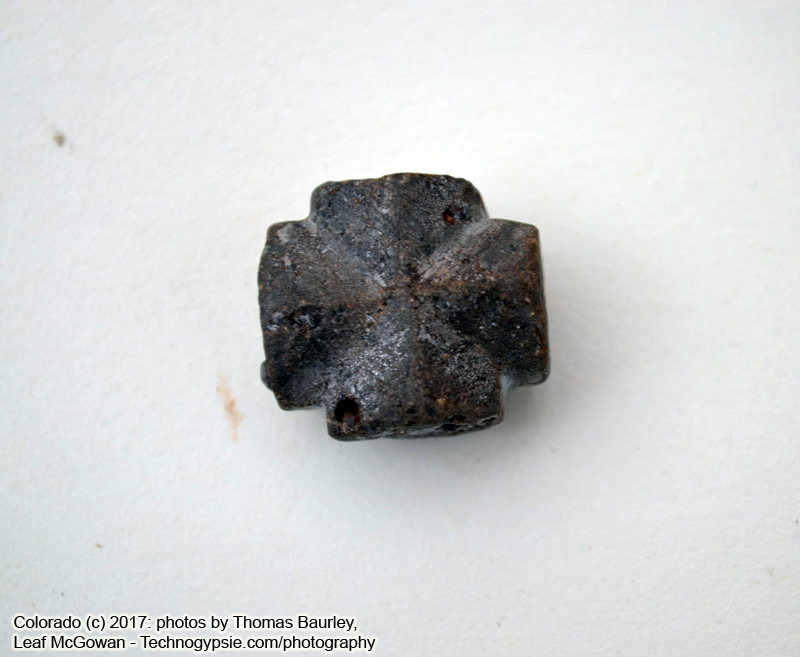
Staurolite: Fairy crosses/stones

FC-005: Celtic Cross Fairy Cross from Taos, New Mexico.


Purchase one here

Fairy Stone / Fairy Cross / Staurolite

Localities: Fairy Stone State Park, Virginia, USA; North Georgia, USA; Little Falls, Minnesota, USA; Taos, New Mexico, USA; Switzerland; Russia; Australia; Brazil; France; Italy; Scotland.

Description: Popular to its folklore and legends, this stone has a State Park in Virginia named after it as it is home to its namesake “fairy stones”. It is also the official stone of the state of Georgia in the USA. Most commonly shaped like Celtic crosses or the St. Andrew’s cross, as an “X” or as a “T” shaped Roman cross, and square Maltese crosses. Color of the Staurolite varies to the region it comes from but can be dark brow, brownish black, grey, or reddish brown.

Geology:Staurolite are a combination of silica, iron, and aluminum. A silicate mineral, with the Chemical formula of Fe2+2Al9O6(SiO4)4(O,OH)2, and a Strunz classification of 9.AF.30, possessing a monclinic prismatic crystal symmetry. It’s H-M symbol is (2/m), with a Space group of C 2/m, and a unit cell a = 7.86, b = 16.6, c = 5.65; ? = 90.45; Z=2. Coloring ranges from yellowish brown, rarely blue, dark reddish brown to blackish brown, pale golden yellow in thin sections with a subvitreous to resinous luster, white to gray streaks, transparent to opague diaphaneity. Specific gravity is 3.74 – 3.83 meas. 3.686 calc. Twinning is commonly as 60 twins, less common as 90 cruciform twins. Subconchoidal fracture, brittle tenacity, mosh scale hardness of 7-7.5. Common to have penetration twinning, or a characteristic cross-shape. It occurs with almandine garnet, micas, kyanite; as well as albite, biotite, and sillimanite in gneiss and schist of regional metamorphic rocks. It is only found in rocks once subjected to great heat and pressure. A rare mineral occurrence in nature, it is only found in certain areas of the world in the fairy cross or Celtic cross shapes. Each are unique and never are identical. True Staurolite crosses are hard enough to scratch glass.

Folklore: Named after the Greek word “Stauros” for “cross”, they are commonly known as “fairy stones” or “fairy crosses”. According to European and Christianity influenced Native American legend on the state park website, “hundreds of years before Chief Powhatan’s reign, the fairies were dancing around a magical spring of water, playing with naiads and wood nymphs, when a elfin messenger arrived from a city far away bringing the news of the death of Christ. When these creatures of the forest heard the story of the crucifixion, they wept, as their tears fell upon the earth they crystallized into beautiful crosses”. During the first meeting of John Smith and Pocahontas, it is said the Indian princess gave John Smith a good luck charm made out of a “fairy cross”. Legend has it that Richard the Lionheart used them during the crusades to heal the wounded. Some say these are the tears of the Cherokee who wept over the loss of their homeland during the exodus on the “Trail of Tears”. Others talk of an ancient race of mountain faeries who were dancing at their favorite meeting places, and upon finding out that the “Great Creator” had died, shed tears, so moved, were crushed in heart and cried, as they wept their tears crystallized into the “fairy crosses”. Others say that during the defeat of the Tuatha de Danann and other faerie races when they were forced under-ground to live in the hills, the faeries around the world shed tears, made of Iron to represent the Iron Age destroying their race, in the shapes of crosses as an omen of the peopling that would destroy the planet next.

    Ay the charms of the fairy stone make you blessed
    through the days of labor and nights of rest
    Where ever you stay, where ever you go,
    May the beautiful flowers of the good Fairies Grow.
    ~ Little Falls Minnesota web page

Well known that Presidents Theodore Roosevelt, Wilson, Thomas A. Edison, Colonel Charles Lindbergh, and other prominent people carried one of these on their person(s).

Magical uses: For centuries these were believed to protect the wearer from sickness, accidents, disaster, and witchcraft. Used to find lost objects. Placed under the pillow to help induce lucid dreaming and astral travel. Used as amulets for good luck. Used to aid stress, anxiety, fear, considered soothing energy, and helpful with grounding. Many believe they embody an energy that will help you make contact with faeries or nature spirits. Some believe wearing the stones will help one stop smoking. Astrologically associated with Pisces. Associated with the base chakra. Healing qualities, good luck, rituals, protection, fever, defeat of malaria, stress, depression, addictive personality traits, time management, smoking cessation.

By Thomas Baurley, Technogypsie Productions and Research Facility.

(more…)


There are no mermaids: US government

Comments Off on There are no mermaids: US government | Living Myth, Mermaids, Zombies Tags:, , , , , ,

You know there has to be something incredible about to be revealed when after thousands of years of myth and legend, all of the sudden the Government has to address fairy tales and telling people that such things “PROBABLY” do not exist … ~ Leaf McGowan
[cross post via WordPress PressThis ]
http://news.yahoo.com/no-mermaids-us-government-212628320.html

AFP
AFP – 3 hrs ago

The United States government has assured its citizens that, much like zombies, mermaids probably do not exist, saying in an official post: “No evidence of aquatic humanoids has ever been found.”

“Mermaids — those half-human, half-fish sirens of the sea — are legendary sea creatures,” read the online statement from the National Ocean Service (NOS).

The agency, charged with responding to natural hazards, received letters inquiring about the existence of the sea maidens after the Discovery Channel’s Animal Planet network broadcast “Mermaids: The Body Found” in May.

File photo of Hannah the Mermaid in the Mermaid Lagoon exhibit at the Sydney Aquarium. The United States government has assured citizens that much like zombies, mermaids probably do not exist. "Mermaids -- those half-human, half-fish sirens of the sea -- are legendary sea creatures." (AFP Photo/Torsten Blackwood)
File photo of Hannah the Mermaid … The show “paints a wildly convincing picture of the existence of mermaids, what they may look like, and why they’ve stayed hidden… until now,” a Discovery Channel press release says.

Conversely, the US government declaration offered no conclusive proof to deny the existence of mermaids.

The statement comes after another government agency, this time the US Centers for Disease Control and Prevention (CDC), declared there was no conclusive evidence for the existence of zombies.

The CDC had published instructional materials on how to survive a “zombie apocalypse,” in what the agency now calls “a tongue in cheek campaign to engage new audiences with messages of preparedness messages.”

The campaign was followed by a series of cannibalistic attacks in North America.
People dressed as zombies march around the streets of San Francisco to promote a new game for the iPhone in May 2012. The US Centers for Disease Control and Prevention (CDC) has declared there was no conclusive evidence for the existence of zombies. (AFP Photo/Kimihiro Hoshino)
People dressed as zombies march …

In one such attack on May 26, a 31-year-old Miami man stripped naked and chewed off most of a homeless man’s face.
The Twittersphere was suddenly alive with people talking about the real and present danger of a zombie apocalypse.
The CDC was quick to respond to allegations of corpses rising from the dead to eat the living.
(more…)


Tiveragh Fairy Hill (Cushendall)

Tiveragh Hill / Fairy Hill of Cushendall, Northern Ireland. June 2, 2012:
Irish Folklore Quest – Northern Ireland, UK. (c) 2012 – photography by Leaf McGowan/Thomas Baurley

The Tiveragh Fairy Hill
Cushendall, Northern Ireland

Legend and lore have it that this very broad-sided hill with steep sides overlooking the small village of Cushendall in Northern Ireland is the gateway to Tir na nOg. A place very well known locally to be haunted by faeries, leprechauns, elves, and pixies … this giant hill is a natural fortress all on its own and easily seen to be claimed as a stronghold by the fae.

Fairy tales mention many stories about it rising on pillars during the twilight evening with a glimmering merriment of faeries frolicking and dining. Many believe that the wee folk live in this hill accessed by a nearby cave. As the warning goes, if ye are mortal, regardless of how appeasing the faerie music may sound, if you wander within, you’ll never be seen again on this plane of existence. Time holds a whole different rhythm in Faerieworlds.

We, however, of fae persuasion, did venture up the hill at the turn of twilight just as the sun went down. We spied the hill with visions of faerie impressions while across the valley atop Ossian’s Grave – the Megalithic tomb believed to be the burial spot of the fabled poet and bard Oisin. Now Oisin was lured into fae, into Tir na nOg, where he lived until he requested to return to the land of mortals to visit his family. Of course due to faerie time, he returned several hundred years later to find them all gone and deceased. He fell off his faerie steed and became a blind old man wandering these fields, eventually dying.

If the faerie tale is accurate, this would be the hill he would have ridden out of, and across the valley would have been his grave overlooking it … curious and more curious. Midway along the way up the base of the hill is one of the most magnificent Faerie Thorn Trees I’ve ever encountered. As usual with these faerie hills, I always find a wee hole just big enough for the Victorian-sized fae to enter within, usually lined with heavy rocks, making it look peculiarly like a miniature mine rather than an animal hole.

We climbed atop as the sun went down, empowered by the feelings of the ancient ones. Archaeologically, though, this may be a massive hillfort. I’m looking for those records and will post my findings here.

And their playing pitch was hardly as big
As my Uncle Barney’s potato rig;
And me there watchin’ them puck and clout
At the back o’ the wall with my eyes stuck out.

When all at once, like the squeal of a hare,
A wee voice shouted, “Who’s that up there?”
And a bit off a thing about nine – inch tall
Came climbing up to the top of the wall.

And he stood there; he stood about pot -size
With his two wee fingers up at my eyes,
And its God’s own truth that I’m speakin’ mind ye,
“Get out o’ that,” says he, “or I’ll blind ye!”

Aye that’s what he said, “I’ll blind ye,” says he,
And by Jing what he said was enough for me,
Did I run? Aye surely; I didn’t miss –
And I haven’t seen Tiveragh from that to this.

~ H.Browne

The Fairy Hill Tiveragh is a fairy hill and near to Cushendall,
And nobody goes there at night, no nobody at all.
The hill is small, the sides are steep.
And I have heard it said That flickering lights go in and out While everyone’s in bed.
And on the top two hawthorns grow, A white one and a red.

~ John Irvine Desmond

~ Yours truly, Leaf McGowan

Tiveragh Hill / Fairy Hill of Cushendall, Northern Ireland
(more…)


Shannon Pot and the Salmon of Knowledge

Shannon Pot and the search for the Salmon of Knowledge

(crossposted via WordPress PressThis: Article by Rob Wildwood – visit link for full article)

I was becoming intrigued by the Celtic tales of magical fish living in holy wells. My experience at the Pigeon Hole near Cong, on the border between County Galway and County Mayo in Ireland had only served to increase my fascination. There I had meditated and when I opened my eyes had actually seen the magic trout swimming in the water before me (see The Pigeon Hole and the Magic Trout )

My investigations led me deeper and deeper in Celtic mythology until inevitably I came across the most famous of all Celtic fish legends, the tale of the Salmon of Knowledge, said to live in a pool overhung by nine hazel trees who’s nuts carried the source of all wisdom and poetry.
The stories start in mythological times when the fairy folk ruled Ireland, the Tuatha De Danann:

“And they had a well below the sea where the nine hazels of wisdom were growing; that is, the hazels of inspiration and of the knowledge of poetry. And their leaves and their blossoms would break out in the same hour, and would fall on the well in a shower that raised a purple wave. And then the five salmon that were waiting there would eat the nuts, and their colour would come out in the red spots of their skin, and any person that would eat one of those salmon would know all wisdom and all poetry. And there were seven streams of wisdom that sprang from that well and turned back to it again; and the people of many arts have all drank from that well.”
Read More at Rob Wildwood’s

Shannon Pot and the search for the Salmon of Knowledge ….


Cabin in the Woods

Cabin in the Woods ~ (Rated R: 2012)
http://www.imdb.com/title/tt1259521/ * Director: Drew Goddard. * Written by Joss Whedon and Drew Goddard. * Starring: Kristen Connolly as Dana; Chris Hemsworth as Curt; Anna Hutchison as Jules; Fran Kranz as Marty; Jesse Williams as Holden; Richard Jenkins as Sitterson; Bradley Whitford as Hadley; Brian White as Truman, and many others.

Within the last several years, Hollywood and the film industry have been evolving and expanding the classical monster tale, as we watched through the ages, meandering from Frankenstein, the Mummy, the Werewolf, and Count Dracula towards a whole different species of Werewolves, vampires, and zombies. Then came the serial killers obsessed with pain, torture, maiming, and realistic, grotesque murder sprees self-styled after Ted Bundy, Fred West, or Jeffrey Dahmer, only to exaggerate to supernatural tales of Halloween, Friday the 13th, and the Texas Chainsaw Massacre. Now, a new sense of horror, going back to supernatural beliefs on Witches, Druids, Spirits, and creatures from the races of Darker Faeries come crawling out from their sidhe with vicious mermaids and mer-men, leprechauns, gremlins, goblins, orcs, giants, and titans.

The Old God/desses are being brought back to life. What one would imagine would be a typical hack n’ slash film by the title of “Cabin in the Woods” turned into a conspiracy theory, a Dark ancient Deities tale of human sacrifice at a high corporate level ploy to satiate the “ancient ones”. None other than a tale weaved by Buffy’s Joss Whedon to give that twisted plot some fantastical depth. These five friends go on vacation to a remote cabin in the woods, only to find themselves trapped and manipulated in a pseudo-realm where they are lined up to voluntarily sacrifice themselves to the dark spirits.

The five college-aged kids head off to a friend’s cabin in the woods and lose all communication with the outside world. During “party time” and unwinding, the cellar door mysteriously flips open, only to involve a truth or “dare” to investigate the darkness. Within is a treasure trove of artifacts, each with a secret and a beast to unleash. Meanwhile, they are monitored by a high-tech secret lab where the white coats bet on which creature they will face – Pinhead, the Mer-man, flesh-eating zombies, a ghoul, or a prehistoric monster of dinosaur proportions. Dana reads from the diary of an inbred hillybilly family, thereby awakening the now-dead family of deadly murderous zombies. But this is not the only laboratory experiment of what supernatural creatures will be unleashed, as the lab coats are monitoring similar setups from around the world, hopeful of a successful stint with the cabin.

As each of the college kids get knocked off, the ploy backfires as the “virgin” saved for the last, teamed up with the brainy pot-head discover the conspiracy and find their way down into depths uncovering an ancient temple lair holding back the ancient Titans from destroying the Earth – satiated by an annual sacrifice that was planned. None of the scenarios work out for the guardians, and literally “all hell breaks loose” as magical and supernatural beings, creatures, and monsters look at the lab coats and armed forces as a smorgasbord brunch. The Director of the agency, played by Sigourney Weaver, tells them the truth that the ritual involving sacrifice of the Whore (Jules), the Athlete (Curt), the Scholar (Holden), the Fool (Marty), and the Virgin (Dana) was to appease the “Ancient Ones” who lived beneath the facility. They had to die in archetypical order until the virgin remained. Werewolves, mer-creatures, unicorns, ghouls, zombies, and a giant serpent take their wraith. The Ancient ones rise to destroy the facility and the cabin. While an element of “kitch” and wacky elements loomed over the film, the special effects and deep mythical supernatural plot humored and entertained me. [Rating: 4 stars out of 5] Rating of four stars out of five. ~ Reviewed by Leaf McGowan.

Youtube Trailer Preview


June 22-24, 2012 ~ 12th Annual Fairy Human Relations Congress: Twisp, Washington

Comments Off on June 22-24, 2012 ~ 12th Annual Fairy Human Relations Congress: Twisp, Washington | Events, Modern Fae Tags:, , , , , , , , , , ,

The March 15 early registration date is coming up!
Get 3 days of Fairy Congress for $215!

– that’s meals, workshops, rituals, camping, the magic of Skalitude, music
and enough fairy dust to make you shine for the rest of the year!

details at www.fairycongress.com


Friends of the Trees • PO Box 826 • Tonasket, WA 98855

http://www.friendsofthetrees.net


Ireland's First Mythical Inhabitants: The Fomorians

4500 B.C.E. to ca. 500 B.C.E.
The Mythological Cycle:
The understanding of the folktales, folklore, myths, and legends of “Otherworldly” creatures who landed in Ireland in prehistoric times is known as “The Mythological Cycle.” A notable work exists called the Lebor Gabála Érenn (The Book of the Taking of Ireland) or otherwise known as the “Book of Invasions” which is a Middle Irish title of a loose collection of poems and prose narratives recounting the history, mythology, and origins of the Irish race from the creation of the world down to the Middle Ages.
The Fomorians:
According to the myths and legends of early Ireland, the very first human-like inhabitants of the Green Island of Eire were the Fomorians. The Fomorians are believed to be beings who preceded the Gods, similar to the Greek Titans representing Gods of Chaos and wild nature. They were also depicted as the supernatural undead and magical beings of the Underworld or Otherworld.  They were seen as a giant demonic race of beings who lived in boats off the coast of Ireland, often coming ashore to plunder and pillage all that existed on this grand Green Isle.  According to medieval scholars, the name “Fomorians”, “Fomhoire”, “Formorian”, “Fomoraig”, and “Faoi-Mhuir” came from “Fomoire” a word combination of “fomó”  meaning “giant” or “pirate”, the Gaelic “Faoi-mhuir” meaning “beneath the sea”, with the elements ‘muire’ or ‘sea’  or “mor” as “spirit” or “phantom” giving them the reputation as ‘sea pirates or under-sea phantoms.’  Some legends suggest that the Fomorians originally came from Asia or Northern Africa having been birthed by Noah’s son Ham after he was cursed by Noah. Some believe the Fomorians were the descendants of GogmaGog. They left Africa as seafarers who were often depicted as having black skin, black haired with the body of a man and the head of a goat according to the Eleventh century text called the “Book of the Dun Cow” or the Lebor na hUidre. In some manners, they have similarities to the descriptions of Ancient Egyptian and Nubian Gods, Goddesses, and half-human/half-animal creatures.  Some of them have also been described as having one eye, one arm, and one leg; while others were fancied as elegant beauties as with “Elatha” the father of “Bres”. They were also notorious for their powers over the forces of nature, such as being able to bring forth fog, storms, diseases, blights, and plagues with their so-accused “evil” magic.  Through history, they claimed several famous royalties, especially in guise as “kings” by various names, the most remembered as King Conaing, King Morc, King Indech, King Tethra, King Balor, King Elatha, the Warrior Cichol, the Smith Dolb, the Steward Liagh, the Poet Oghma, and Queen Ceithlenn. Throughout the lands of present day Ireland and the United Kingdom, are their mythical tromping grounds of Conaing’s Tower, Tory Island, The Hebrides, Rathlin, Islay, Lochlann (Norway), and Dun Aengus. By the period of history when they participated in the Second Battle of Magh Tuiredh, the rumor was that their fleet stretched far and wide from the Northeastern coast of Ireland all the way to Norway.
The first Fomorian King to have settled in Ireland was “Conaing” taking root on all the Northern Islands along the coasts of Ireland, Scotland, and Norway. In some respects, they had a “under the seas” glamour about them having lived “beneath the waves” giving some affiliation with “mer-folk”, “selchies,”  and “mermen or mermaids”. They were then reputed to have split themselves up into different tribes, residing in the Underworld, which was later ruled by “Tethra” the Fomorian Faerie King.  Often described to have the color and composure that is common-place for a Nubian with the darkest of black skin and hair, oddly though “Elatha” the father of “Bres” was depicted as having the most “golden hair” and the handsomest man in sight.  He seemed the fairest of the leaders, not being so blood-thirsty as the other Fomorian leaders, and very interested in justice. In later years, he refused to go to war with his son “Bres” against the later faerie invaders known as the “Tuatha de Danann” as he felt such actions was “unjust”.  By right of the myths and legends, the Fomorians were unique in their DNA, racial, and family lineage with their own customs and language dialects than the other invading inhabitants of Ireland.  Whereas the Nemedians, the Fir-Bolg, and the Tuatha de Danann were believed to have shared the same DNA, family lines, languages, and were considered to be of the same races. At a later point in history, they were known to have intermarried with the Tuatha De Danann according to faerie tales and legends.  Popular stories relating to the Fomorians were the “Bres Mac Elatha and the Tuatha De Danann”, “The Second Battle of Magh Tuiredh”, “How Balor was Defeated”, “The Courting of Emer”, “The Fate of the Children of Turenn”, “the Fir Bolg”, “The Story of the Tuatha De Danann”, “The Death Tales of the Tuatha De Danann”, “Credhe’s Lament”, “the Hard Servant”, and “Partholon” myths.  They came to be defeated by the first invaders of Ireland from Greece known as the “Partholon” by 2680 or 2061 B.C.E. (dates differ to scholar’s theories).  Shortly after defeat by the Partholon, they took back the land by instilling a plague that killed off the Partholon, laying them waste in the fields. They battled again with the Nemeds and then finally defeated and vanquished by the Tuatha de Danann. Ever since, any settled pirates or sea-based raiders were labeled “Fomorians”.
By Thomas Baurley
 

Bibliography:

  • Anomymous scholar:
    11th c. C.E. Lebor Gabála Érenn (The Book of the Taking of Ireland)


  • Encyclopedia Mythica:
    2012 The Fomorians. Website referenced March 2012.
    http://www.pantheon.org/articles/f/fomorians.html.
  • Magic & Mythology:
    2012 The Fomorians. Website referenced March 2012.
    http://www.shee-eire.com/Magic&Mythology/Races/Formorians/Page1.htm
  • Slavin, Michael:
    2010 “The Book of Tara”. Wolfhound Press: Dublin, Ireland.
  • Walsh, Brian:
    2006 “The Riddle of the Hobbit”: August 28, 2006: Time Magazine Online:
    http://www.time.com/time/magazine/article/0,9171,1399614,00.html.
  • Wikipedia: The Free Online Encyclopedia.
    2012 “The Fomorians”. Website reerenced February 2012.
    http://en.wikipedia.org/wiki/Fomorians
  • W.Y. Evans-Wentz:
    1966 “The Fairy Faith in Celtic Countries”. Citadel Press: New York.


The Realm of Faerie

Comments Off on The Realm of Faerie | Faeries, Faeries on TV Tags:, ,

The Realm of Faerie exists in myths and legends around the world. Who are the Faeries? Where did they come from? NOW ON DVD Full Version 168 mins. on 2-DVDs. Cat. #U695. Go to http://www.UFOTV.com.


Archives

Categories