Skip to content

Faerie Lore and Legends

Exploring the Unknown, Myths, Lores, and Legends

  • Home
  • Techno Tink
  • Page 20

Author: Techno Tink

Brigids Sacred Wells in Kildare, Ireland

Posted on December 14, 2010 By Techno Tink No Comments on Brigids Sacred Wells in Kildare, Ireland
Mythology, Religion, Sacred Sites

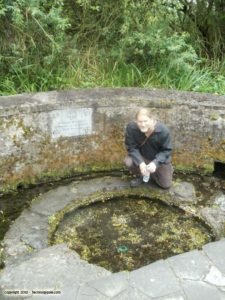
Brigid’s Well #1, the “Wayward Well”, Kildare, Ireland

Brighid’s Holy Wells in Kildare
* Kildare, Ireland
The Goddess or St. Brigid has two holy wells in Kildare? She certainly does. Some say that one of the wells belongs to the Ancient Goddess Brigid, while the other well belongs to St. Brigid. Both are sacred, both are holy, and both hold Brigid’s magical healing waters.

Well #1 is the ancient “original” sacred well of Brigid. Well #2 is the dressed-up sacred shrine and park of Brigid with her well. They were two distinctly different entities … an Ancient Goddess whose ethereal Godly presence could manifest as a human female and the actual magical human nun turned Saint who was the personification of the Deity. One and the same? could be. Two differently distinct entities who share the common thread? very possibly.

Two wells … that seems to be the case. One for the Goddess and One for the Saint? I would say “both” wells contain “both” the Saint and the Goddess in them. I’ve come to notice a pattern with this, that the “ancient” Pagan “original” well is often offset from the “Christian” one. This seemed to be the case when I went to see the Madron well in Cornwall, England (though technically that one had “three” – the original one buried in the marsh, the Pagan “original” one offset from the one underwater, and the Christian well house.).

There are many Brigid wells in Ireland as well as Britain. As wells were the sacred sites of veneration in the Druidic faith, many also have an associated sacred tree with them that is covered with votive offerings. These are often called “Wishing Trees”. Trees covered with “clotties” or ribbons of cloth are done as a prayer for healing or a spell to obtain something. Pilgrims come here to get in touch with the well inside themselves. Wells are sacred places where people for thousands of years have come to pray, worship, and reflect.

Pagan and Holy wells are often seen as the entrance to the womb of Mother Earth, the source of life. Each holy well is always related to healing, and each well usually has a specialty that it performs. Brigid’s wells are pretty powerful for healing sore eyes. Brigid is associated with all healing. Her girdle is capable of curing all disease and illness, and this well is rumored to make “the blind man seeing, the dumb girl speaking, etc.”

Brighid’s Holy Well #1 a.k.a. “The Wayside Well”
The first well is the ancient Pagan sacred well of the Goddess Brigid. It is located just next to the car park of the Japanese Gardens. This well/spring itself feeds and nourishes the Gardens themselves. This is the spring source whose waters run off and feed the newer well. It’s not really decorated and is simple, rustic, ancient, and silent. Seemingly forgotten. It has only an inscription sign in Irish that translates as “St. Brigid, Mary of the Gael, pray for us.” However, it is still a major focal point for pilgrimages and ceremonies.

The Brigid Eve ceremonies (January 31st) start at a small fire set up just outside the Japanese Gardens car park with a chanting to the Goddess Brigid, which is followed by a candlelit journey of contemplation about the Goddess and the Saint and the spirit that weaves them together. The candlelit journey goes to this well and ends at the second well. It is customary to gather this well water in a bottle because of its strong healing properties and, in exchange, to leave an offering for the spirits and faeries who dwell there.
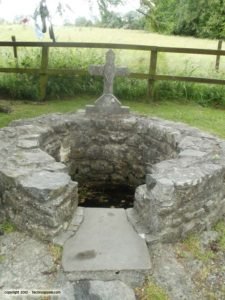

“Tobair Bride” / St. Brigid’s Well, Kildare, Ireland

Brighid’s Holy Well #2 a.k.a. “Tobair Bride” (St. Brigid’s Well)
The second well is the “supposed” Christian well of St. Brigid. It’s the tourist one. It’s the “Official” one. This is the one in the tourist guides, signposts, and advertisements. It is located in a landscaped grotto at the end of a short lane close to Well #1. The local Catholic clergy moved Christian devotion and practices to this site in the 1950s, supposedly out of concern for people’s safety in accessing the original well, which was at the bend in a narrow, busy road. It is here that the Roman Catholic healing well is located. While pilgrims often visit both wells, this is the well where an involved ceremony, similar to the “stations of the cross,” is conducted. Pilgrims reflect on the Goddess and/or Saint Brigid and how they weave together.
Read More “Brigids Sacred Wells in Kildare, Ireland” »

Brigids Sacred Flame at Kildare

Posted on December 14, 2010 By Techno Tink No Comments on Brigids Sacred Flame at Kildare
Brigids Sacred Flame at Kildare
Mythology, Religion, Sacred Sites

or well over 1,000 years, if not 2,000 years or more, the sacred fire of the Goddess Brigid (now St. Brigid of Ireland) has existed and kept holy/sacred by her followers, priestesses, and/or members of her Order. In Ancient times, the Priestesses of Brighid kept her flame eternally lit with 19 Priestesses keeping vigil that the flame was never extinguished.

Brigids Cross

Posted on December 13, 2010 By Techno Tink No Comments on Brigids Cross
Mythology
Brigid's Cross
Brigid’s Cross

Brighid’s Cross
* Kildare, Ireland *
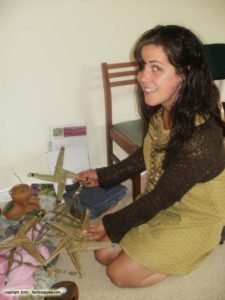
Another blessed part of my pilgrimage to Brigid and Kildare was learning more about Brigid’s Cross. I had the pleasure of Faerie Moe as a guide, a local friend giving me the tour of Kildare and the sacred wells as well as giving me an on-hand explanation on how to weave a Brigid’s Cross.

As a dedicant to the Goddess Brigid for over 20 years, in my early years, i fumbled at making them but never made anything as intricate and powerful as the crosses I saw at St. Brigid’s shrine and Sister Mary’s house. Amazing.

Many say that the St. Brigid’s Cross, a.k.a. Cros Bríde, Crosóg Bríde or Bogha Bríde, is actually an Irish symbol of sun worship representing the sun in the center with rays of light coming from it in the shape of the arms of the Cross. Some say it represents a Brigid legend wherein the story St. Brigid miraculously hung her wet clothes to dry on a sunbeam. It is also considered a Pagan sun wheel. They are traditionally made on February 1st for Lá Fhéile Bhríde (St. Brigid’s feast day).

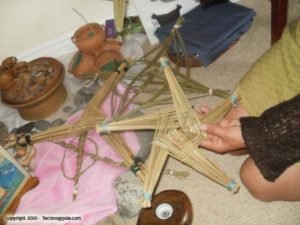
It is also a symbol of Ireland and its provinces. Ireland has four provinces, but in ancient Ireland, there were five – an invisible one in the center of Ireland. To some, Brigid’s cross represents the four provinces (in the modern standard design) and in the 5 handed cross like shown in these pictures, representing the 5 provinces. The arms represent North, South, East, West, and Center. The 5th Province, the invisible one, is the province of healing and reconciliation.

Brigid’s Cross probably first appeared in Ireland between the 2nd century B.C.E. and the 2nd century C.E. It is a folk magic tradition of weaving together straw to create an equal-armed Celtic cross that represents the Goddess Brigid, or modern-day St. Brigid. Taking rushes that are woven together into a swastica-like /Celtic cross-like ornament, with a central square and four spokes protruding from each corner of the square in opposing directions, that has some variations found in Celtic art both ancient and modern.

Brigid’s cross appears often traditionally on February 1st, the eve of St. Brigid’s feast / Imbolc / or Candlemas. In some traditions, the Brideoga or Biddies, young virgin boys who would carry a churn dash (post used to churn butter) that is dressed up as a woman or an effigy of St. Brigid, and would go door-to-door through their neighborhood collecting alms for the poor.

While collecting alms, they would leave bundles of straw and rushes outside the homes that they visited. At nightfall, young virgin girls would pick them up and ask to be admitted to the homes in the name of Brigid and would weave the rushes into crosses. After traditional prayers and a meal at the homes, the crosses would be placed under the eaves in the house or in the outhouses and sometimes blessed with holy water. The leftover rushes would be woven into a girdle called a “crios” or a tie for cattle or sometimes as a Brid’s bed or mattress for the Saint.

Just as cattle were traditionally led through holy lakes or doused in water from Brigid’s well, they were often led through uplifted arches of these girdles. The Brid’s bed or holy mattresses were often placed at specific sacred wells and believed to possess curative powers to counter barrenness and to protect families and animals from natural calamities, especially lightning and fire. Some see Brigid’s cross as symbolic of the evolution of the Goddess into the Saint. The Brigid’s Cross magically is believed to protect a house where it hangs from evil and from fire. Because of this, it is often hung in kitchens.

The Brigid’s cross is commonly woven on February 1st or 2nd, the date of Celtic Imbolc or Candlemas, a time to celebrate Brigid in her maiden form – the winter elder “cailleach” is reborn the maiden in her phase of collecting kindling for winter fires and warming the hearth for spring when she becomes young again. (After serving the winter as the aged woman still collecting kindling to keep the fire going to rejoice the flame for her rebirth) As the inventor of “caoineadh” or “keening”, from the mourning of her son Ruadán’s death, she inadvertently created the art form to keen. Some say this is tied to the creation of Brigid’s cross.

At this time when the night sky turns to the North star, the big dipper turns through the seasonal year, creating patterns in the sky that the Brigid cross is said to invoke. To tie into the warming for spring, Brigid is the fire keeper of the eternal flame always burning in Kildare, keeping the people of Ireland eternally warm. During her conversion to becoming a nun led to the practice of Brigid’s cross, a craft many children and adults partake of weaving the kindling into a spiral form of Brigid’s cross.

Here is a great web site with diagrams of the weave: http://www.fisheaters.com/stbrigidscross.html


Faerie Moe weaving a cross

Read More “Brigids Cross” »

The Pagan Goddess Brigid, or the Christian Saint Brigid

Posted on December 11, 2010 By Techno Tink No Comments on The Pagan Goddess Brigid, or the Christian Saint Brigid
The Pagan Goddess Brigid, or the Christian Saint Brigid
God/desses, Mythology, Religion

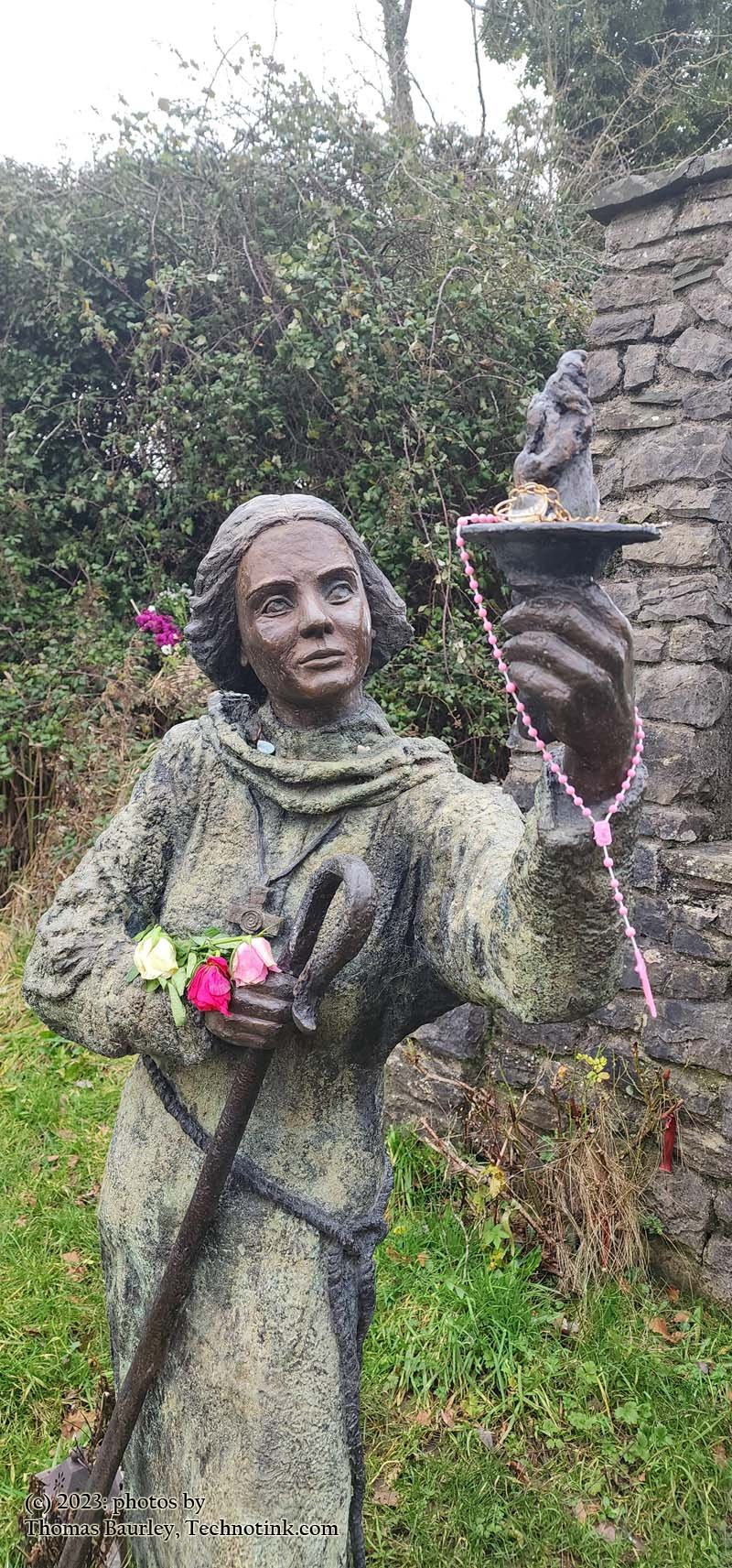
As a Saint and Actual Living Person: St. Brigid – c. 451 – 525 C.E. (A.D.)Goddess of Poetry, Magic, Healing, Smithcraft, Learning, Common People, Flocks/Stock/Yield of the Earth, and Inspiration.

Legend of the Blarney Stone

Posted on November 6, 2010 By Techno Tink No Comments on Legend of the Blarney Stone
Mythology, Sacred Sites


Legend of the Blarney Stone
Blarney Castle, Blarney, Co. Cork, Ireland * Phone: 00 353 21 4385252 * http://www.blarneycastle.ie/
One of Ireland’s most valuable and mesmerizing mythical collections is the infamous Blarney Stone. Called “Cloch na Blarnan” in Irish, it is the legendary stone for the gift of gab. “Blarney” means “Clever, Flattering, or coaxing talk”. The Blarney Stone is a block of bluestone that is built within the battlements of Blarney Castle, locaed approximately 8 kilometers from Cork, Ireland. It is believed that whoever kisses the stone is endowed with the gift of gab, great eloquence, or the skill at flattery. It allows the gifted to impart the ability to deceive without offending. Its not an easy task to kiss the stone, as one needs to be held upside down atop a drop of a tall tower to reach the kissing spot. The stone became part of the tower in 1446 and has become one of Ireland’s most notable tourist sites.
Where does the stone come from? There are many myths and legends surrounding the stone and its origins, the earliest of which involves the Goddess Clíodhna. It is believed that the Castle’s builder, Cormac Laidir MacCarthy, was in a lawsuit and sought out Clíodhna for her assistance. She told him to kiss the first stone he found in the morning on his way to court, and as he did, he gained eloquence and won the court case. Flabberghasted by this magical event he took the stone and added to the castle’s stones. Many believe that it was a piece of the Stone of Scone. Others believe it to be the rock that Moses struck with his staff to produce water for the Israelites during their exodus from Egypt. Others believe it to be the stone that Jacob used as a pillow and was later brought to Ireland by the prophet Jeremiah. It is said that it then became the Lia Fail, or ‘Fatal Stone’ and was used as an oracular throne of the Irish kings. Some say its the Stone of Ezel which David hid behind on Jonathan’s advice while fleeing King Saul and brought to Ireland during the Crusades. Others believe it to be the rock pillow used by St. Columba of Iona on his deathbead. Some believe that the stone was first presented to Cormac McCarthy by Robert the Bruce in 1314 to recognize his support in the Battle of Bannockburn. Some say that the stone was previously in Ireland then taken to Scotland and brought back to Ireland in 1314. It is also said that during the time of Queen Elizabeth I, Dermot McCarthy, had been required to surrender his fortress to the Queen as proof of his loyalty. He told her he would be delighted to do so, but something always happened at the last moment to prevent his surrender. Many believe this was the charm of the Blarney Stone in effect. The Queen replied to this as “Odds bodikins, more Blarney talk!”
Kissing the Stone has been performed by literally ‘millions of people’ in the world, including world statesmen, literary giants, and legends of the silver screen. Kissing the stone is kissing all of these people by proxy, and by the magical law of contact – gaining the gift of gab that all these people possess. Its not an easy kiss and its important for the lips to touch the bluestone. This quest involves ascending to the castle’s peak, leaning over backwards on the parapet’s edge, entrusting a stranger (Castle guard) with your life by holding on to you. Today, safety wrought-iron guide rails and protective crossbars help prevent death or serious injury. Prior to these installations, the kisser was in danger of serious life risk as they were grasped by their ankles and dangled from the plummet. According to the Sherlock Holmes radio dramatization in “The Adventure of the Blarney Stone” (March 18, 1946) reported a man attempting the kiss plummeting to his death – but determined to be a murder as his boots had been greased before the attempt. The cautious and germ phoebic consider the Blarney Stone to be the most unhygienic tourist attraction in the world, as ranked as such by Tripadvisor.com in 2009. When I attended, I watched the guards use antiseptic wipes after every kiss and had hand sanitizer on the spot. Urban legends are amiss that claim locals go up to the Blarney stone at night and piss on it. Of course, anyone who has ever been to the Blarney stone, knowing the tight and tiny ascension up the treacherous tower (that is locked after hours and guarded) that even with breaching security and risking royal criminal punishment, would have to be damn good aim to hit the Blarney stone. Much of the urban legend comes from the incident in the film “Fight Club” where the narrator urinates on the Blarney Stone during his visit to Ireland as his first act of vandalism.
 

    ‘Tis there’s the stone that whoever kisses
    He never misses to grow eloquent;
    ‘Tis he may clamber to a lady’s chamber, Or become a member of Parliament.
    “A noble spouter he’ll sure turn out, or An out and outer to be let alone;
    Don’t try to hinder him, or to bewilder him, For he is a pilgrim from the Blarney stone.”

 
Many nation’s around the world have attempted to obtain the Blarney Stone. There are quite a few imposters out and about. The one and true stone is in the Blarney Castle. According to a tradition at Texas Tech University, a stone fragment on display since 1939 outside the old Electrical Engineering Building claims to be a missing piece of the Blarney Stone.
One can kiss the stone from monday thru saturday, 9 am to 6:30 pm in September and May, 9 am to 7 pm from June through August, and 9 am to sundown from October to April. On sundays, kissing can commence from 9 am to 5:30 pm during the summer, and 9 am to sundown during the winter.


Read More “Legend of the Blarney Stone” »

Faerie Trees

Posted on November 3, 2010 By Techno Tink No Comments on Faerie Trees
Faeries, Mythology, Sacred Sites, Sidhe


Fairy Tree, the Curraugh, Kildare, Ireland

Faerie Trees
United Kingdom and Ireland
Faerie trees are mythical hotspots of otherworldly and/or faerie activity. Faerie trees are seen as the haunts of Faeries. They are fiercely protected by the Fae. It is believed that any human foolish enough to pass by a host-tree late at night will find their arms bruised or pinched by small faerie fingers. Three thorn trees growing closely together are especially potent. Thorn trees hung with ribbons or rags are good gifts to faeries of the tree. Faerie trees are most associated with the Oak, Ash, and Thorn. Sometimes it is associated with the Rowan tree. Others claim its the Elder, Blackthorn, Hazel, and/or Alder. The trees most twisted together are the most notorious of faerie trees – and this is common amongst the Elder. If two thorns and an elder are found together it warns of great danger as do Oak, Ash, and Thorn. In the British Isles, the Rowan is believed to protect one from witchcraft and enchantment. Its berries opposite its stalk display tiny five pointed stars or pentagrams which are notable protective symbols. Color red, as in the flavor of the berry, is also seen as a protection against enchantment. The tree is believed to afford protection to the dwellings by which it grew and often people would take branches of the tree to be carried for personal protection from witchcraft. The belief in them go back to classical mythology, whereas legends tell us that ‘Hebe’, the Goddess of youth, once dispensed rejuvenating ambrosia to the Gods from her magical chalice. When she lost this cup to demons, the Gods sent an eagle to recover the cup. The feathers and drops of blood which the eagle bled in the fight, fell to the earth, whereas each one of them turned into a Rowan tree – the legendary Faerie Tree. It is because of this it is believed that the Rowan derived the shape of its leaves from eagle’s feathers and its berries look like the droplets of blood. The Rowan is also prominent in Norse mythology as being the tree from where the first woman was made. The Mountain Ash were also associated as Faerie Trees which are the most well-known of the Rowan. The wood of the Rowan is often used for staves, wands, divining rods, and walking sticks. Berries are often used to make alcoholic drinks.


The Curraugh, Kildare, Ireland

Read More “Faerie Trees” »

Knocknashee

Posted on October 12, 2010 By Techno Tink No Comments on Knocknashee
Mythology, Sacred Sites

 
“Knocknashee”, legendary ” Hill of the Faeries”
County Sligo, Ireland
Knocknashee is known as the legendary “Hill of the Faeries” and is one of Ireland’s seven most sacred hills. The name comes from the Irish “knock” (cnoc) meaning “hill” and “shee” meaning “fairy”. Its older name is Mullinabreena or “Fairy Palace”. The hill fort is located near Lavagh, Ballymote, and rises 900 feet high with a flat top, green and lush, with a diameter of a square mile. Oddly, unlike any other hill in the area, it has absolutely no heather. At its base stands the ruins of Court Abbey and its 90 foot high tower that was built in the 15th century by the O’Haras for the Franciscans. This legendary “Hill of the Fairy Mansion or Palace” as “Mullinabreena” or “Knocknashee” is a sacred site for Faeries and those who worship or believe in them being the mythical headquarters or high court of the Fae. Geologically the hill is a 276 m Marilyn located in the Ox Mountains of County Sligo, Ireland with the River Moy at its foot. It consists of a limestone top with shales underlying the lower slopes. The hill is culturally rich with archaeology as it was discovered to be a hilltop fort in 1988 during a Office of Public Works aerial survey of the county with the observbation of the remains of limestone ramparts containing cairns, burial chambers, and hutsites on its top. The fort is 700 meters long and 320 meters wide, enclosed by two earth and stone ramparts covering an area of 53 acres. There are two cairns, the remains of over 30 circular house sites, and two earth/stone ramparts. The hill has a panoramic view of the Connacht plains. The lower exposures of the hill show irregularly bedded limestone with a diverse fauna of colonial and solitary corals, with very well preserved fossils in silica that were deposited some 340 million years ago. Hilltop is covered with a thin peat. A popular play was made in tribute of the hill called “Knocknashee” by the Irish playwright Deirdre Kinahan in 2002. A traditional Irish song was also named after the hill called “The Hills of Knocknashee” with “The River Moy so gently flows from there unto the sea. Farewell to you, farewell to all from the hill of Knocknashee”.
Directions: Knocknashee is a table-top plateau 7 kilometres NEN of Tobercurry. From Tobercurry take the N17 north for 5 kilometres to Carrowclare then take a left to a T-Junction then a right about 1/2 kilometre on your left is a farm house ask here for permission to climb the hill. Portal Tombs around Knocknasee: http://www.irishmegaliths.org.uk/sligo.htm


Read More “Knocknashee” »

Gilligan's World

Posted on October 12, 2010 By Techno Tink No Comments on Gilligan's World
Faeries, Living Myth, Museums, Mythology, Sacred Sites, Sidhe


Gillighans World
* Tel / Fax 00 353 (0)71 30286 / 00 353 (0)71 84100 * Mobile 087 6811690 / 087 6780831 * e-mail gillighans@eircom.net * Registered Office: Baroncourt, Kilmacowen, Ballysadare, County Sligo * Sligo, Ireland *
Gilligan’s World is a hidden little Faerie theme park, farm, and botanical gardens in the heart of Sligo County in the rolling countryside at the base of the famed Tuatha de Danaan battle mound, the “Knocknashee” the Legendary “Hill of the Faeries”, one of Irelands 7 sacred hills. Mainly centered around children, the park can be a bit of fun for adults and kids alike, especially for those in the faerie persuasion. This little magical kingdom was created by the Baronness of Leyny, the Lady Melody Urquhart (Ph.D) as a faerie habitat to capture the true spirit of Ireland and its mythological/archaeological past. In 1993, she left fame and fortune behind in England as a choreographer / producer / director/ and owner of a finishing school in order to build this sanctuary. Attracted to the Knocknashee, the Mullinabreena, the Hill of the Fairy Mansion or Palace. Complete with miniature model villages, enchanted glades, streams, botanical gardens, a petting zoo, snack shop, gift shop, library, restrooms, car park, picnic areas, and an inn. Streams, forests, wildlife ponds, an aquatic cave, play facilities, with games, quizzes, and puzzles to achieve. The staff is well educated about faerie lore and history. Great place for the kids, schools, coach tours, birthday parties, family groups, and overseas tourists. It has a stone tunnel entrance, with dolmen, an amphitheater, lush green lawns, and inspiration for the wild, wacky, kitch, artistic, imaginative, and fantasy. Its open 7 days a week, Easter through September from 12 to 6 pm on mondays thru fridays, 2 pm to 7 pm on saturdays and sundays. While very kitchy and centered around children, as an adult with a faerie fascination, I enjoyed the park very much – and hope to go back to actually explore the actual Knocknashee. Rating: 4.5 stars out of 5.


Read More “Gilligan's World” »

Faerie Poop

Posted on October 5, 2010 By Techno Tink No Comments on Faerie Poop
Faeries, Mythology


Faerie Poop or Spittlebug mess
The legend has it that areas in the bushes and on plants where faeries take a leak, or take a poop, is left behind white foamy material. Of course these “Poop faeries” or “shit faeries” are not the urban “shit faerie” of modern urban legend. It actually is the defecation of the Spittlebug nymphs (though some say mealworms will cause it too). Spittlebugs love most plants, especially fruit bearers and fragrant herbs. What they leave behind doesn’t cause permanent damage to the plant unless in very high concentrations. The spittle is actually a protective covering that the nymph builds up around itself through its anus. It looks like white foam, a pile of bubbles, or a big gob of spit, or faerie shit. Spittlebugs look like leafhoppers that suck on plants by sucking out its sap. It produces a dollop of foam, a mix of slimy sugary insect excretions and air bubbles, enclosing a single spitlebug protecting it from dessication and predators like lacewings and ladybugs. Mealybug infestations can also appear on plants as tiny, soft-bodied insects surrounded by a fuzzy white mess around the stem and leaf nodes where the female mealy bugs hide their eggs that hatch in 10 days producing crawlers or nymphs where they relocate upon birth to another part of the plant and spend 4-8 weeks developing into adults.
Unless it’s a shit faerie that would oddly defecate on plants as their usual habit is to climb into human beds while they are asleep, shit in their mouths as a punishment for over endulging in alcohol – this explains why after heavy nights of drinking one awakes with a yucky taste in their mouths. http://www.urbandictionary.com/define.php?term=shit%20fairy. Though one could also say its the “Poop Faerie”, but then again, this critter isn’t known for pooping on plants, but again, on humans. They are reputedly derived from the Greek “Poopides Poop-a-lot-alous Nymphicacides” as a petite indigenous creature who is thinly related to the Tooth Fairy. It legendarily enters human residences and permeates the bedroom with a repulsive stink that lingers what seems forever. She apparently appears after the victim passes out after a long night of excessive consumption and riotous sex. Unlike the Shit Faerie, she waves her magic Shit-Stick to disperse a pasty white substance that imbues the victim’s mouth with a corrosive pungence. One can read more of this faerie at http://www.urbandictionary.com/define.php?term=poop%20fairy.


Read More “Faerie Poop” »

Mermaids/Mermen

Posted on October 2, 2010 By Techno Tink No Comments on Mermaids/Mermen
Mermaids/Mermen
Mermaids, Mythology

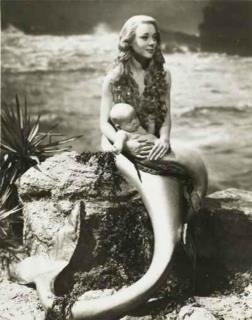
A rich realm of characters in faerie lore, mermaids, and mermen have consumed popular myth through the ages, including fantasy, entertainment, and imagery. Mermaids (and the male form “Mermen”) are a race of Faerie that consist of human-like mythological aquatic creatures that are depicted with a human head and torso attached to the tail of a fish.

Posts pagination

Previous 1 … 19 20 21 Next

Categories

New Posts

  • Thunder Mountain
  • Area 51
  • The Old Tonopah Cemetery
  • The Clown Motel
  • Thomas the Rhymer / Tam Lin

Pages

  • About Faerie Lore ....
  • Donate
  • Newsletter

Archives

  • Home
  • About Faerie Lore ….
  • Evolution
  • Haunted Locations
  • Herblore
  • Magic & The Occult
  • Media, News, Tales
  • Mythology
  • Folk Songs
  • Giants
  • God/desses
  • Living Myth
  • Monsters
  • Otherkin
  • Prophecies
  • Shadow beings
  • The Undead
  • Urban Legends
  • Religion
  • Traditions
  • Newsletter
  • Donate

Copyright © 2026 Faerie Lore and Legends.

Theme: Oceanly News Dark by ScriptsTown