Skip to content

Faerie Lore and Legends

Exploring the Unknown, Myths, Lores, and Legends

  • Home
  • Goddess Brigid

Tag: Goddess Brigid

The White Spring of Glastonbury

Posted on August 29, 2018 By Techno Tink No Comments on The White Spring of Glastonbury
Faeries, Living Myth, Mythology, Sacred Sites


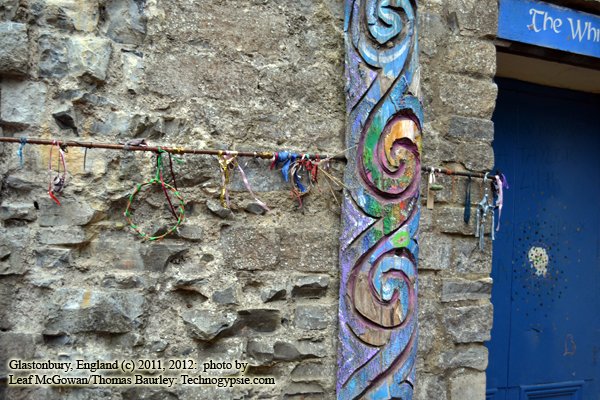
White Spring Entrance
August 1, 2011: The White Spring, Glastonbury, England.

White Spring
~ Wellhouse Lane, Glastonbury, England BA6 8BL, UK +44 7340 288392 * https://www.whitespring.org.uk/ ~

While backpacking Europe during the Summer of 2011 this was one of my favorite sacred spaces to visit, even more so than the infamous Chalice Well. The White Spring is a free-to-visit spring welling up in a Victorian pump house that has been converted to a temple and pilgrimage site. It offers calcium-rich spring water to all for free unlike the Chalice Well that charges high admission to enter their sacred garden.

It was the concept and dedication to the well that strengthened the birthing of my decision to be a Water Protector and Springs Guardian for the remainder of my life. This space was monumental for this change from a Protector of the Ancestors (Archaeologist) to Water Guardian as my life’s purpose.
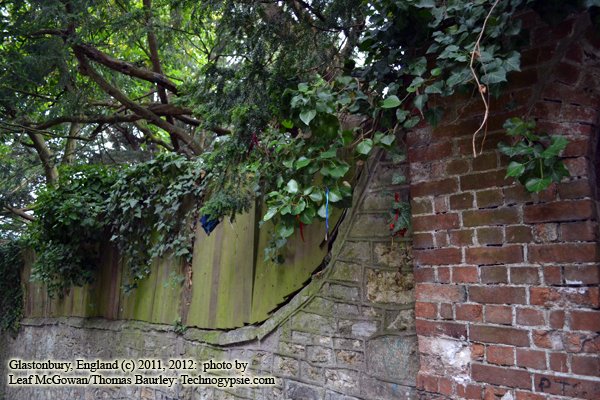
 

The White Spring
August 1, 2011: The White Spring, Glastonbury, England.

Within a few feet from one another, the two Isle of Avalon mysteries wells forth from the Earth bestowing blessings, magic, and healing to its visitors and pilgrims. Each offers different healing properties, the Chalice Well being the Red spring rich with iron, the other white with calcite, both from the magical caverns beneath Glastonbury Tor, with rumors of Merlin’s magic. There is actually a third Blue Spring that has since vanished.

A temple has been built here at the White Spring offering the gift of pure water that is cavernous, mysterious, dark, Gothic, and magical as contrary to the Chalice Well in a well lit open-aired garden. The interior has three domed vaults standing at 16 feet height with beautiful bowed floors some say mimic the illusion of a hull of a boat moored at the portal to the Otherworld.

The pools within were designed and constructed based on sacred geometry following the Michael ley line that flows through space with shrines added honoring ancient energies and the Spirits of Avalon.

A company of volunteers watch over the Spring and temple who designed it, built it, and care for it on a daily basis. The site sees pilgrimages and visitors daily. Group ceremonies and meditations are also conducted daily during opening hours, including celebrations of the turning of the seasons, the full moon, and the new moon. Private ceremonies can be arranged. There is no charge or expectation of donations and all caretakers do not get paid.
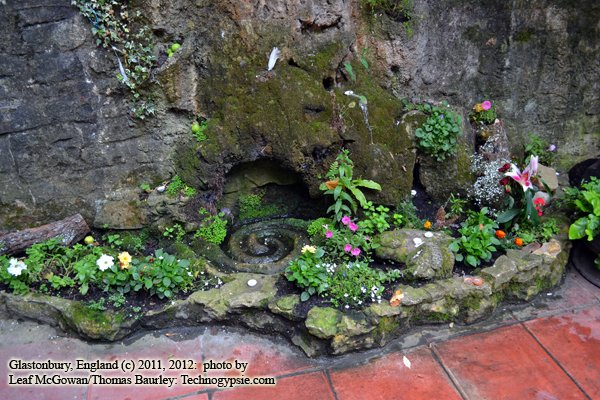
 

The White Spring
August 1, 2011: The White Spring


The sanctuary is candle-lit and dark, the sound of the water flowing can meditatively be heard and is a guide for ceremony and contemplation. Talking or conversations is strictly discouraged as silence other than the Spring is desired, though songs are welcome and check with the well keeper if wanting to play musical instruments. No Cameras, mobile phones, or electronic equipment is permitted in the sanctuary.

Legend has it that Glastonbury is England’s most sacred site and is where the foundations of the earliest church in Britain was formed and may be the site of the earliest church in the world second to Jerusalem and was dedicated to Mary. (There is no archaeological evidence to support this legend)

The Glastonbury Tor or the Holy Hill of Albion is also believed to be England’s most sacred mountain and a place of Ancient Goddess worship. The Tor and its caverns beneath host numerous aquifers and springs that well forth from its base. Many of the springs have dried up except the Red Spring (Chalice Well) and the White Spring.

There is evidence of a monastic site at the summit of the Tor and archaeological excavations revealed it is likely that early Celtic Christian hermits once lived on the sacred site of the White Spring. In 1872 a well house was constructed over the spring creating a reservoir that was used by townsfolk who were suffering from cholera and therefore destroyed the beautiful combe that once was there.

A historic document by George Wright in 1896 stated “And what was Glastonbury like then? One thing that clings to me was the beautiful Well House Lane of those days before it had been spoilt by the erection of the reservoir. There was a small copse of bushes on the right hand running up the hill, and through it could be, not seen, but heard, the rush of running water, which made itself visible as it poured into the lane. But the lane itself was beautiful, for the whole bank was a series of fairy dropping wells – little caverns clothed with moss and vedure, and each small twig and leaf was a medium for the water to flow, drop, drop, drop into a small basin below. This water contained lime, and pieces of wood or leaves subject to this dropping became encrusted with a covering of lime. For a long time, I attended those pretty caverns with affectionate care, and Well House Lane was an object of interest to all our visitors”
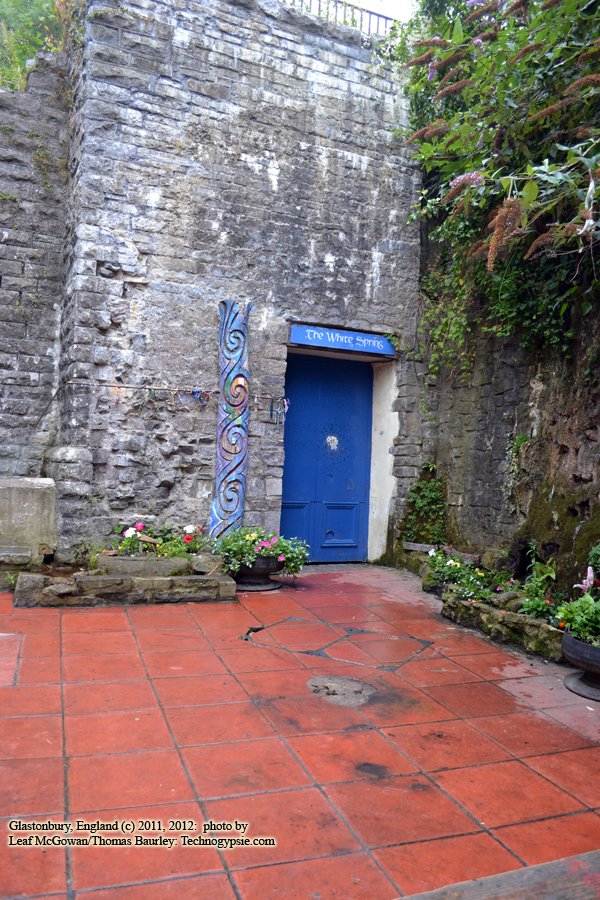
 

The White Spring blue door
August 1, 2011: The White Spring, Glastonbury, England.

The reservoir fell into disuse as the high calciferous waters often blocked the pipes and by the 19th-century water was piped into Glastonbury from out of town, the well house falling into disuse and forgotten. In the 1980’s it was re-opened and reconstructed being used for drinking water for the town. The walls, floors, water pipes, and chemical paint added in the ’80s was removed.

The high ceilings bowed floors, and original stone walls were uncovered unveiling the cathedral-like structure you see today. By 2004 a new owner took over the building and erected the sacred space you can visit now. The temple was consecrated in 2005. In October 2009 various pools were built inside based on sacred geometry. Its design and layout are always changing. The seasonal altar changes at each turn of the wheel. The bower that forms the Brigid shrine is rebuilt with fresh hazel for Imbolc and a February 1st celebration held in conjunction with Chalice Well and Bride’s Mound.

The White Spring is dedicated to the Goddess Brigid – the Celtic Fire Goddess and Guardian of the Sacred Springs within, and a perpetually burning Brigid Flame flickers her magic. A shrine in honor of the Lady of Avalon is within as well as a shrine in honor of the King of the World of Faerie at the portal to the Otherworld. Legend has it that the nun named Brigid who was said to be a child in 525 C.E. filled with the spirit of the Goddess Brigid who was born in Ireland from a Druidic father named Dubtach and a Christian slave mother named Brocessa. She was raised in both traditions and chose to enter a monastery – making her an Abbess as well as a nun. Legend states she lived and learned at the Beckery in Glastonbury before founding her abbey Cill Dara in Kildare Ireland.

The Lady of Avalon is seen at the White Spring as the Lady of ancient feminine primary power as Mother, Earth Mother, Mother of God, and Mother of us all. She is forever conceiving and birthing yet remains unchanged as herself self-fulfilled as the Virgin Mother. She is a dark lady like the earth – dark, womb-like, safe, hidden, mysterious, vast, abstract, and protective. She is also called the Black Madonna.

The King of the Faeries represents nature as wild, beautiful, majestic, diverse, interdependent, and powerful. He represents the Fae, the Otherworld, and is King of the World of Faerie as well as all the nature spirits of this world. He represents the unity of both worlds.

It is said that the White Spring is a portal to the Celtic Otherworld. It is said that Gwyn Ap Nudd was said to ride through here.

More Information: https://www.atlasobscura.com/places/the-white-spring-glastonbury-england
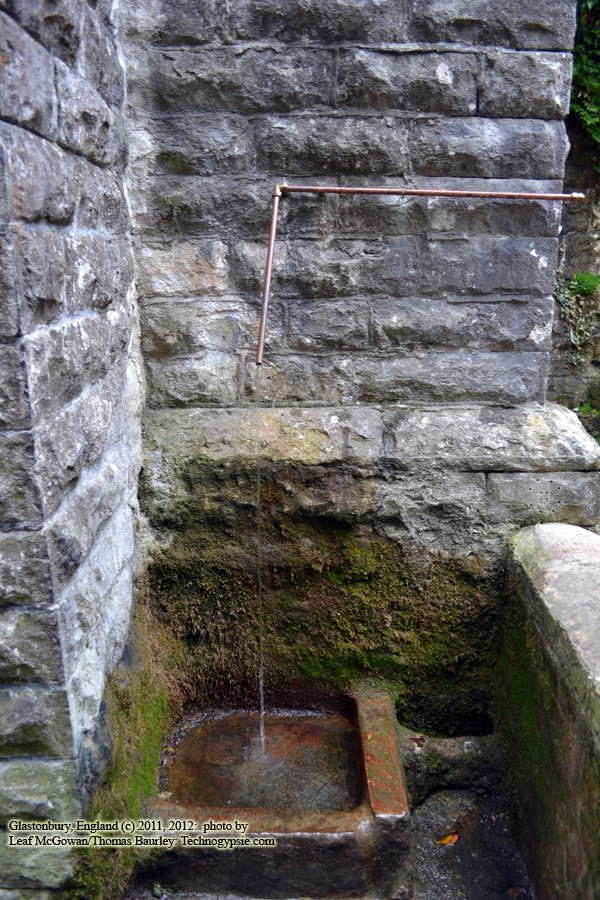
 

The White Spring
 

Read More “The White Spring of Glastonbury” »

Brigids Sacred Wells in Kildare, Ireland

Posted on December 14, 2010 By Techno Tink No Comments on Brigids Sacred Wells in Kildare, Ireland
Mythology, Religion, Sacred Sites

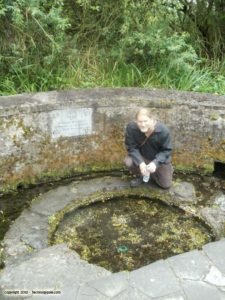
Brigid’s Well #1, the “Wayward Well”, Kildare, Ireland

Brighid’s Holy Wells in Kildare
* Kildare, Ireland
The Goddess or St. Brigid has two holy wells in Kildare? She certainly does. Some say that one of the wells belongs to the Ancient Goddess Brigid, while the other well belongs to St. Brigid. Both are sacred, both are holy, and both hold Brigid’s magical healing waters.

Well #1 is the ancient “original” sacred well of Brigid. Well #2 is the dressed-up sacred shrine and park of Brigid with her well. They were two distinctly different entities … an Ancient Goddess whose ethereal Godly presence could manifest as a human female and the actual magical human nun turned Saint who was the personification of the Deity. One and the same? could be. Two differently distinct entities who share the common thread? very possibly.

Two wells … that seems to be the case. One for the Goddess and One for the Saint? I would say “both” wells contain “both” the Saint and the Goddess in them. I’ve come to notice a pattern with this, that the “ancient” Pagan “original” well is often offset from the “Christian” one. This seemed to be the case when I went to see the Madron well in Cornwall, England (though technically that one had “three” – the original one buried in the marsh, the Pagan “original” one offset from the one underwater, and the Christian well house.).

There are many Brigid wells in Ireland as well as Britain. As wells were the sacred sites of veneration in the Druidic faith, many also have an associated sacred tree with them that is covered with votive offerings. These are often called “Wishing Trees”. Trees covered with “clotties” or ribbons of cloth are done as a prayer for healing or a spell to obtain something. Pilgrims come here to get in touch with the well inside themselves. Wells are sacred places where people for thousands of years have come to pray, worship, and reflect.

Pagan and Holy wells are often seen as the entrance to the womb of Mother Earth, the source of life. Each holy well is always related to healing, and each well usually has a specialty that it performs. Brigid’s wells are pretty powerful for healing sore eyes. Brigid is associated with all healing. Her girdle is capable of curing all disease and illness, and this well is rumored to make “the blind man seeing, the dumb girl speaking, etc.”

Brighid’s Holy Well #1 a.k.a. “The Wayside Well”
The first well is the ancient Pagan sacred well of the Goddess Brigid. It is located just next to the car park of the Japanese Gardens. This well/spring itself feeds and nourishes the Gardens themselves. This is the spring source whose waters run off and feed the newer well. It’s not really decorated and is simple, rustic, ancient, and silent. Seemingly forgotten. It has only an inscription sign in Irish that translates as “St. Brigid, Mary of the Gael, pray for us.” However, it is still a major focal point for pilgrimages and ceremonies.

The Brigid Eve ceremonies (January 31st) start at a small fire set up just outside the Japanese Gardens car park with a chanting to the Goddess Brigid, which is followed by a candlelit journey of contemplation about the Goddess and the Saint and the spirit that weaves them together. The candlelit journey goes to this well and ends at the second well. It is customary to gather this well water in a bottle because of its strong healing properties and, in exchange, to leave an offering for the spirits and faeries who dwell there.


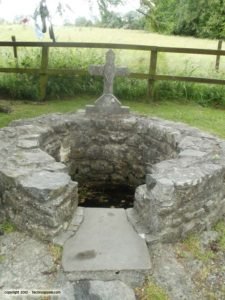
“Tobair Bride” / St. Brigid’s Well, Kildare, Ireland

Brighid’s Holy Well #2 a.k.a. “Tobair Bride” (St. Brigid’s Well)
The second well is the “supposed” Christian well of St. Brigid. It’s the tourist one. It’s the “Official” one. This is the one in the tourist guides, signposts, and advertisements. It is located in a landscaped grotto at the end of a short lane close to Well #1. The local Catholic clergy moved Christian devotion and practices to this site in the 1950s, supposedly out of concern for people’s safety in accessing the original well, which was at the bend in a narrow, busy road. It is here that the Roman Catholic healing well is located. While pilgrims often visit both wells, this is the well where an involved ceremony, similar to the “stations of the cross,” is conducted. Pilgrims reflect on the Goddess and/or Saint Brigid and how they weave together.

Read More “Brigids Sacred Wells in Kildare, Ireland” »

Brigids Sacred Flame at Kildare

Posted on December 14, 2010 By Techno Tink No Comments on Brigids Sacred Flame at Kildare
Brigids Sacred Flame at Kildare
Mythology, Religion, Sacred Sites

or well over 1,000 years, if not 2,000 years or more, the sacred fire of the Goddess Brigid (now St. Brigid of Ireland) has existed and kept holy/sacred by her followers, priestesses, and/or members of her Order. In Ancient times, the Priestesses of Brighid kept her flame eternally lit with 19 Priestesses keeping vigil that the flame was never extinguished.

Brigids Cross

Posted on December 13, 2010 By Techno Tink No Comments on Brigids Cross
Mythology
Brigid's Cross
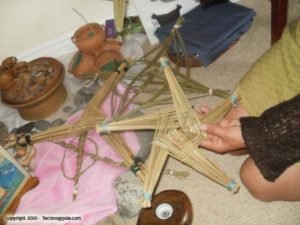
Brigid’s Cross

Brighid’s Cross
* Kildare, Ireland *
Another blessed part of my pilgrimage to Brigid and Kildare was learning more about Brigid’s Cross. I had the pleasure of Faerie Moe as a guide, a local friend giving me the tour of Kildare and the sacred wells as well as giving me an on-hand explanation on how to weave a Brigid’s Cross.

As a dedicant to the Goddess Brigid for over 20 years, in my early years, i fumbled at making them but never made anything as intricate and powerful as the crosses I saw at St. Brigid’s shrine and Sister Mary’s house. Amazing.

Many say that the St. Brigid’s Cross, a.k.a. Cros Bríde, Crosóg Bríde or Bogha Bríde, is actually an Irish symbol of sun worship representing the sun in the center with rays of light coming from it in the shape of the arms of the Cross. Some say it represents a Brigid legend wherein the story St. Brigid miraculously hung her wet clothes to dry on a sunbeam. It is also considered a Pagan sun wheel. They are traditionally made on February 1st for Lá Fhéile Bhríde (St. Brigid’s feast day).

It is also a symbol of Ireland and its provinces. Ireland has four provinces, but in ancient Ireland, there were five – an invisible one in the center of Ireland. To some, Brigid’s cross represents the four provinces (in the modern standard design) and in the 5 handed cross like shown in these pictures, representing the 5 provinces. The arms represent North, South, East, West, and Center. The 5th Province, the invisible one, is the province of healing and reconciliation.

Brigid’s Cross probably first appeared in Ireland between the 2nd century B.C.E. and the 2nd century C.E. It is a folk magic tradition of weaving together straw to create an equal-armed Celtic cross that represents the Goddess Brigid, or modern-day St. Brigid. Taking rushes that are woven together into a swastica-like /Celtic cross-like ornament, with a central square and four spokes protruding from each corner of the square in opposing directions, that has some variations found in Celtic art both ancient and modern.

Brigid’s cross appears often traditionally on February 1st, the eve of St. Brigid’s feast / Imbolc / or Candlemas. In some traditions, the Brideoga or Biddies, young virgin boys who would carry a churn dash (post used to churn butter) that is dressed up as a woman or an effigy of St. Brigid, and would go door-to-door through their neighborhood collecting alms for the poor.

While collecting alms, they would leave bundles of straw and rushes outside the homes that they visited. At nightfall, young virgin girls would pick them up and ask to be admitted to the homes in the name of Brigid and would weave the rushes into crosses. After traditional prayers and a meal at the homes, the crosses would be placed under the eaves in the house or in the outhouses and sometimes blessed with holy water. The leftover rushes would be woven into a girdle called a “crios” or a tie for cattle or sometimes as a Brid’s bed or mattress for the Saint.

Just as cattle were traditionally led through holy lakes or doused in water from Brigid’s well, they were often led through uplifted arches of these girdles. The Brid’s bed or holy mattresses were often placed at specific sacred wells and believed to possess curative powers to counter barrenness and to protect families and animals from natural calamities, especially lightning and fire. Some see Brigid’s cross as symbolic of the evolution of the Goddess into the Saint. The Brigid’s Cross magically is believed to protect a house where it hangs from evil and from fire. Because of this, it is often hung in kitchens.

The Brigid’s cross is commonly woven on February 1st or 2nd, the date of Celtic Imbolc or Candlemas, a time to celebrate Brigid in her maiden form – the winter elder “cailleach” is reborn the maiden in her phase of collecting kindling for winter fires and warming the hearth for spring when she becomes young again. (After serving the winter as the aged woman still collecting kindling to keep the fire going to rejoice the flame for her rebirth) As the inventor of “caoineadh” or “keening”, from the mourning of her son Ruadán’s death, she inadvertently created the art form to keen. Some say this is tied to the creation of Brigid’s cross.

At this time when the night sky turns to the North star, the big dipper turns through the seasonal year, creating patterns in the sky that the Brigid cross is said to invoke. To tie into the warming for spring, Brigid is the fire keeper of the eternal flame always burning in Kildare, keeping the people of Ireland eternally warm. During her conversion to becoming a nun led to the practice of Brigid’s cross, a craft many children and adults partake of weaving the kindling into a spiral form of Brigid’s cross.

Here is a great web site with diagrams of the weave: http://www.fisheaters.com/stbrigidscross.html


Faerie Moe weaving a cross

Read More “Brigids Cross” »

The Pagan Goddess Brigid, or the Christian Saint Brigid

Posted on December 11, 2010 By Techno Tink No Comments on The Pagan Goddess Brigid, or the Christian Saint Brigid
The Pagan Goddess Brigid, or the Christian Saint Brigid
God/desses, Mythology, Religion

As a Saint and Actual Living Person: St. Brigid – c. 451 – 525 C.E. (A.D.)Goddess of Poetry, Magic, Healing, Smithcraft, Learning, Common People, Flocks/Stock/Yield of the Earth, and Inspiration.

Categories

New Posts

  • Thunder Mountain
  • Area 51
  • The Old Tonopah Cemetery
  • The Clown Motel
  • Thomas the Rhymer / Tam Lin

Pages

  • About Faerie Lore ....
  • Donate
  • Newsletter

Archives

  • Home
  • About Faerie Lore ….
  • Evolution
  • Haunted Locations
  • Herblore
  • Magic & The Occult
  • Media, News, Tales
  • Mythology
  • Folk Songs
  • Giants
  • God/desses
  • Living Myth
  • Monsters
  • Otherkin
  • Prophecies
  • Shadow beings
  • The Undead
  • Urban Legends
  • Religion
  • Traditions
  • Newsletter
  • Donate

Copyright © 2026 Faerie Lore and Legends.

Theme: Oceanly News Dark by ScriptsTown