Skip to content

Faerie Lore and Legends

Exploring the Unknown, Myths, Lores, and Legends

  • Home
  • Techno Tink
  • Page 5

Author: Techno Tink

Multnomah County Poor Farm

Posted on February 15, 2021 By Techno Tink No Comments on Multnomah County Poor Farm
Ghosts, Haunted Locations, Sightings, Urban Legends

Multnomah County Poor Farm (Now McMenamins Edgefield) Troutdale, OR Deep in the heart of Troutdale was an early 1900’s farm that housed the homeless, sick, poor, and unfortunate. It was a place for those desperate to come and stay in exchange for work.  Legend has it, many died while working the farm, and the place … Read More “Multnomah County Poor Farm” »

Crosian Creek Road kids

Posted on February 15, 2021 By Techno Tink No Comments on Crosian Creek Road kids
Ghosts, Haunted Locations, Sightings, Urban Legends

The kids of Crosian Creek Road Salem, OR There exists an urban legend or ghost story of a little girl and boy apparitions walking along the road outside of Salem, Oregon. Legend has it the little girl was killed while walking across the road and ever since she’s haunted the roadway with her brother. Some … Read More “Crosian Creek Road kids” »

The Bandage Man of Cannon Beach

Posted on February 15, 2021 By Techno Tink No Comments on The Bandage Man of Cannon Beach
Ghosts, Haunted Locations, Sightings, Urban Legends

The Bandaged Man Hwy 101 near Cannon Beach, Oregon There is a mysterious legend along with the coastal highway 101 on the Oregon coast – that of an apparition of a man walking along the highway covered in bandages. He is often seen on the side of the road or in one’s rear-view mirror. Some … Read More “The Bandage Man of Cannon Beach” »

Gmok am c

Posted on February 14, 2021 By Techno Tink No Comments on Gmok am c
Mythology

Gmok’am’c Coming soon!

Cairns and stacked rocks

Posted on February 14, 2021 By Techno Tink No Comments on Cairns and stacked rocks
Living Myth, Mythology, Sacred Sites
Potential power quest cairns

Cairns and Stacked Rocks
By Thomas Baurley

The stacking of stones is a widespread cultural practice all around the world. You know it is a remnant of modern, historical, or prehistoric cultural manufacture because they were not placed there by nature. Most likely a “human” moved one stone atop another. They vary in size from one or two rocks or more stacked on top of each other in simplicity to complexity of mounds, cairns, pyramids, tombs, and massive megalithic complexes.

The meaning behind the practice varies between cultures and time periods throughout history. Archaeologists however, are only interested in those that are at least 50 years old (historical archaeology in America), 100 years old (Europe and other parts of the world), or prehistoric (hundreds to thousands of years in age).

They can be field clearing piles, fence piles, burial mounds, markers, signifiers, monuments, spiritual tools, graves, food stores, game drives, rock alignments, power quest markers, altars, shrines, prayer seats, hearths, circles, and/or memorials. Their uses can vary from remnants of field clearing for plowing, stabilizing fences, make walls, clearing or road construction, markers of a road trail or path, survey markers, memorial, burial, vision quest marker, or part of something bigger like a structure, burial, tomb, underground chamber, prayer seat, tipi ring, or offering to Gods, spirits, entities.

These commonly can be found along streams, creeks, lakes, springs, rivers, waterways, sea cliffs, beaches, in the desert, tundra, in uplands, on mountaintops, ridges, peaks, and hilltops. In underpopulated areas they can represent emergency location points.

North American trail markers are often called ducks or duckies because they have a beak that points in the direction of the route. Coastal cairns or sea markers are common in the northern latitudes can indicate navigation marking and sometimes are notated on navigation charts. Sometimes these are painted and are visible from offshore. This is a common practice in Iceland, Greenland, Canada, and Scandinavia.
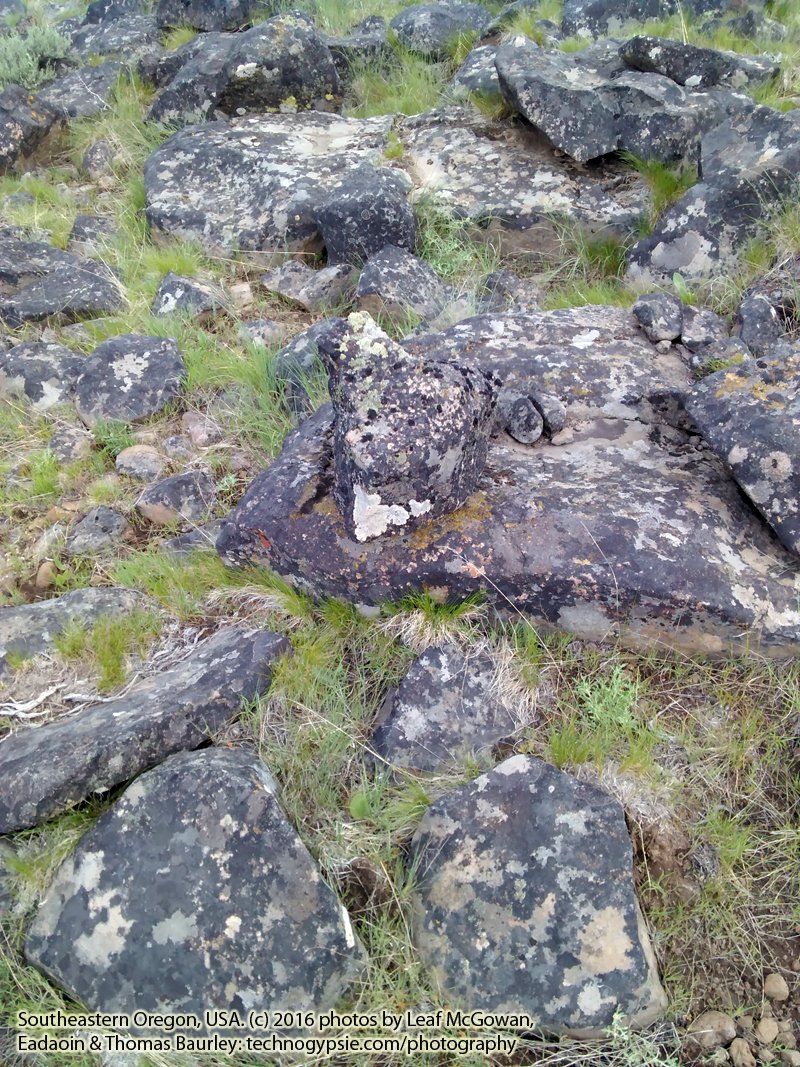
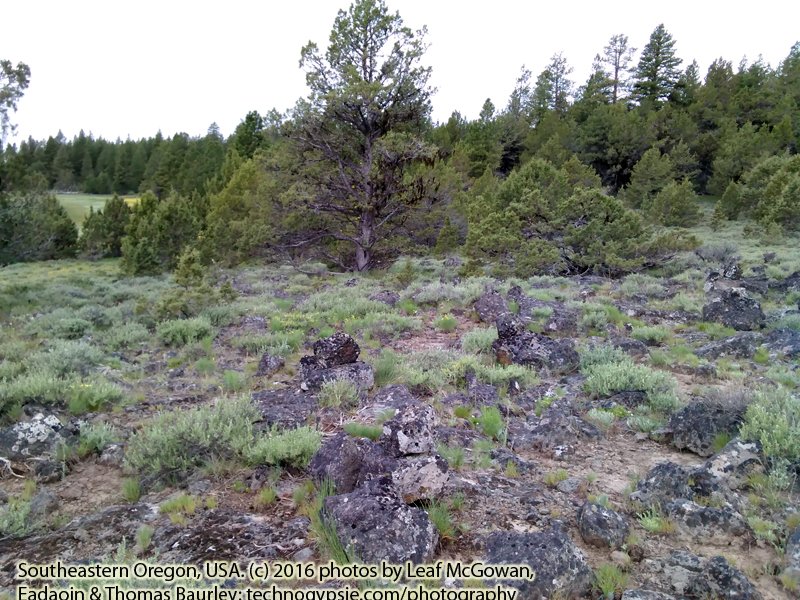
stacked rocks
Cairns / stacked rocks Public Lands near Malin, Oregon – Bryant Mountain.
 

ROCK STACKS
Often the practice of stacking rocks is used to mark a trail, path, or road. Many say without these markings, it is often hard to follow a laid out trail, especially in areas that receive deep snowfall. When modern cairn builders place their art or message of ego along a trail they can be causing harm, hiding the true trail markers and if placed in a wrong place can lead a hiker astray or get them lost.

Original use is often a route marker and it’s important to preserve that integrity. Modern application of this practice can not only lead people astray but disrupt cultural studies, archaeology, geology, and the environment. Moving stones can upset plant life, insect habitats, as well as homes of lizards, rats, mice, and other creatures.

Other times these rock stacks have spiritual or religious purpose. These are sometimes offerings to the little people, fairies, faeries, nature spirits, Saints, entities, or God/desses. Sometimes these are arranged for a vision quest, other times as a prayer seat, or part of a stone circle.

Many times if found around rivers, streams, creeks, or springs they are offerings to the nature spirits, water spirits, nymphs, naiads, and/or dryads. Sometimes these are markers for portals, vortexes, gateways between worlds, lei lines, or places of spiritual importance. They honor spirits, Deities, Ancestors, or the Dead.

Sometimes these stacked rocks are considered art, a meditative exercise, or something someone does out of boredom.
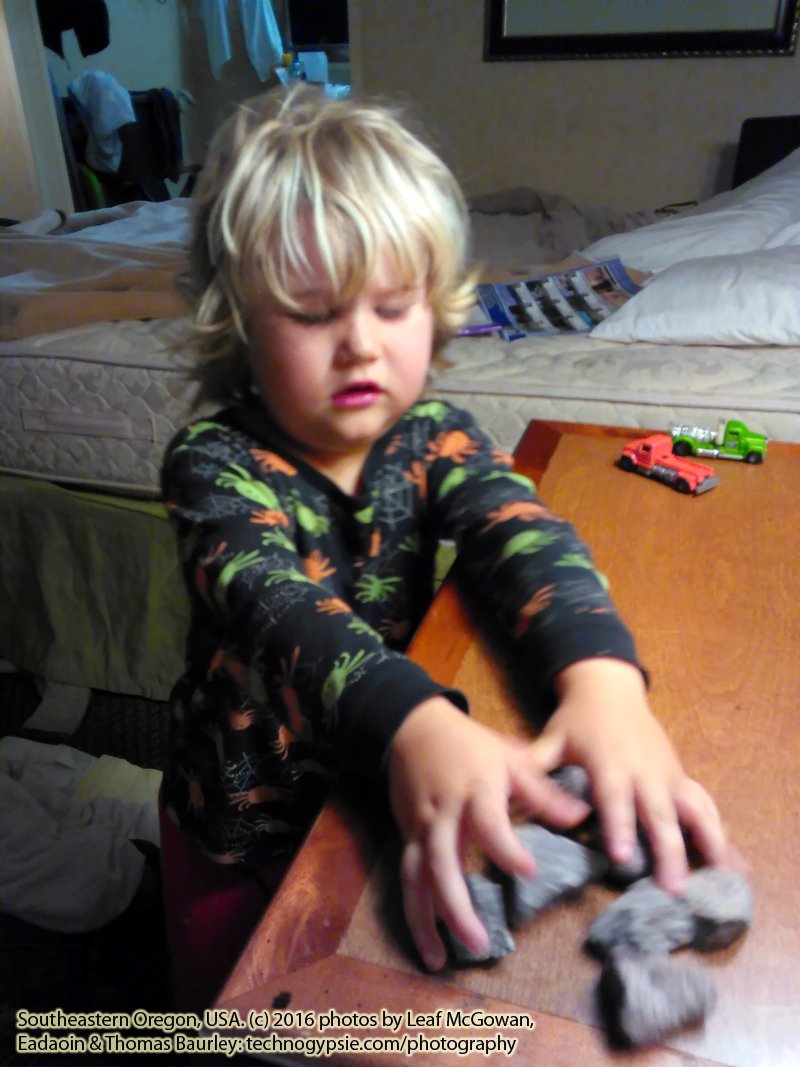
Cian making cairns
Prince Cian making Cairns
 

In spiritual new age hotspots, modern creations of these cairns or rock stacks are actually quite problematic because they have become invasive upon the landscape, blocking access or movement. In addition, modern creations of them destroy, hide, or change importance of historical or prehistoric ones that existed before.

This is a similar impact between modern graffiti and rock art. This has become a major problem in places like Sedona Arizona; Telluride, Colorado; Arches National Park, Utah.

Prehistoric use
Aborigines, Natives, Tribes, and Original Peoples have utilized cairns and rock stacks all over the world. Mostly the intent was as a marker. In the Americas, various tribes such as the Paiutes as well as early Pioneers left them to mark important trails or historic roads. The Inuksuk practice used by the Inuit, Inupiat, Kalaallit, Yupik, and other Arctic aborigines in North America ranging from Alaska to Greenland to Iceland are markers for wayfinding and to locate caches of food, supplies, and other goods.

Cairns and rock stacks have been used prehistorically for hunting, defense, burials, ceremonial structures, astronomical structures, or markers.

Read More “Cairns and stacked rocks” »

Manitou, the Great Spirit

Posted on February 14, 2021 By Techno Tink No Comments on Manitou, the Great Spirit
Giants, God/desses, Living Myth, Mythology

Manitou – the Great Spiritu

Article by Thomas Baurley, Leaf McGowan, Technogypsie Research

In the heart of the Ute and many Algonquian Native American groups, the closest equivalent to the Christian concept of “God” would be the “Great Spirit” or “Manitou”, A God of many names. It is the spiritual and fundamental all-knowing life force, omnipresent, all-seeing, all-existing, and the combined spirit of all organisms, their environments, and life events.

“Aasha Monetoo” – The Great Spirit, divided by “Aashaa monetoo – “The Good Spirit” and otshee monetoo – “the bad spirit”. It is S/he of no sex that gave humanity the land, the sky, and the sea to the people. It was a well-known concept amongst many tribes, especially within the Algonquian family groups, even pre-contact and pre-Christianization by Euro-American contact.

European explorer Thomas Harriot recorded in 1585 in his glossary of the Algonquian language Roanoke the term “mantoac” meaning “Gods”. “Gitche Manitou” in Algonquian refers to “Supreme Being” or “Great Spirit”. In Shamanism, “manitous” (aka “manidoog” or “manidoowag”) are connections that are connected to achieve desired effects such as buffalo manitou for a good hunt, plant manitous for healing, and manidoowag as an aspect of the Great Connection.

The derivatives “manituw” are underwater creatures that were appeased with offerings from hunters for safe passage amongst the Iynu. The Canadian province “Manitoba” is named after Lake Manitoba coming from “manitou-wapow” – the Straight of the Manitou, divine passage through the rocks by the Creator. Manitoulin Island, or “spirit island”, is a very sacred place to the Ojibway or Anishinaabe tribes where they have placed sounding rocks and created sacred sites.

Fox Indians believed the manitou lived in the grandfather stones of the sweat lodge. When one heats the rocks, the heat of the fire forces manitou to come out of its place within the stones. It is released from the stones when water is added, following the steam, and entering the human body. Once inside, it moves all over the body driving out everything that inflicts pain. Before it returns to the stone, it imparts some of its nature to the body. This is why “manitou” is seen from volcanic waters, heated waters, or mineral springs as carrying a ride within the waters, entering the human body when it is drunk, and then healing the body in the process. The Colorado village of “Manitou Springs” is named after the local tribes’ belief that Manitou – the Great Spirit blessed itself in the mineral waters that rise up from the karst topography as a healing spirit – once drank into the body, cleansing, purifying, and healing the body as it travels within.

Manitou is also called “Wakan Tanka” amongst the Sioux tribes, Gitche Manitou in Algonquian, and other names around the varying peoples. Even though there is much evidence that many tribes and peoples, mostly Algonquian, believed in this concept, and being before Christianity affected their belief systems, other scientists believe that not all tribes believed in a supreme being until after the 18th century. It was during the 18th century that many saw the “Great Spirit” an anthropomorphic celestial deity who ruled over the world.

Read More “Manitou, the Great Spirit” »

Samhain / Halloween

Posted on February 13, 2021 By Techno Tink No Comments on Samhain / Halloween
Living Myth, Magic & The Occult, Mythology, Religion, Sacred Sites, Traditions

Coming Soon!

Cuchulainn / Cúchulainn

Posted on February 13, 2021 By Techno Tink No Comments on Cuchulainn / Cúchulainn
Faeries, God/desses, Mythology, Tuatha de Danann

Cúchulainn mythos … coming soon!

Ailill

Posted on February 13, 2021 By Techno Tink No Comments on Ailill
Faeries, God/desses, Mythology, Tuatha de Danann

Coming Soon!

Medb

Posted on February 13, 2021 By Techno Tink No Comments on Medb
Faeries, Living Myth, Mythology, Tuatha de Danann

It is also believed that the Cave of the Cats is the actual physical birthplace of Queen Medb. The legend states that the Fairy Queen/Goddess Étain who was fleeing her human husband with her fairy lover Midir came here. Midir wanted to visit a relative named Sinech (the large breasted one) who lived in the … Read More “Medb” »

Posts pagination

Previous 1 … 4 5 6 … 21 Next

Categories

New Posts

  • Thunder Mountain
  • Area 51
  • The Old Tonopah Cemetery
  • The Clown Motel
  • Thomas the Rhymer / Tam Lin

Pages

  • About Faerie Lore ....
  • Donate
  • Newsletter

Archives

  • Home
  • About Faerie Lore ….
  • Evolution
  • Haunted Locations
  • Herblore
  • Magic & The Occult
  • Media, News, Tales
  • Mythology
  • Folk Songs
  • Giants
  • God/desses
  • Living Myth
  • Monsters
  • Otherkin
  • Prophecies
  • Shadow beings
  • The Undead
  • Urban Legends
  • Religion
  • Traditions
  • Newsletter
  • Donate

Copyright © 2026 Faerie Lore and Legends.

Theme: Oceanly News Dark by ScriptsTown