Skip to content

Faerie Lore and Legends

Exploring the Unknown, Myths, Lores, and Legends

  • Home
  • mythology
  • Page 2

Tag: mythology

Faerie or Elven Star

Posted on February 8, 2011 By Techno Tink No Comments on Faerie or Elven Star
Elves, Faeries, Mythology, Religion

Faery Star
Elven Star
or
Faerie Star

[originally posted 1987 on geocities; posted on faeid.com from 1991-2000; updated 2/7/2011. Current home location: http://www.technogypsie.com/faeid/elvenstar.html. ]
Seven Pointed Stars, called “Faerie or Elven Stars” represent a gift from Faerie to humans to bridge the understanding between the Mortal human realm and that of Faerieland. The 7 pointed star is known as a gateway symbol, a Gate or entrance between our world and that of Faery, the Otherworld. Each point on the star represents a gateway or path of the Higher Self to prepare one for entrance into Faery. It is also known as a septagram, Heptagram, or “7 pointed star”. It is also a representation of those who believe in Faeries, consider themselves to be Fae, or blessed by the Fae. Originating from Faerie faiths, alchemy, and ceremonial magickal groups – the Faerie Star has been adopted by many old and newer faiths, including some brands of modern day Witchcraft / Wicca such as the Faerie Tradition, Blue Star Wicca, many Otherkin groups (especially Elves), The Silver Elves, Faeidism, Aleister Crowley’s Order of the Silver Star, the Pleidians, and some New Age Cults. It’s first documented use was in the Kabbalah, then with Aleister Crowley, the Ordo Templi Orientis as the Star of Babalon, and by Alchemists to represent the 7 planets and 7 elements of the Universe. Christianity has even used the star to represent the seven days of creation, to ward off evil, etc. It has been found in the Former Georgian Coat of Arms (1918-1921; 1991-2004). The Cherokee Nation has incorporated the symbol into various bands of the Cherokee Nation. Many police entities use the 7 pointed star on their badges, including the Navajo Nation Police. It is employed in the Flag of Australia having 5 heptagrams and one pentagram to depict the Southern Cross constellation and the Commonwealth Star.
Faerie Star :
 

  1. Power, Personal Will, Determination, Prosperity, Justice, the Gate.
  2. Unconditional Love, Wisdom, Growth, Friendship, Healing.
  3. Knowledge, Intelligence, Creativity, Sexuality, Awakening.
  4. Harmony, Tranquility, Blessings, Love.
  5. Powers of Mind and Science, Balance, Dexterity.
  6. Devotion, Honesty, justice, Healing.
  7. Magick, Success, the Gaian Hypothesis.


Meditation:
Meditations on the Seven-Pointed Star
Draw line from 1 to 6 (1 = The Sun (prosperity, justice, the Gate) )
6 to 4 (6 – Wind Spirits (justice, healing) )
4 to 2 (4 – Magic (Goddess bless, love))
2 to 7 (2 – Tree Spirits (friendship and healing) )
7 to 5 (7 – Success (Gaian Hypothesis))
5 to 3 (5 – the Gateway (balance/entering Faeryland) )
3 to 1 (3 – Water Spirits (creativity, sexuality, Awakening) )
Read More “Faerie or Elven Star” »

The Power of Numbers and the Elements

Posted on February 4, 2011 By Techno Tink No Comments on The Power of Numbers and the Elements
Mythology, Religion

The Power of Numbers: The Power of One ONE: represents the power of the person, the Me/Myself/ and I. Power of the Individual. It is a number, a numeral, and a glyph. It is representative of a single entity. It represents the unit of counting or measurement. It demonstrates Unity. It is the first odd … Read More “The Power of Numbers and the Elements” »

Wishing Trees

Posted on December 16, 2010 By Techno Tink No Comments on Wishing Trees
Faeries, God/desses, Living Myth, Mythology, Religion, Sacred Sites, Sidhe
Brigid’s well, Kildare, Ireland

Wishing Trees
“Wishing Trees” are very common throughout Ireland, England, and Scotland. They are usually individual trees upon which “folk magic”, “folk spells”, “faerie offerings”, or “prayers” are offered. Sometimes it is particular to a specific species, where the tree lives, or how it looks. Many times they are associated with faeries or a particular Deity. They are very common alongside sacred wells in Ireland and the UK. The practice usually involves petitions or offerings made to the tree, a nature spirit associated with the tree, a Saint, a God/dess, or the ancestors with a request for a wish to be fulfilled.

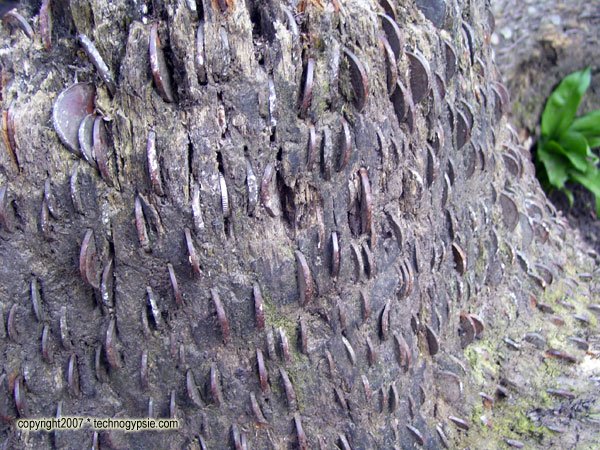
Coin trees involve the offering of coins to a particular tree. These are often hammered into an old trunk, branch, or small tree. Sometimes these are oaks, rowan trees, hawthorns, ash, or thorn trees. Some hawthorns serve for fertility magic such as a common one in Argyll, Scotland by the Ardmaddy House. Sometimes hundreds of coins are hammered into the bark and wood with the belief that a wish will be granted for each of the coins added. A similar one that is well known is the sacred well of ST. Maree in Loch Maree, Gairloch, Scotland has hundreds of coins hammered into it. Also all over the Yorkshire Dales, such as in the pictures shown here I took during a hike, are found hundreds of coins offered to nature spirits and/or faeries for a granting of a wish.

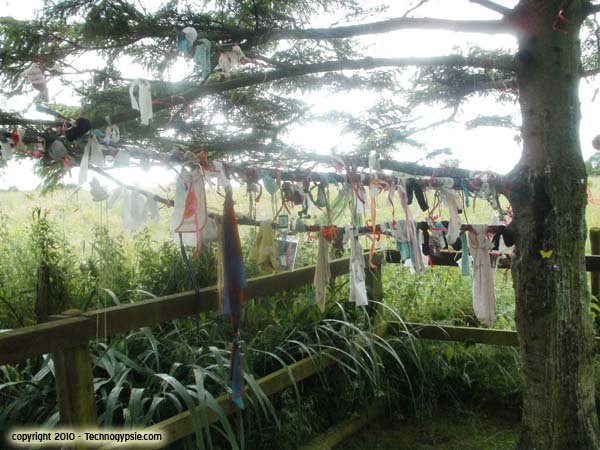
Clootie Wish Trees (a.k.a. Cloughtie or Rag Trees) are found next to sacred wells throughout England, Scotland, and Ireland. This involves the practice of tying a piece of cloth, often called “clouties”, “clooties”, or “cloughties” to ask for an answer to a prayer, a wish, and/or a petition. As the rag decays, so will the illness; or so will the petition come true. It is a form of sympathetic magic. One of the most well-known “wishing trees” is the Madron Well in Cornwall. With the Madron well, a sacred well of healing, it is believed that as the cloth rots, the ailment that one is seeking a cure for disappears. Even Charles Darwin recorded the finding of a “wishing tree” in his travels in Argentina called “Walleechu” which was treated by the local inhabitants as a Deity. It was festooned with offerings such as cigars, food, water, and cloth hung from the branches by bright strips of colored thread. A popular wishing tree in Hong Kong is the “Lam Tsuen Wishing Tree” near the “Tin Hau Temple” in Lam Tsu where paper is tied to an orange and thrown up in the trees that stick will grant the petitioner a wish. The wishing tree next to Brigid’s Well in Kildare is a common tree for petitioning healing requests.

Penny offerings for good luck and as gifts to the Fae "Wishing Tree" Yorkshire Dales, England

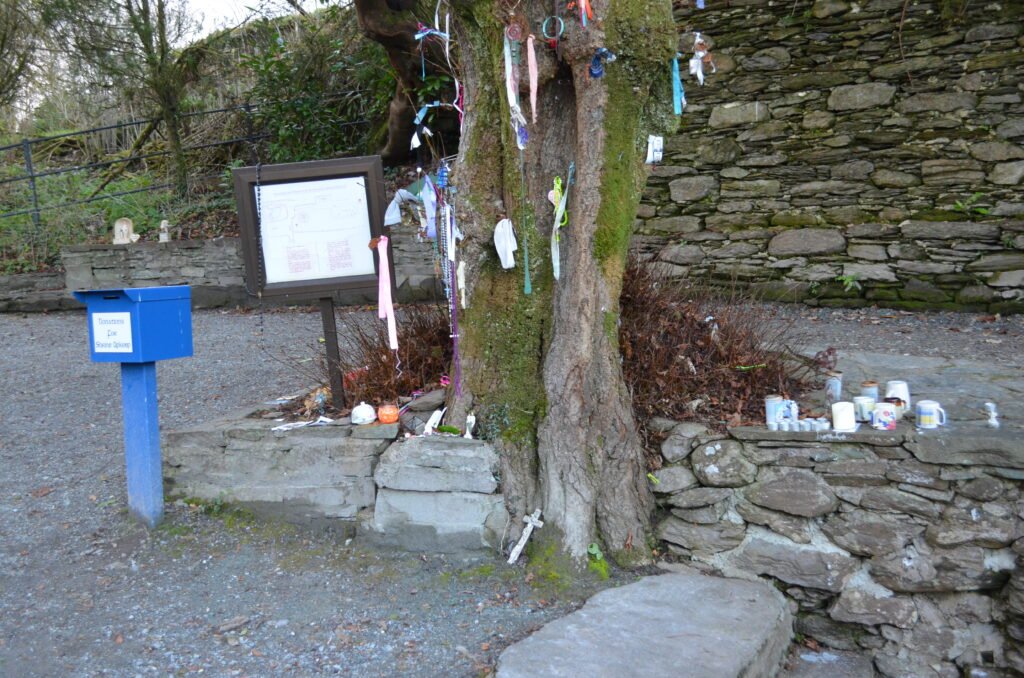
The Wishing Tree at Tobar Ghobnatan Holy Well
not only consists of rags, but trinkets, rosaries, jewelry, prayer cards, toys, personal effects, and other items given as offerings. You can see these at Tobar Ghobnatan Wishing Trees. The concept is to leave behind something of yourself or someone that you love who is in need of prayers, healing, or petitions. The concept with the rags is that when it decays so will the illness that it represents. This is a kind of sympathetic magical rite.

Unfortunately, some pilgrims to the sites don’t realize how the spell or magic works. You can see this when they tie a piece of a plastic bag on the tree. Plastic will take forever to decay, and so will the illness it is to represent. If only they knew! In addition to the rags, others leave coins, jewelry, rings, prayer cards, figurines, toys, personal effects, and clothing items such as belts, shoes, garments, and trinkets. The cloutie and Wish trees found at Tobar Ghobnatan are considered to be dedicated to the Matron Saint of Ballyvourney and sacred Bee-Keeping mistress, Saint Ghobnatan holy pilgrimage site and monastic settlement known as “Tobar Ghobnatan”. This is the legendary home of St. Gobnait/Ghobnatan. It is located a kilometer south of the village of Ballyvourney where her church Móin Mór (a.k.a. Bairnech) was built.

Tobar Ghobnatan Holy Well

Read More “Wishing Trees” »

Brigids Sacred Flame at Kildare

Posted on December 14, 2010 By Techno Tink No Comments on Brigids Sacred Flame at Kildare
Brigids Sacred Flame at Kildare
Mythology, Religion, Sacred Sites

or well over 1,000 years, if not 2,000 years or more, the sacred fire of the Goddess Brigid (now St. Brigid of Ireland) has existed and kept holy/sacred by her followers, priestesses, and/or members of her Order. In Ancient times, the Priestesses of Brighid kept her flame eternally lit with 19 Priestesses keeping vigil that the flame was never extinguished.

Legend of the Blarney Stone

Posted on November 6, 2010 By Techno Tink No Comments on Legend of the Blarney Stone
Mythology, Sacred Sites


Legend of the Blarney Stone
Blarney Castle, Blarney, Co. Cork, Ireland * Phone: 00 353 21 4385252 * http://www.blarneycastle.ie/
One of Ireland’s most valuable and mesmerizing mythical collections is the infamous Blarney Stone. Called “Cloch na Blarnan” in Irish, it is the legendary stone for the gift of gab. “Blarney” means “Clever, Flattering, or coaxing talk”. The Blarney Stone is a block of bluestone that is built within the battlements of Blarney Castle, locaed approximately 8 kilometers from Cork, Ireland. It is believed that whoever kisses the stone is endowed with the gift of gab, great eloquence, or the skill at flattery. It allows the gifted to impart the ability to deceive without offending. Its not an easy task to kiss the stone, as one needs to be held upside down atop a drop of a tall tower to reach the kissing spot. The stone became part of the tower in 1446 and has become one of Ireland’s most notable tourist sites.
Where does the stone come from? There are many myths and legends surrounding the stone and its origins, the earliest of which involves the Goddess Clíodhna. It is believed that the Castle’s builder, Cormac Laidir MacCarthy, was in a lawsuit and sought out Clíodhna for her assistance. She told him to kiss the first stone he found in the morning on his way to court, and as he did, he gained eloquence and won the court case. Flabberghasted by this magical event he took the stone and added to the castle’s stones. Many believe that it was a piece of the Stone of Scone. Others believe it to be the rock that Moses struck with his staff to produce water for the Israelites during their exodus from Egypt. Others believe it to be the stone that Jacob used as a pillow and was later brought to Ireland by the prophet Jeremiah. It is said that it then became the Lia Fail, or ‘Fatal Stone’ and was used as an oracular throne of the Irish kings. Some say its the Stone of Ezel which David hid behind on Jonathan’s advice while fleeing King Saul and brought to Ireland during the Crusades. Others believe it to be the rock pillow used by St. Columba of Iona on his deathbead. Some believe that the stone was first presented to Cormac McCarthy by Robert the Bruce in 1314 to recognize his support in the Battle of Bannockburn. Some say that the stone was previously in Ireland then taken to Scotland and brought back to Ireland in 1314. It is also said that during the time of Queen Elizabeth I, Dermot McCarthy, had been required to surrender his fortress to the Queen as proof of his loyalty. He told her he would be delighted to do so, but something always happened at the last moment to prevent his surrender. Many believe this was the charm of the Blarney Stone in effect. The Queen replied to this as “Odds bodikins, more Blarney talk!”
Kissing the Stone has been performed by literally ‘millions of people’ in the world, including world statesmen, literary giants, and legends of the silver screen. Kissing the stone is kissing all of these people by proxy, and by the magical law of contact – gaining the gift of gab that all these people possess. Its not an easy kiss and its important for the lips to touch the bluestone. This quest involves ascending to the castle’s peak, leaning over backwards on the parapet’s edge, entrusting a stranger (Castle guard) with your life by holding on to you. Today, safety wrought-iron guide rails and protective crossbars help prevent death or serious injury. Prior to these installations, the kisser was in danger of serious life risk as they were grasped by their ankles and dangled from the plummet. According to the Sherlock Holmes radio dramatization in “The Adventure of the Blarney Stone” (March 18, 1946) reported a man attempting the kiss plummeting to his death – but determined to be a murder as his boots had been greased before the attempt. The cautious and germ phoebic consider the Blarney Stone to be the most unhygienic tourist attraction in the world, as ranked as such by Tripadvisor.com in 2009. When I attended, I watched the guards use antiseptic wipes after every kiss and had hand sanitizer on the spot. Urban legends are amiss that claim locals go up to the Blarney stone at night and piss on it. Of course, anyone who has ever been to the Blarney stone, knowing the tight and tiny ascension up the treacherous tower (that is locked after hours and guarded) that even with breaching security and risking royal criminal punishment, would have to be damn good aim to hit the Blarney stone. Much of the urban legend comes from the incident in the film “Fight Club” where the narrator urinates on the Blarney Stone during his visit to Ireland as his first act of vandalism.
 

    ‘Tis there’s the stone that whoever kisses
    He never misses to grow eloquent;
    ‘Tis he may clamber to a lady’s chamber, Or become a member of Parliament.
    “A noble spouter he’ll sure turn out, or An out and outer to be let alone;
    Don’t try to hinder him, or to bewilder him, For he is a pilgrim from the Blarney stone.”

 
Many nation’s around the world have attempted to obtain the Blarney Stone. There are quite a few imposters out and about. The one and true stone is in the Blarney Castle. According to a tradition at Texas Tech University, a stone fragment on display since 1939 outside the old Electrical Engineering Building claims to be a missing piece of the Blarney Stone.
One can kiss the stone from monday thru saturday, 9 am to 6:30 pm in September and May, 9 am to 7 pm from June through August, and 9 am to sundown from October to April. On sundays, kissing can commence from 9 am to 5:30 pm during the summer, and 9 am to sundown during the winter.


Read More “Legend of the Blarney Stone” »

Mermaids/Mermen

Posted on October 2, 2010 By Techno Tink No Comments on Mermaids/Mermen
Mermaids/Mermen
Mermaids, Mythology

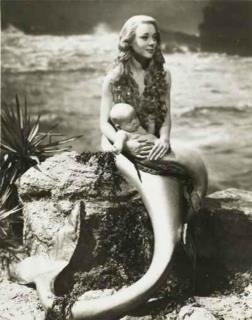
A rich realm of characters in faerie lore, mermaids, and mermen have consumed popular myth through the ages, including fantasy, entertainment, and imagery. Mermaids (and the male form “Mermen”) are a race of Faerie that consist of human-like mythological aquatic creatures that are depicted with a human head and torso attached to the tail of a fish.

Faeries

Posted on August 25, 2010 By Techno Tink No Comments on Faeries
Faeries

The Tree Leaves’ Oracle icon flower fairy

The Victorian Flower Fairy or Nature Sprite

Flower Fairies are believed to be the fairy spirit essence of various flowers; they are portrayed as tiny creatures that rarely are larger than 20 cm. tall. Most of these depictions come from Victorian art and is a common ‘model’ for what most people think of what is a fairy. They live in tree tops, marshes, forests, gardens, fields, and waysides. It is believed by many that when a seed sprouts a flower fairy is born. Each flower fairy lives upon its host plant and not found too far from it. They sleep within the flower. As the flower grows so does the fairy. The flower fairy exists to tend and watch over the flower. If the flower dies, so too does the fairy. Disembodied spirits, elves, fairies or daemons; often the term used for the Air elemental known as “sylphs,” or as the name of the elementals of Spirit. Flower fairies are often also referred to as nature sprites or spirits. Some define sprites as a being who are beginning a course of evolutionary growth and in the elemental states of their growth. In some ways, this is the concept, in the life of a flower, what makes a flower fairy a sprite. Examples: http://www.flowerfaeries.com/flowerfairies.shtml; http://www.flowerfairies.com/US_version/home.html.

Read More “Faeries” »

Ragnarok

Posted on August 25, 2010 By Techno Tink No Comments on Ragnarok
Events, God/desses, Living Myth, Mythology, Religion

Ragnarok   Ragnarok “Ragnarok”, “Gotterdammerung”, or a.k.a. “Doom of the Gods” or “Final Destiny of the Gods” is the apocalypse in Norse mythology. Its an important event in the Norse canon. This event will be followed by the Fimbulvetr, or the “Winter of Winters”. These three winters will follow each other with no summer. This … Read More “Ragnarok” »

Posts pagination

Previous 1 2

Categories

New Posts

  • Thunder Mountain
  • Area 51
  • The Old Tonopah Cemetery
  • The Clown Motel
  • Thomas the Rhymer / Tam Lin

Pages

  • About Faerie Lore ....
  • Donate
  • Newsletter

Archives

  • Home
  • About Faerie Lore ….
  • Evolution
  • Haunted Locations
  • Herblore
  • Magic & The Occult
  • Media, News, Tales
  • Mythology
  • Folk Songs
  • Giants
  • God/desses
  • Living Myth
  • Monsters
  • Otherkin
  • Prophecies
  • Shadow beings
  • The Undead
  • Urban Legends
  • Religion
  • Traditions
  • Newsletter
  • Donate

Copyright © 2026 Faerie Lore and Legends.

Theme: Oceanly News Dark by ScriptsTown