Skip to content

Faerie Lore and Legends

Exploring the Unknown, Myths, Lores, and Legends

  • Home
  • Living Myth
  • Page 3

Category: Living Myth

The Fairy-Go-Round Ring Fort, Dingle Peninsula, Co. Kerry, Ireland

Posted on March 6, 2024 By Techno Tink No Comments on The Fairy-Go-Round Ring Fort, Dingle Peninsula, Co. Kerry, Ireland
Faerie Hills, Faeries, Living Myth, Mythology

A tourist-attraction with a petting farm, this privately owned attraction is 10 km west of Dingle in the parish of Kilvickadownig. Its along the world famous Slea Head Drive.  This Ring fort, also known as a “Rath”, “Lios”, or “Fairy Fort” is a circular ancient pre-Celtic settlement

Mass Rocks

Posted on February 19, 2024 By Thomas Baurley No Comments on Mass Rocks
Haunted Locations, Living Myth, Religion, Sacred Sites, Traditions

Mass Rocks: Generally, a “Mass Rock” was used as an altar in the mid-17th century for Catholic masses in Ireland and Scotland or regions where the Protestants persecuted the Catholics.

Tobar Ghobanatan

Posted on January 21, 2024 By Techno Tink No Comments on Tobar Ghobanatan
Living Myth, Religion, Sacred Sites, Traditions

The holy wells and shrine of Tobar Ghobanatan in Ballyvourney, County Cork, Ireland

Ireland’s Last Witch Burning / Changeling murder: 1895 Bridget Cleary

Posted on December 25, 2023 By Techno Tink No Comments on Ireland’s Last Witch Burning / Changeling murder: 1895 Bridget Cleary
Adbductions, Changeling, Faerie Hills, Faeries, Living Myth

We’re talking about Ireland’s infamous last burning of a Witch or killing of a Changeling: that is the 1895 murder of Bridget Cleary in Ballyvadlea, Ireland. Her body was dumped in a shallow grave in a bog then relocated to an unmarked grave in a local cemetery.

Glastonbury Tor

Posted on June 7, 2022 By Techno Tink No Comments on Glastonbury Tor
Faerie Hills, Haunted Locations, Living Myth, Mythology, Sacred Sites

One of the most infamous landmarks of Glastonbury is the Tor. It is extremely popular in the Arthurian legends. The Tor is a tall hill that ascends over 158 meters from Glastonbury and hosts panoramic views of the English countryside, viewing the three counties of Somerset, Dorset, and Wiltshire.

Helltown (Boston, Ohio)

Posted on May 19, 2021 By Leaf McGowan No Comments on Helltown (Boston, Ohio)
Living Myth, Magic & The Occult, Media, News, Tales, Mythology, Wendigo, Witchcraft

One of the sites of interest to pop up on my radar was the government take-over eminent domain of a town formerly known as “Boston, Ohio”. It is now fabled in urban legend and called “Helltown.”

Spirits and Entities, the spirituality of Alcohol

Posted on May 13, 2021 By Techno Tink No Comments on Spirits and Entities, the spirituality of Alcohol
Living Myth, Magic(k), Mythology, Religion

Spirits and Entities of Alcoholby Thomas Baurley, Leaf McGowan, Technogypsie Productions It always amazes me how the world really doesn’t understand the “root” of all things, nor pay attention to the “history” of various items or substances that they use occasionally or daily in life. I strongly believe it is very important to know the … Read More “Spirits and Entities, the spirituality of Alcohol” »

The Breckenridge Fairy Forest

Posted on March 19, 2021 By Techno Tink No Comments on The Breckenridge Fairy Forest
Living Myth, Traditions

This was a major bucket list item of mine, but I snoozed, and loss. The city has “closed” the Fairy Forest. “Fairy Lives Don’t Matter” as per Will Smith’s humor in the movie “Bright”. They claim it is being revegetated, though that’s government speak for “you’re not welcome”. It’s a sad loss for Breckenridge, mainly … Read More “The Breckenridge Fairy Forest” »

The Breckenridge Troll

Posted on March 19, 2021 By Techno Tink No Comments on The Breckenridge Troll
Art and Sculpture, Living Myth

Isak Heartstone – The Troll of Breckenridge There’s a troll in the woods, and his name is “Isak Heartstone”. He’s been a resident of Breckenridge for quite some time, and recently changed hoods. He’s 15 feet tall and is a recycled wood art sculpture created by infamous Danish artisan Thomas Dambo. He is an icon … Read More “The Breckenridge Troll” »

Cairns and stacked rocks

Posted on February 14, 2021 By Techno Tink No Comments on Cairns and stacked rocks
Living Myth, Mythology, Sacred Sites
Potential power quest cairns

Cairns and Stacked Rocks
By Thomas Baurley

The stacking of stones is a widespread cultural practice all around the world. You know it is a remnant of modern, historical, or prehistoric cultural manufacture because they were not placed there by nature. Most likely a “human” moved one stone atop another. They vary in size from one or two rocks or more stacked on top of each other in simplicity to complexity of mounds, cairns, pyramids, tombs, and massive megalithic complexes.

The meaning behind the practice varies between cultures and time periods throughout history. Archaeologists however, are only interested in those that are at least 50 years old (historical archaeology in America), 100 years old (Europe and other parts of the world), or prehistoric (hundreds to thousands of years in age).

They can be field clearing piles, fence piles, burial mounds, markers, signifiers, monuments, spiritual tools, graves, food stores, game drives, rock alignments, power quest markers, altars, shrines, prayer seats, hearths, circles, and/or memorials. Their uses can vary from remnants of field clearing for plowing, stabilizing fences, make walls, clearing or road construction, markers of a road trail or path, survey markers, memorial, burial, vision quest marker, or part of something bigger like a structure, burial, tomb, underground chamber, prayer seat, tipi ring, or offering to Gods, spirits, entities.

These commonly can be found along streams, creeks, lakes, springs, rivers, waterways, sea cliffs, beaches, in the desert, tundra, in uplands, on mountaintops, ridges, peaks, and hilltops. In underpopulated areas they can represent emergency location points.

North American trail markers are often called ducks or duckies because they have a beak that points in the direction of the route. Coastal cairns or sea markers are common in the northern latitudes can indicate navigation marking and sometimes are notated on navigation charts. Sometimes these are painted and are visible from offshore. This is a common practice in Iceland, Greenland, Canada, and Scandinavia.
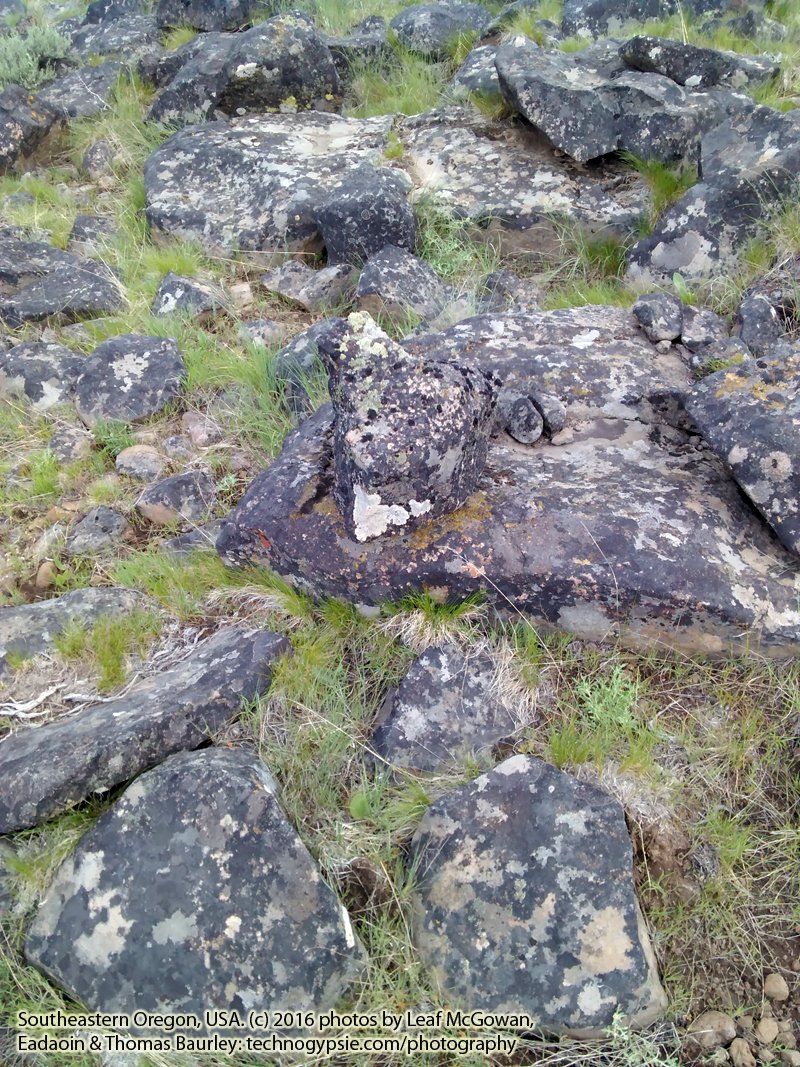
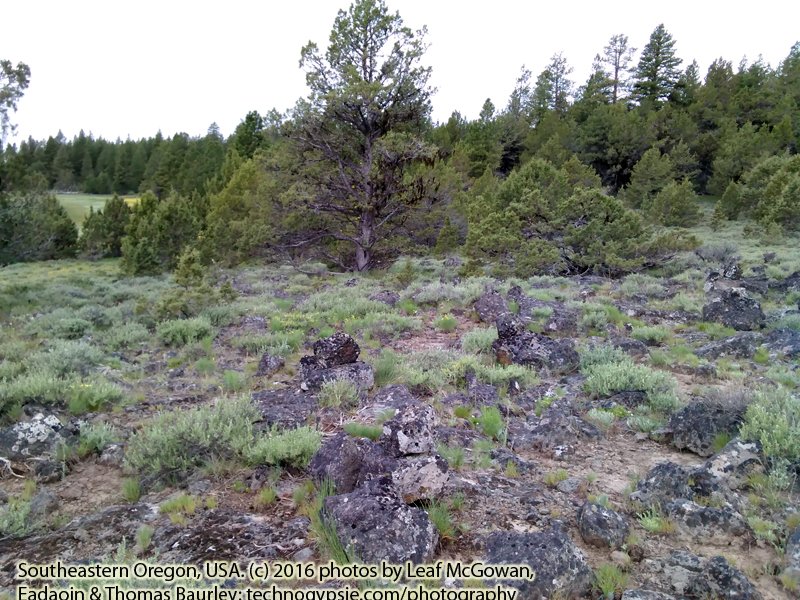
stacked rocks
Cairns / stacked rocks Public Lands near Malin, Oregon – Bryant Mountain.
 

ROCK STACKS
Often the practice of stacking rocks is used to mark a trail, path, or road. Many say without these markings, it is often hard to follow a laid out trail, especially in areas that receive deep snowfall. When modern cairn builders place their art or message of ego along a trail they can be causing harm, hiding the true trail markers and if placed in a wrong place can lead a hiker astray or get them lost.

Original use is often a route marker and it’s important to preserve that integrity. Modern application of this practice can not only lead people astray but disrupt cultural studies, archaeology, geology, and the environment. Moving stones can upset plant life, insect habitats, as well as homes of lizards, rats, mice, and other creatures.

Other times these rock stacks have spiritual or religious purpose. These are sometimes offerings to the little people, fairies, faeries, nature spirits, Saints, entities, or God/desses. Sometimes these are arranged for a vision quest, other times as a prayer seat, or part of a stone circle.

Many times if found around rivers, streams, creeks, or springs they are offerings to the nature spirits, water spirits, nymphs, naiads, and/or dryads. Sometimes these are markers for portals, vortexes, gateways between worlds, lei lines, or places of spiritual importance. They honor spirits, Deities, Ancestors, or the Dead.

Sometimes these stacked rocks are considered art, a meditative exercise, or something someone does out of boredom.
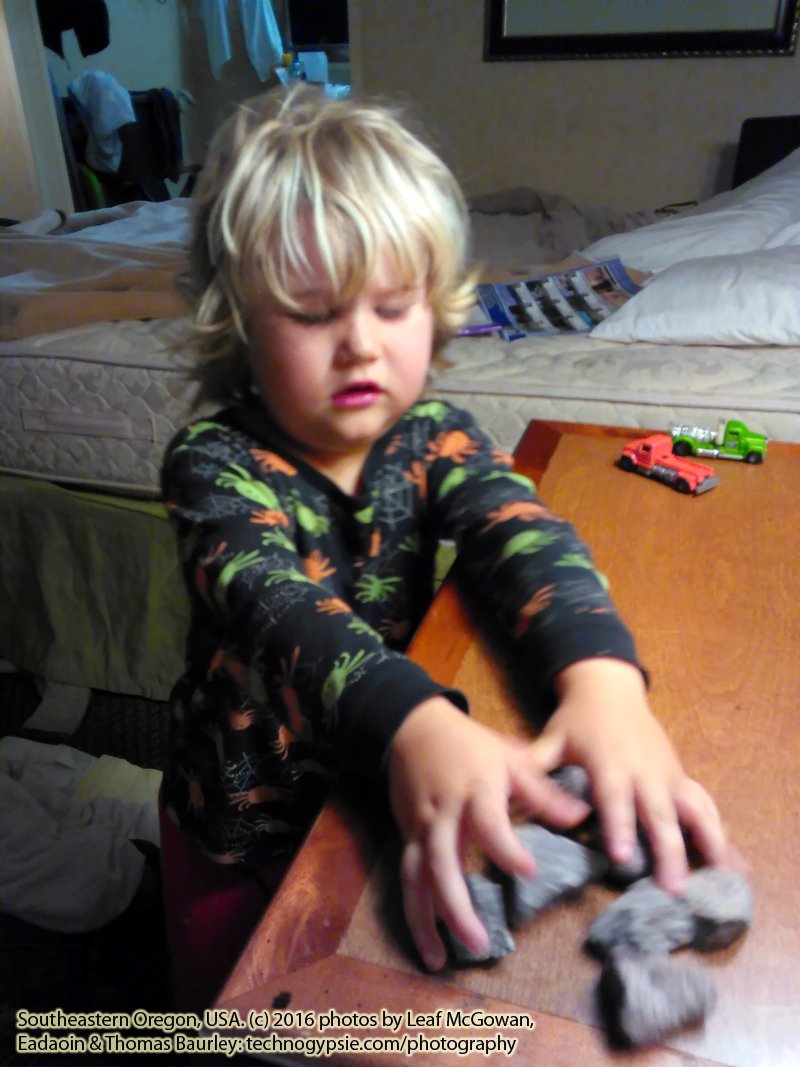
Cian making cairns
Prince Cian making Cairns
 

In spiritual new age hotspots, modern creations of these cairns or rock stacks are actually quite problematic because they have become invasive upon the landscape, blocking access or movement. In addition, modern creations of them destroy, hide, or change importance of historical or prehistoric ones that existed before.

This is a similar impact between modern graffiti and rock art. This has become a major problem in places like Sedona Arizona; Telluride, Colorado; Arches National Park, Utah.

Prehistoric use
Aborigines, Natives, Tribes, and Original Peoples have utilized cairns and rock stacks all over the world. Mostly the intent was as a marker. In the Americas, various tribes such as the Paiutes as well as early Pioneers left them to mark important trails or historic roads. The Inuksuk practice used by the Inuit, Inupiat, Kalaallit, Yupik, and other Arctic aborigines in North America ranging from Alaska to Greenland to Iceland are markers for wayfinding and to locate caches of food, supplies, and other goods.

Cairns and rock stacks have been used prehistorically for hunting, defense, burials, ceremonial structures, astronomical structures, or markers.

Read More “Cairns and stacked rocks” »

Posts pagination

Previous 1 2 3 4 … 8 Next

Categories

New Posts

  • Thunder Mountain
  • Area 51
  • The Old Tonopah Cemetery
  • The Clown Motel
  • Thomas the Rhymer / Tam Lin

Pages

  • About Faerie Lore ....
  • Donate
  • Newsletter

Archives

  • Home
  • About Faerie Lore ….
  • Evolution
  • Haunted Locations
  • Herblore
  • Magic & The Occult
  • Media, News, Tales
  • Mythology
  • Folk Songs
  • Giants
  • God/desses
  • Living Myth
  • Monsters
  • Otherkin
  • Prophecies
  • Shadow beings
  • The Undead
  • Urban Legends
  • Religion
  • Traditions
  • Newsletter
  • Donate

Copyright © 2026 Faerie Lore and Legends.

Theme: Oceanly News Dark by ScriptsTown