Histiopteris incisa: Bat’s wing fern

Official page: https://treeleavesoracle.com/lore/?p=103

Histiopteris incisa

Also known as bat’s wing fern, water fern, histiopteris, mata, and fern mata.

A common fern found in Australia, New Zealand, and many of the South Pacific Islands in moist areas where it forms large colonies. Found in coastal to subalpine regions. The large fronds of this fern provide a shady moist place for frogs to hide. The lower lobe of each pinna has a bat wing-like appearance from whence it name comes. This medium-sized fern produces approx. 60-200 cm long fronds that are widely spaced, distinct, and slightly dimorphic with fertile lobes. Rhizomes are long-creeping, scaly, with stipes and rachis chestnut-brown at the base otherwise mainly yellow-brown blarous except for basal scales, glossy, with stipe .15-1.2 meters long, 5-10 mm in diameter.

Uses:

Ornamental – both indoor and outdoors.

References:

  • nzpcn.org.nz n.d. “Histiopteris incisa” website referenced 6/23/21 at https://www.nzpcn.org.nz/flora/species/histiopteris-incisa/
  • Wikipedia n.d. “Histiopteris incisa” website referenced 6/23/21 at https://en.wikipedia.org/wiki/Histiopteris_incisa
Posted in Botany | Tagged , , , , , , | Comments Off on Histiopteris incisa: Bat’s wing fern

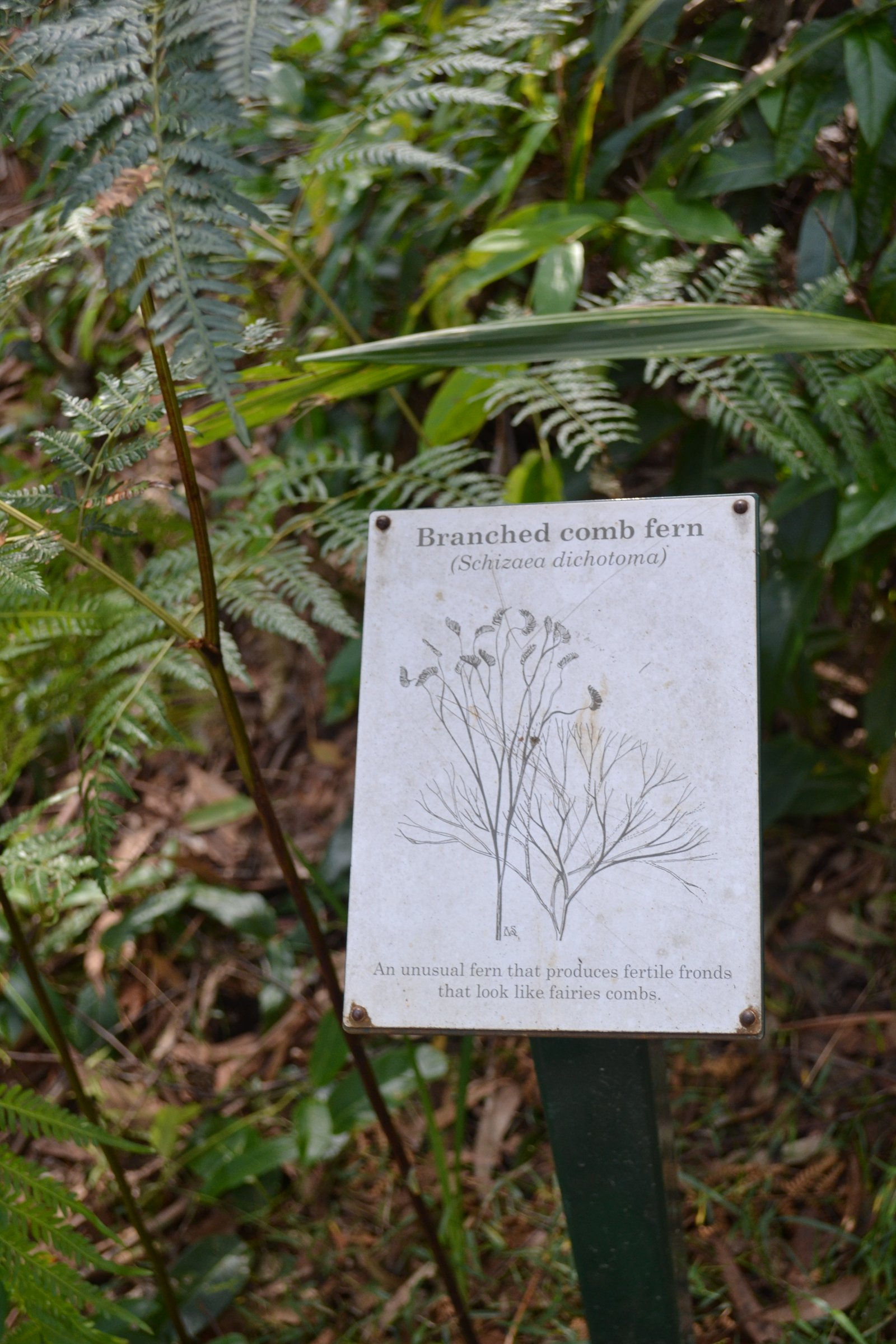
Schizaea dichotoma : Branched Comb Fern

Official page: https://treeleavesoracle.com/lore/?p=99

Schizaea dichotoma

The fairy comb, branched comb fern, schizaea, fan fern

A small terrestrial fern and Australian plant found on the heath, in open forests, and sandy soils. It is an unusual fern that produces fertile fronds that look like fairies’ combs. It is often upright with upwards of 20 segments, 2+ branched. The repeatedly forked leaves lobes end in sorophores. Rhizomes short creeping upwards of 6 cm in length that is covered with coarse, lustrous, brown hairs extending 2-3 mm in length. It is common in Australia, New Zealand, Malesia, and Papua New Guinea, as well as Pacific Ocean Islands. It grows approximately 20-40 cm high. It is named after the Greek word “dichotoma” meaning “twice cut” because of its fronds branched nature.

Uses:

In Indonesian folk traditions, the root is used to treat coughs and other throat issues as well as a childbirth tonic for women. In Malaysian lore, a decoction of the roots are used to treat coughs, and when mixed with other herbs to treat kidney issues and impotency.

References:

  • nzpcn.org.nz n.d. “Schizaea dichotoma” New Zealand Plant Conservation Network. Website referenced 6/23/21 at https://www.nzpcn.org.nz/flora/species/schizaea-dichotoma/
  • Smith, J.E. n.d. “Schizaea dichotoma (PROSEA)”. Pl@ntUse. Website referenced 6/23/21 at https://uses.plantnet-project.org/en/Schizaea_dichotoma_(PROSEA)
  • Wikipedia n.d. “Schizaea dichotoma”. Website referenced 6/23/21 at https://en.wikipedia.org/wiki/Schizaea_dichotoma
Posted in Botany | Tagged , , , , , , , , , , , , , | Comments Off on Schizaea dichotoma : Branched Comb Fern

Banksia integrifolia: Coastal banksia

Official page: https://treeleavesoracle.com/lore/?p=89

Banksia integrifolia

also known as coast banksia, coastal banksia, honeysuckle, white banksia, white bottlebrush, and white honeysuckle. Coast Banksia is an Australian coastal tree or shrub that can grow upwards of 25 meters in height. It has a single rough gray stout trunk that is often depicted gnarled and twisted. It has dark green leaves with white undersides. It was identified and named after Sir Joseph Banks in 1782. It has a flower spike – an inflorescence made up of several hundred densely packed greenish – pinkish – pale yellow budding flowers spiraling around its woody axis.

Uses:

It is commonly used for landscaping, especially in parks and along streetscapes, bush revegetation, and stabilization of dunes. The wood is pink to red with inconspicuous rings and conspicuous rays that is spongy and porous so used for decorative woodwork, cabinet panelling, ornamental turnery, boat knees, and firewood. Bees visiting the plant make a highly sought after dark amber honey.

References:

  • Plant Lust n.d. “Banksia integrifolia” Website visited 6/22/21 at https://plantlust.com/plants/12302/banksia-integrifolia/
  • UFEI n.d. “Coast Banksia” SelecTree: A Tree Selection Guide. Website visited 6/22/21 at https://selectree.calpoly.edu/tree-detail/1694
  • Wikipedia n.d. “Banksia integrifolia”. Website visited 6/22/21 at https://en.wikipedia.org/wiki/Banksia_integrifolia.
Posted in Botany | Tagged , , , | Comments Off on Banksia integrifolia: Coastal banksia

Acianthus fornicatus: Pixie caps

Official page: https://treeleavesoracle.com/lore/?p=72

Acianthus fornicatus

also known as Pixie Cap.

This terrestrial, perennial, deciduous, sympodial herb and orchid has a single heart-shaped dark green glabrous leaf with an reddish-purple coloring on its underneath. The leaves range from 10-40 mm in length x 10-20 mm in width, on a 4-9 cm stalk in height. It often produces upwards of 10 flowers, well-spaced on a raceme 100-300 mm tall, with each flower 10-40 mm in length, and translucent pinkish-red with green sometimes black labellum. The callus covers most of the central areas and is thick and fleshy with small pimple-like papillae on the outer half. It flowers between May and August.

References:

  • Jones, D.L. 1993 “Acianthus fornicatus R.Br.” PlantNET website referenced 6/22/21 ayt https://plantnet.rbgsyd.nsw.gov.au/cgi-bin/NSWfl.pl?page=nswfl&lvl=sp&name=Acianthus~fornicatus
  • Orchid Roots 2017-2021 “Acianthus fornicatus, R.Br. 1810” Website referenced 6/22/21 at https://www.orchidroots.com/detail/information/?role=&pid=1869
  • Wikipedia n.d. “Acianthus fornicatus”. Website referenced on 6/22/21 at https://en.wikipedia.org/wiki/Acianthus_fornicatus.
Posted in Botany | Tagged , , , , | Comments Off on Acianthus fornicatus: Pixie caps

Allocasuarina littoralis: Black she-oak

official page: https://treeleavesoracle.com/lore/?p=67

Allocasuarina littoralis
also known as black she-oak, black sheoak, river black-oak.

The Black she-oak is an endemic medium-sized Australian tree that grows upward of 8 meters, a coarse shrub in exposed maritime areas. It is evergreen with modified branchlets appearing to be leaves 5-8 cm in length and narrow width less than 4 mm in width, with a true very minute less than 1 mm length leaves occurring on the tips of the branchlets. It is a fast-growing tree that is commonly found along roadsides. It has a red female flower in the Spring.

References:

  • Pfaf.org n.d. “Allocasuarina littoralis – Salisb. L.A. S. Johnson” Plants For A Future. Website referenced 6/22/21 at https://pfaf.org/user/Plant.aspx?LatinName=Allocasuarina+littoralis
  • Vicflora 1982 “Allocasuarina littoralis” VICFLORA – Flora of Victoria. Website referenced 6/22/21 at https://vicflora.rbg.vic.gov.au/flora/taxon/ffb1666e-3e9a-4d25-9b99-fc5a7edfaf69
  • Wikipedia n.d. “Allocasuarina littoralis”. Website referenced 6/22/21 at https://en.wikipedia.org/wiki/Allocasuarina_littoralis.
Posted in Botany, Trees | Tagged , , , , | Comments Off on Allocasuarina littoralis: Black she-oak

Hovea acutifolia: Pointed leafed hovia

Official Page: https://treeleavesoracle.com/lore/?p=62

This plant is adorned with purple flowers in August and is one of the many pea flowered plants that add nitrogen to the soil. It is a shrub common to Australia. Some use them as ornamentals. Found in wet forests and rainforest margins from southeast Queensland to central New South Wales. This small to medium sized shrub grows upwards of 1.5-4 meters tall with dense grey to rusty haired covered stems and branches. They produce a dark green elliptical or lanceolate leaf approx. 70 mm in length x 12 mm in width boasting a rusty appearance. Flowers are pea-shaped with 4 petals, blue to purple in color, hosting a keel and two wings.

Posted in Botany | Tagged , , , , | Comments Off on Hovea acutifolia: Pointed leafed hovia

Dodonaea triquetra: Hop Bush

Official Page: https://treeleavesoracle.com/lore/?p=57

Dodonaea triquetra
also known as common hop bush or large leaf hop bush

A common shrub of Eastern Australian origin, it grows as an erect shrub upwards of 3 meters in height. It has 5-12 cm long elliptic or lanceolate or ovate leaves, that form tiny yellow-green flowers on panicles, creating purplish fruit with seeds coming from a winged capsule 9-16 mm in length. It is found in the forest understory in wet or dry sclerophyll forests and sedimentary soils.

Uses:

Settlers used the capsules as a substitute for hops. It is common ornamental plant. Bird seed.

Aboriginals used the fruit to relieve toothaches and fevers.

References:

  • Bluedale Wholesale Nursery n.d. “Commercial Nursery – Native Shrub: Dodonaea triquetra: Common Hop Bush, Large Leaf Hop Bush”. Website referenced 6/22/21 at https://bluedale.com.au/portfolio-item/dodonoea-triquetra-common-hop-bush-large-leaf-hop-bush-native-shrubs/.
  • Paten Park Native Nursery n.d. “Dodonaea triquetra: Forest Hop Bush”. Website referenced 6/22/21 at https://ppnn.org.au/plantlist/dodonaea-triquetra/
  • Wikipedia n.d “Dodonaea triquetra”. Website referenced 6/22/21 at https://en.wikipedia.org/wiki/Dodonaea_triquetra.
Posted in Botany | Tagged , , , | Comments Off on Dodonaea triquetra: Hop Bush

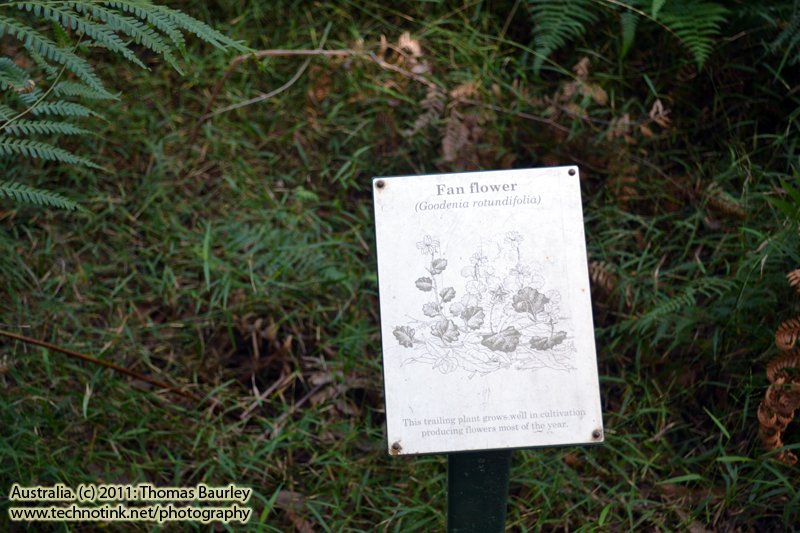
Goodenia rotundifolia: Fan Flower

Official page: https://treeleavesoracle.com/lore/?p=54

Goodenia rotundifolia
otherwise known as Fan Flower

A flowering plant common in Australia that has a prostrate to erect a perennial herb with more or less round toothed leaves and racemes of yellow flowers, growing to a typical height of 50 cm. Leaves stay mostly at the base of the plant, producing more or less round or egg-shaped leaves 8-20 mm long and 5-20 mm wide with toothed or often wavy-edged leaves. These produce flowers arranged in racemes upwards to 300 mm long on a peduncle 8-23 mm long with leaf-like bracts and each flower on a pedicel upwards of 2 mm long with linear bracteoles about 5 mm in length. Sepals are linear to lance-shaped 5-7.5 mm in length and yellow petals 12-16 mm long. the corolla lower lobes are 5-6 mm in length with .8-1.5 mm wings width – flowering from September to May. It produces a spherical capsule fruit approximately 5-7 mm in diameter.

References:

  • Queensland Government n.d. “Species profile – Goodenia rotundifolia”. Website referenced 6/21/22 at https://apps.des.qld.gov.au/species-search/details/?id=17065
  • Wikipedia n.d. “Goodenia rotundifolia”. Website referenced 6/22/21 at https://en.wikipedia.org/wiki/Goodenia_rotundifolia
Posted in Botany | Tagged , , | Comments Off on Goodenia rotundifolia: Fan Flower

Parsonsia straminia: Silkpod or Monkey Rope

Official page: https://treeleavesoracle.com/lore/?p=45

Parsonsia straminia
also known as Silkpod, Monkey Rope, Parsonsia. Common Silkpod

Common in New South Wales and Queensland Australia, this dogbane family woody vine has woody stems reaching 9 cm in diameter, extending approx 20 meters into the tree canopy with adventitious roots. When cut, the vine will produce a clear pale brown sap. The leaves are leathery arranged oppositely in pairs along the stems, yellowish green on upper surface, pale green-gray underneath, measuring approximately 4-24 cm in length by 1.5-8 cm in width. The leaves are elliptical to oblong-ovate in shape, with round or heart-shaped bases. They produce a fragrant pale yellow flower from November to June, followed by slender pods 10-20 cm in length that split to release feathery seeds from September-December.

Pictures from Our Adventures:

Pictures from Wikipedia Creative Commons/Public Domain:

tags: Parsonsia straminia, silkpod, monkey rope, common silkpod

References:

  • Anbg.gov.au n.d. “Parsonsia straminea” in “Australian Tropical Rainforest Plants”. Website referenced 6/22/21 at http://www.anbg.gov.au/cpbr/cd-keys/RFK7/key/RFK7/Media/Html/entities/Parsonsia_straminea.htm
  • Harden, G. J. & Williams, J.B. 1996 “Parsonsia straminea (R.Br.) F.Muell.” PlantNET. website referenced on 6/22/21 at https://plantnet.rbgsyd.nsw.gov.au/cgi-bin/NSWfl.pl?page=nswfl&lvl=sp&name=Parsonsia~straminea
  • Wikipedia n.d. “Parsonsia straminea”. Website referneced 6/22/21 at https://en.wikipedia.org/wiki/Parsonsia_straminea.

Posted in Botany, Flora | Tagged , , , | Comments Off on Parsonsia straminia: Silkpod or Monkey Rope

Tallowood (Eucalyptus microcorys)

Official page: https://treeleavesoracle.com/lore/?p=35

Eucalytpus microorys
Tallowood

Endemic to Eastern Australia, Talloweed has rough fibrous or string bark on its trunk and branches, with lance shaped to egg-shaped adult leaves, budding in flowers of 7-9 white to lemon-yellow flowers that produce conical fruit. The tree grows to a typical height of 40-60 meters but has been found upwards of 70 meters. It is common in tall open forests on fertile soil slopes, ridges, and valleys.

Photos from our Expeditions:

From Wikipedia Commons: public share:

Recommended reading and references:

  • Hill, K. 1991 “Eucalyptus microcorys F. Muell.” PlantNET website referenced 6/22/21 at https://plantnet.rbgsyd.nsw.gov.au/cgi-bin/NSWfl.pl?page=nswfl&lvl=sp&name=Eucalyptus~microcorys
  • Wikipedia n.d. “Eucalyptus microcorys”. Website referenced 6/22/21 at https://en.wikipedia.org/wiki/Eucalyptus_microcorys.
Posted in Botany, Eucalyptus, Flora, Trees | Tagged , , , , | Comments Off on Tallowood (Eucalyptus microcorys)