Skip to content

Faerie Lore and Legends

Exploring the Unknown, Myths, Lores, and Legends

  • Home
  • folk beliefs

Tag: folk beliefs

Three Main Types of Magic

Posted on February 6, 2011 By Techno Tink No Comments on Three Main Types of Magic
Mythology, Religion

THE THREE MAIN TYPES OF MAGIC:
Three basic types of magic anthropologically defined:
 

  1. Homeopathic Magic
    (The law that like produces like) – if some form of action is being performed on something, it will have the same impact on the intended real thing.
  2. Sympathetic or Imitative Magic
    The believe that Performing an action on some object, the same will happen to the person or object in which it represents. This is based on the belief that a relationship is made between the objects based on the presumption that one can influence something based on the attachment. An example of this is such acts as rock art with hunting magick by drawing out a successful hunt, rain dances, etc.
  3. Contagious Magic
    The law of contagion basically states that if a person has contact with certain things, they will influence the person who is under contact with such things. Examples of this are: Voodoo dolls which contain part of fingernails, hair, or teeth (DNA) of a targeted person – creates the person him/herself within the doll and anything happening to the doll happens to the attached person.Methods of Spellcraft:
    Herbs, incenses, oils, brews, candles, divination, oracles, sacrifices, offerings, sex magic, tantra, incantations, rhymes, dances, 8-Fold states, chemistry, alchemy, stones, elemental, worlds, fire, water, air, earth, trance, prayer, petition, manifestation, portals, visualization, invocation, evocation, poetry, words, names, symbols, talismans, charms, amulets, tools, events, prana, healing, cursing, attacking, defensive, curing, poppets, etc.
    Methods of Purification:
    Sweeping, censing, asperging, anointing, cleansing, bathing, showering, dusting, warming, implantation of symbols, dunking, baptizing, erasing, purifying.

Read More “Three Main Types of Magic” »

Brigids Cross

Posted on December 13, 2010 By Techno Tink No Comments on Brigids Cross
Mythology
Brigid's Cross
Brigid’s Cross

Brighid’s Cross
* Kildare, Ireland *
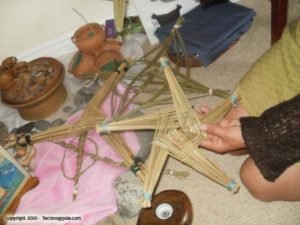
Another blessed part of my pilgrimage to Brigid and Kildare was learning more about Brigid’s Cross. I had the pleasure of Faerie Moe as a guide, a local friend giving me the tour of Kildare and the sacred wells as well as giving me an on-hand explanation on how to weave a Brigid’s Cross.

As a dedicant to the Goddess Brigid for over 20 years, in my early years, i fumbled at making them but never made anything as intricate and powerful as the crosses I saw at St. Brigid’s shrine and Sister Mary’s house. Amazing.

Many say that the St. Brigid’s Cross, a.k.a. Cros Bríde, Crosóg Bríde or Bogha Bríde, is actually an Irish symbol of sun worship representing the sun in the center with rays of light coming from it in the shape of the arms of the Cross. Some say it represents a Brigid legend wherein the story St. Brigid miraculously hung her wet clothes to dry on a sunbeam. It is also considered a Pagan sun wheel. They are traditionally made on February 1st for Lá Fhéile Bhríde (St. Brigid’s feast day).

It is also a symbol of Ireland and its provinces. Ireland has four provinces, but in ancient Ireland, there were five – an invisible one in the center of Ireland. To some, Brigid’s cross represents the four provinces (in the modern standard design) and in the 5 handed cross like shown in these pictures, representing the 5 provinces. The arms represent North, South, East, West, and Center. The 5th Province, the invisible one, is the province of healing and reconciliation.

Brigid’s Cross probably first appeared in Ireland between the 2nd century B.C.E. and the 2nd century C.E. It is a folk magic tradition of weaving together straw to create an equal-armed Celtic cross that represents the Goddess Brigid, or modern-day St. Brigid. Taking rushes that are woven together into a swastica-like /Celtic cross-like ornament, with a central square and four spokes protruding from each corner of the square in opposing directions, that has some variations found in Celtic art both ancient and modern.

Brigid’s cross appears often traditionally on February 1st, the eve of St. Brigid’s feast / Imbolc / or Candlemas. In some traditions, the Brideoga or Biddies, young virgin boys who would carry a churn dash (post used to churn butter) that is dressed up as a woman or an effigy of St. Brigid, and would go door-to-door through their neighborhood collecting alms for the poor.

While collecting alms, they would leave bundles of straw and rushes outside the homes that they visited. At nightfall, young virgin girls would pick them up and ask to be admitted to the homes in the name of Brigid and would weave the rushes into crosses. After traditional prayers and a meal at the homes, the crosses would be placed under the eaves in the house or in the outhouses and sometimes blessed with holy water. The leftover rushes would be woven into a girdle called a “crios” or a tie for cattle or sometimes as a Brid’s bed or mattress for the Saint.

Just as cattle were traditionally led through holy lakes or doused in water from Brigid’s well, they were often led through uplifted arches of these girdles. The Brid’s bed or holy mattresses were often placed at specific sacred wells and believed to possess curative powers to counter barrenness and to protect families and animals from natural calamities, especially lightning and fire. Some see Brigid’s cross as symbolic of the evolution of the Goddess into the Saint. The Brigid’s Cross magically is believed to protect a house where it hangs from evil and from fire. Because of this, it is often hung in kitchens.

The Brigid’s cross is commonly woven on February 1st or 2nd, the date of Celtic Imbolc or Candlemas, a time to celebrate Brigid in her maiden form – the winter elder “cailleach” is reborn the maiden in her phase of collecting kindling for winter fires and warming the hearth for spring when she becomes young again. (After serving the winter as the aged woman still collecting kindling to keep the fire going to rejoice the flame for her rebirth) As the inventor of “caoineadh” or “keening”, from the mourning of her son Ruadán’s death, she inadvertently created the art form to keen. Some say this is tied to the creation of Brigid’s cross.

At this time when the night sky turns to the North star, the big dipper turns through the seasonal year, creating patterns in the sky that the Brigid cross is said to invoke. To tie into the warming for spring, Brigid is the fire keeper of the eternal flame always burning in Kildare, keeping the people of Ireland eternally warm. During her conversion to becoming a nun led to the practice of Brigid’s cross, a craft many children and adults partake of weaving the kindling into a spiral form of Brigid’s cross.

Here is a great web site with diagrams of the weave: http://www.fisheaters.com/stbrigidscross.html


Faerie Moe weaving a cross

Read More “Brigids Cross” »

The Pagan Goddess Brigid, or the Christian Saint Brigid

Posted on December 11, 2010 By Techno Tink No Comments on The Pagan Goddess Brigid, or the Christian Saint Brigid
The Pagan Goddess Brigid, or the Christian Saint Brigid
God/desses, Mythology, Religion

As a Saint and Actual Living Person: St. Brigid – c. 451 – 525 C.E. (A.D.)Goddess of Poetry, Magic, Healing, Smithcraft, Learning, Common People, Flocks/Stock/Yield of the Earth, and Inspiration.

Categories

New Posts

  • Thunder Mountain
  • Area 51
  • The Old Tonopah Cemetery
  • The Clown Motel
  • Thomas the Rhymer / Tam Lin

Pages

  • About Faerie Lore ....
  • Donate
  • Newsletter

Archives

  • Home
  • About Faerie Lore ….
  • Evolution
  • Haunted Locations
  • Herblore
  • Magic & The Occult
  • Media, News, Tales
  • Mythology
  • Folk Songs
  • Giants
  • God/desses
  • Living Myth
  • Monsters
  • Otherkin
  • Prophecies
  • Shadow beings
  • The Undead
  • Urban Legends
  • Religion
  • Traditions
  • Newsletter
  • Donate

Copyright © 2026 Faerie Lore and Legends.

Theme: Oceanly News Dark by ScriptsTown