The Tale of Oisín
Oisín; sometimes spelled Ossian (Old Irish: [ˈɔʃiːnʲ], pronounced “uh-SHEEN”); was the son of Fionn mac Cumhaill, leader of the Fianna, and Sadb, daughter of Bodb Dearg, king of the Tuatha Dé Danann.
In the ancient Fenian Cycle of Irish mythology, Oisín is celebrated as Ireland’s greatest poet and warrior-bard, the gentle heart of the Fianna, and the narrator of their epic deeds.
The name Oisín means “young deer” or “fawn,” a name born from a tale of transformation and loss.

The Birth of the Young Deer
Oisín’s mother, Sadb, caught the attention of a jealous Druid named Fear Doirche (“the Dark Man”). When she refused his advances, he struck her with a curse, transforming her into a deer.
One day, the great hunter Fionn mac Cumhaill encountered this beautiful doe while hunting in the wild woods. As his hounds approached, she turned back into a woman before his eyes. Enchanted, Fionn laid down his weapons and fell in love with her.
They lived in peace for a time, and Sadb became pregnant with their child. But Fear Doirche, learning of this union, returned in vengeance and transformed her once more into a deer. She fled into the forest, vanishing from Fionn’s life forever.
Years later, while hunting near Benbulbin in County Sligo, Fionn found a small, naked child lying in the grass; a boy guarded by a doe. The child was his son. Fionn named him Oisín, “little deer,” and raised him among the Fianna, where he grew to be a poet, warrior, and seer.
Oisín and the Faerie Queen Niamh
The greatest of Oisín’s tales is his journey to Tír na nÓg …. Land of Youth.
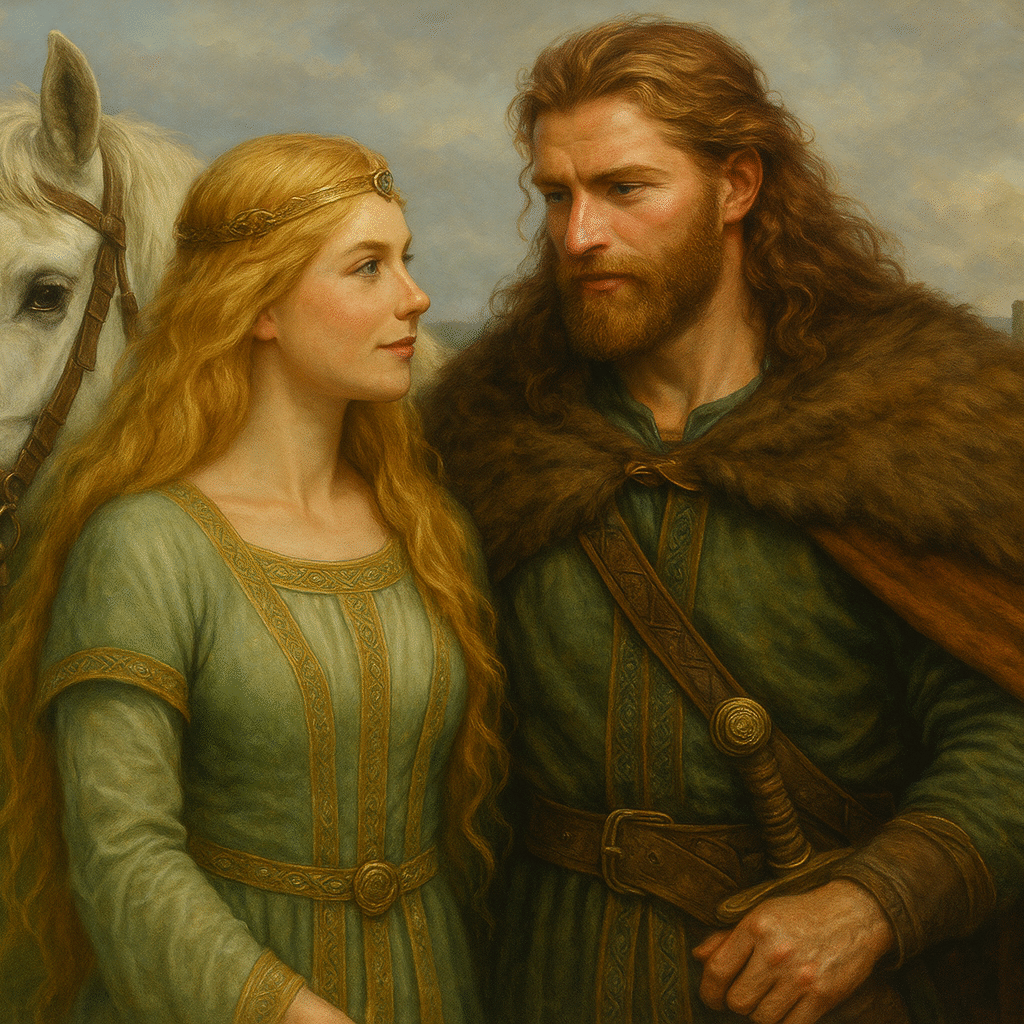
One morning, a woman of radiant beauty appeared upon the shore, riding a white horse across the waves. Her name was Níamh Chinn Óir; Niamh of the Golden Hair; daughter of the sea god Manannán mac Lir.
She called to Oisín, telling him that she had long known him through dream and song; that he was her destined love, and must come with her to her land beyond time, the realm of eternal youth and joy.
Oisín, moved by the vision of her and the promise of love unending, mounted her white steed, Embarr, and together they crossed the western sea to Tír na nÓg.
There, Oisín and Niamh dwelled in splendor. They had a son, Oscar, and a daughter, Plor na mBan; Flower of Women. Theirs was a life without sorrow or age, filled with feasts, music, and beauty. Yet, after what felt like three short years, Oisín’s heart grew restless. He longed to see his father, his friends, and his homeland once more.
The Return to Ireland
Niamh, knowing the danger, pleaded with him not to go. For though only three years had passed in Faerie, three hundred years had passed in the mortal realm. Still, seeing his sorrow, she relented and gave him her white horse, Embarr, warning him:
“Set not your foot upon the earth, Oisín — for the moment you touch the soil of Ireland, all the years will fall upon you.”
Oisín rode across a land he no longer recognized. The hills of Almu, once home to the Fianna, lay in ruin. The forests had changed; the people were strangers. As he wandered, he saw men struggling to lift a heavy stone onto a cart. Out of kindness, he leaned from his saddle to help, but the girth broke, and he fell.
The instant his feet touched the ground, the white steed vanished into the mists, and Oisín became a withered, blind old man.

The Wanderings of Oisín
Thus began his final journey. Oisín wandered the countryside, telling tales of the Fianna, the Tuatha Dé Danann, and the age before time. He was said to have become a bardic wanderer, walking between the Pagan and Christian worlds, between memory and myth.
In a later legend, Oisín encounters Saint Patrick, who had brought Christianity to Ireland. The two are said to have debated faith, time, and the fading of the old gods. Oisín spoke of Tír na nÓg, of Niamh, and of the beauty and sorrow of the ancient world; a time when magic and honor walked hand in hand.
In Yeats’ poem “The Wanderings of Oisin”, this meeting becomes a lament for Ireland’s lost spiritual golden age.
Some say that Niamh returned, searching for her beloved, but never found him. Others say that she found his grave and wept upon it, her tears becoming wildflowers.
Legacy and Memory
Oisín’s grave is said to lie at Glenann in the Glens of Antrim, Northern Ireland. His story echoes through the centuries, told by poets like Yeats, Goethe, Walter Scott, and James Macpherson, who all sought to capture his voice in verse.
He endures not merely as a myth, but as a symbol of longing; the poet caught between worlds, the lover of Faerie and of Earth, the wanderer who remembers what others forget.
Through him, Ireland’s ancient soul still speaks:
the dreamer, the exile, and the immortal bard of the Land of Youth.


From the journal of Sir Thomas “Rymour Oisin” Leaf:
The 10th of Quintilis (Julius Caesar’s “July”) in the good year 2009 of the Common Era:
“You may or may not have been following the LoTR (Lady of the Rhine) Quests of mine to Europe. The fantastical tales of breaking the curse on the enchanted ring and finding the key of youthful life have become the inspirations for what I call my “Living Myth,” which has led to some amazing journeys and tales as I would travel back and forth from the New World to the Old Country to the service of the lovely Lady of the Rhine. These are my “Chronicles” written about my exploits in exploring the New and Old World, investigating myths, legends, folklore, fables, and premonitions that haunt and enchant these lands. For those that want to know how the Chronicles began, please visit my index for a journal page to journal page account of these adventures.
I strongly believe that every human life in this world is inspired by a myth, fable, legend, or folk story that indeed “shapes” their journey from birth to death. Sometimes, many of these tales shape one’s life. I believe part of the puzzle of life is to find your living myth and purpose in life. I think these myths, stories, fables, and legends can give us guidance, inspiration, energy, ethics, and values to become successful in finding our dream, seizing it, and living it. I also believe that once we find our ‘living myth’, we are that much closer to finding out our purpose in this life, as I believe we all have one. I don’t believe in chance; I do believe in fate and destiny. I believe you can control, change, and manipulate your fate as you wish. I believe there are messages in our dreams. I believe in visions. I believe in premonitions. I believe in Omens, Oracles, and divination – all of which are tools to help you gain insight, clarity, and a future view of what lies ahead or understanding what has happened. I believe these messages are puzzles and riddles that are not always easy to decipher, but once solved, they will give you a world of guidance to find and achieve your purpose, dreams, and desires. With that said, let me tell you a bit about myself and the myths that ‘shape’ who I am, and how they inspire my journeys as a Techno-Gypsy.
My name is “Sir Thomas ‘Rhymour Oisin’ Leaf McGowan”. Yes, that is quite a long name. But there is power in a name. There is meaning in every one of those names. Of course, this is not my ‘real’ or ‘given’ name. Only those close to me know that side of me.
This is my artist name. I am a cartographer, curator, and archaeologist by day; and a body painter, diviner, and craftsman by night. Those would be my trades and professions that currently title me in this world. This is where the “Sir” comes from. As I ventured forth to the Rhineland under the servitude of the Lady Vanessa of the Rhine, it was only appropriate to pre-label myself with this classic label as her ‘cartographer/knight / and guide’ for the most excellent adventures we have had. “Thomas” is actually my birth name.
Named after “St. Thomas” the doubter, to which I do live up to, as I question just about everything. I also identify with the myth/tale of “Thomas the Rhymour” and that is where the middle name “Rhymour” comes in. Since “Thomas” also means “Twin”, I obviously have a twin-side, that being the myth/fable of “Oisin”. I’ll explain both ‘Thomas Rhymour’ and ‘Oisin’ in this foreword.
So where does “Leaf” come from? It was a name given to me by my friends in the great country of Canada, who nicknamed me “Leaf” because I once had several companies with “Leaf” in their name, and I was always researching and learning about botany as well as being an avid tree hugger. My roots are of Irish and German descent.
I have a bit of Irish Tinker in me. On the “McGowan” name front, it was given to me because (a) Rose McGowan is one of my favorite actresses of which some of my friends think I share ‘oddness’ with, and because my Canadian friends believe I must somehow be related to (b) Joe McGowan, an Irish Historian and folklorist; and (c) Richard McGowan the American Explorer, Mountaineer, and Entrepreneur. As far as I know, I have no biological connections to any of the McGowans. My real surname actually means “Farmer in a Field” or “peasant,” which I suppose explains my deep connection with plants and botany.

It was a series of haunting childhood dreams with puzzle pieces reminescent of the Fable of “Oisin” that led me to investigate his mythos. As I pieced together these dreams, much of the story of Oisin started to be told without having read his tale in the beginning. As I seem to ‘relive’ his ‘living myth’ that serves to inspire, guide, and add adventure to my life; each day I feel a deeper connection to his story which seems to reveal some visions of what lies ahead for me in my future yet to come. “
The Tale of Oisin
Oisín (Old Irish, pronounced [ˈɔʃiːnʲ], roughly uh-SHEEN; often anglicized to Ossian), was the son of Fionn mac Cumhail and of Sadb (daughter of Bodb Dearg). He was regarded in legend as the greatest poet of Ireland, and a warrior of the Fianna in the Ossianic or Fenian Cycle of Irish mythology. and is the narrator of much of this cycle. [wikipedia] “Oisin” means “Young Deer or Fawn”. Apparently, Oisin’s mother, Sadbh, was turned into a deer by the Druid “Fear Doirche,” who was angered with her because she refused him. When the great hunter Fionn was out on a hunt, he caught her and she returned to human form. He was amazed by her beauty and spirit, so he retired from hunting and decided to settle down with her. They became pregnant with a son. When “Fear Doirche” discovered this, he turned her back into a deer, and she ran off into the woods, never to be seen again.
Seven years later, Fionn found her child lying naked on the Benbulbin. He raised Oisin to be a great poet, hunter, and warrior. In the “Oisín in Tir na nÓg” adventure tale, we are told that Oisín is visited by a Faerie woman named “Níamh Chinn Óir – Niamh of the Golden Hair or Head”. Niamh was one of Manannán Mac Lir’s daughters. Manannan was an Irish God of the Sea. Niamh announced to Oisin that she was his true love and soul mate and that he must come with her to the “Tir na nÓg” (“the land of the young”, or “the land of promise”). Niamh and Oisin gave birth to a son and a daughter.
Oisin’s son is “Oscar” and his daughter was “Plor na mBan”, the “Flower of Women”. They were all quite happy. However, after what seemed like three years in Faerieland, Oisin grew weary of seeing his family in Ireland and persistently requested Niamh’s permission to return for a visit. Little did Oisin know that those three years in Faerie were in actuality, 300 human years that had passed.
So Niamh gives him “Embarr”, her white faerie steed, with specific instructions that he shall not dismount for any reason, for if his feet touch the ground, those 300 years would immediately turn him into an ancient, withered old man. Oisin returns to find his home on the hill of Almu abandoned and in disrepair. As he tries to find his father, he encounters some men trying to lift a great stone onto their wagon. As he tries to help, his girth breaks and he falls to the ground, becoming a blind old man just as Niamh warned.
Embarr returns to the Tir na nÓg without him. Oisin is then left to wander the countryside of the human realms as a wise old blind man. He teams up with Caílte mac Rónáin and takes on the bardic path, sharing folklore, faerie tales, and stories of the Fianna. He becomes the Epitome of the term “Wanderlust”. He is also rumored to be a staunch advocate of the Pagan faiths. He becomes quite bothered by the fact that all his comrades, family, and friends are gone, as is the Pagan faith of Ireland. He encounters the Irish Catholic Saint Patrick, who was responsible for destroying the Pagan faiths of Ireland.
Oisin tries to teach Saint Patrick about the glories of Ancient Ireland and the land of the Faerie. This is the source of William Butler Yeats’ poem on the “Wanderings of Oisin”. Further mythology tells of Niamh coming to the shores of Ireland in search of her long-lost love to find him and bring him back to Faerie. Story has it she does not ever find him, and Oisin dies of old age. Oisin’s grave is believed to be located close to the foot of the Glenann in the Glens of Antrim in Northern Ireland. Yeats, James Macpherson, Goethe, and Walter Scott all wrote about Oisin and were obsessed with translating his poems. Books have been written about him. Films have been made about his story. [More stories of Oisin: Oisin and Niamh; The Youths of OisinWikipedia; The Wanderings of Oisin; and Oisin and Patrick.]

“In the early 90’s, Elyse Tera, a former lover, once dedicated a book to me called “Thomas the Rhymer” as I reminder to her deeply of this historic figure. I recently re-read the book. Quite a few things clicked as a spirit within my being awakened during many different changes I am currently going through. Little did I know how insightful she was and that eight years later I would wake up with the realization that there were messages and mythos in this tale that I needed for understanding my life path. “
The Tale of Thomas the Rymour
“Thomas the Rhymer”, “Thomas Rymour”, or “True Thomas” is the story of the 13th century Scottish laird and reputed prophet from Earlston (Erceldoune) named “Thomas Learmonth”. He lived approximately from 1220 to 1290 of the Common Era. He is the protagonist of the ballad known as “Thomas the Rymour” and is most likely the source of the legend of Tam Lin. During the 13th century, Thomas was born in Erceldoune, Berwickshire as a young lad who was gifted with prophecy and a tongue of honesty and charm. He was a well-known author of many prophetic verses.
Many attributed him with multiple supernatural powers. He was so popular for centuries after his death that many people have fabricated Thomas ‘prophecies’ to further the cause of Scottish independence. He was known as “True Thomas” because he could not tell a lie. This was linked to his poetic ability and was a curse placed upon him by a Faerie queen. He apparently prophesied many great events in Scottish history, including the death of Alexander III of Scotland. The Ballad of “Thomas the Rymour” has to do with Thomas’ journey with the faerie folk. Thomas was a young lad that, while lounging on a bank, met a beautiful woman atop a white horse.
They immediately lust after one another. She tells him she is the Queen of the Faeries, takes him onto her horse, and seals his service to her with a kiss. They have a romantic love affair. A version states that the Queen turned into a hag immediately after sleeping with him, and as a punishment to him, but returned to her beautiful state once they arrived at her castle, where her husband lived. He stayed at a party in the castle until she told him to return with her, coming back to the mortal realm after seven years had passed. He asked for a token from her to remember her by, and she offered him the choice of becoming a harper or a prophet, and he chose the latter. He wandered the world, revealing great prophecy and theoretically said farewell to his homeland and returned to Faerieland, from whence he still has not returned. There is also the 14th century romance story of “Thomas of Erceldoune” with accompanying prophecies relating to the Ballad of Thomas the Rhymer telling a very similar tale.13th-century
[ Comparing Tam Lin to Thomas the Rhymer ] [ Oxford Book of English Verse reference ] [ Thomas the Rhymer of Scotland ]
“So there you have the two most inspirational and motivating characters of history that have and continue to shape my life. As I delve deeper into their stories, analysis of their legends and lives I find that my living mythos starts to take form, giving mea clear vision of what I want and inspires me to further pursue my travels, investigations, research, and love of life. They have also played a major role as a “muse” for my writing, blogging, journaling, and upcoming books that I’m working on. “
Omens, Oracles, Visions, and Prophecies
“I strongly believe that everyone’s life is accompanied by prophecies, omens, and visions; but that a great majority of humankind chose not to listen to them or ignore them blindly as hogwash and nonsense. Of course, the majority of those who actually believe in them won’t admit to it for fear of being ridiculed as a ‘quack’. Of course, the good majority of what I’m about to summarize usually involves some sort of faith in some kind of religious view as none of the following is advocated by or explained by science. “,
Prophecy – Is divine inspiration, revelation, or interpretation; otherwise known as psychic predictions. Regardless of one’s religious beliefs or non-beliefs, the concept of prophecy is found throughout the religions of the world, including Christianity and Islam. It’s the disclosing of information that is not known to the prophet by any ordinary means. The Rabbi Maimonides describes prophecy as “an emanation sent forth by the Divine Being through the medium of the Active Intellect, in the first instance to man’s rational faculty, and then to his imaginative faculty”. The Catholic Encyclopedia states it as “the foreknowledge of future events, though it may sometimes apply to past events of which there is no memory, and to present hidden things which cannot be known by the natural light of reason”. Whether one believes in it or not, we’re all affected by it, as it is one of the greatest motivational influences behind all world religions in the actions they take upon humankind.
Visions – Again, by definition and belief in from a majority of the world’s religions is the phenomenon known as a “vision”. These are often inspirational renderings, generally of a future state and/or of a mythical being, and are believed to come from a Deity, sometimes directly or indirectly via prophets, and serve to inspire or prod believers as part of a revelation or an epiphany. Sometimes these are seen as miracles. It can also refer to the experience of “Energies” of Deity as defined by the Eastern Orthodox Church. Often, visions are the muse to artistic creations or masterpieces, songs, stories, or poetry. Visions have more clarity than dreams but traditionally fewer psychological connotations. In many cultures, visions are generated by entheogens (Peyote, Mushrooms, Acid, Opium, Salvia Divinorum, etc.) Some explain “visions” as manifestations of picture thinking or visual-spatial thinking.
Omens Are part of a phenomenon known as portent or presage that tells the future or foretells the advent of change, either good or bad in interpretation. Often, Omens are associated with items or the appearance of certain signs or indicators that something will happen. In the United States and some European countries, the appearance of a black cat is an omen of bad luck. Comets are also associated with indicators of an omen – sometimes good and sometimes bad. Omens are sometimes revealed through the craft of divination.
Oracles – are usually a person or agency considered to be a source of wise counsel or prophetic opinion, or as a revealed prediction or precognition of the future from Deities that is spoken through another object or life-form. In the ancient world, many sites gained a reputation for dispensing oracular wisdom and came to be known as the “oracles”.
Divination is the act of gaining foresight from supernatural or ritualistic means. It is the attempt to gain insight into a question or a situation by way of a standardized process or ritual. Diviners utilize readings, signs, events, omens, and prophecies often by use of tools such as runes, tarot cards, sticks, stones, bones, and other mediums that are used to contact a supernatural agency for a subject who has inquired about a question or a future concern. Divination appears in most of the world’s religions, even by those that often shun it. Divination is attacked the most by skeptics, including the scientific community as merely “superstition”. The use of divination is often considered a sin in some Christian denominations and Judaism.
Dreams are probably the most common form of inspiration, divination, prediction, and thought process that most are familiar with, since we all dream. Dreams often are composed of a series of images, ideas, emotions, and sensations that are projected in the mind while we sleep. Most of the content and purpose behind these dreams are never fully understood, even though it has become a field of study embraced by science since it can be dependably manifested. The scientific study of dreams is called “oneirology”. Always a subject of conjecture and a source of inspiration, dreams have been one of the most common and utilized forms of divination throughout history. Dreams have been described as responses to neural processes during sleep, as reflections of the subconscious, as messages from God(s) or as predictions of the future.
“Now that I have the technical definitions out of the way, we can begin to proceed on my journey on the investigation of various prophecies, visions, omens, and oracles that have presented themselves upon the lives of myself and my friends; not necessarily to explain or debunk, but to embrace and attempt to understand, digging throughout the ashes of which to find the nuggets of wisdom that they are meant to reveal. Lastly I have brought to you many fables and tales from explorations in Europe. This time, we take a different journey, across the continent of North and South America, which are revealed within the Chronicles of Sir Thomas Leaf.
I have many oracles, visions, prophecies, and revelations that deluged my life from my early years as a child being raised as a devout Catholic to my evolution (or devolution to some of you) as an adult into a Heathen. Most of these focused on purpose, career, lifestyle, love, faith, and travel. I’m sure to tell the tale of each of them at some point here in the Chronicles or the Quests or in my upcoming publications. For now, I am to embrace a journey into the investigation of the fables, stories, and legends of prophecies and visions that many of my family, friends, and community members reveal to me daily. Again to understand and seek gems of wisdom from, rather than to dispel, debunk, or analyze them. I bring to you the following video that seems to be the current revelation influencing and shaping many a community that I frolick amongst …. the Mythic Call. The Mythic Call – The Bluestar of Enlightenment. Presentation to the Hopi Nations. Beloved Starlight, we are pleased to announce the Awakening of your Home of Hearts. This is a time of New Beginnings.